Wednesday, August 1, 2012

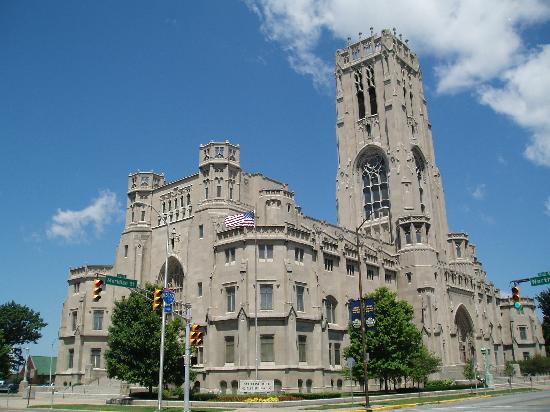
Sights and Places: Indianapolis Scottish Rite Cathedral

Situated downtown the Scottish Rite Cathedral is a beacon for Freemasonry in the area. Construction starting on May 3, 1927, and last for 2-years when the last stone was placed on February 26, 1929, at the cost of $2,500,000.  The dedication ceremony was held on September 10, 1929

The building consists of a 54-bell carillon (weighing over 56,000-lbs.) housed in the main tower, known as the Singing Tower, that rises 212-ft. The top of the tower is twelve fleurs-de-lis (four in each of the Cardinal directions). Over the main entrance depicts the story of the Ruffians, and above the doors, the motto "Spes Meo In Deo Est" meaning "Our faith is in God" is carved into the limestone. The building also contains a ballroom, a lounge room, and an auditorium/theater.

The main entrance, referred to as the Tiler's Room, is a cube of 33-ft to remind us of the highest degree one can attain in Scottish Rite Freemasonry. The windows above the entrance doors contain many emblems found in Masonry, from the First Degree of the Symbolic Blue Lodge to the 32 of the Scottish Rite.

From the website:
The floor is a reproduction of the floor in the Inner Chamber of King Solomon's Temple. In the center is a polished brass medallion which contains the 12 signs of the Zodiac and the symbols of the four bodies of Scottish Rite Masonry: The Triangle for the Adoniram Lodge of Perfection; the Scale of Justice for the Saraiah Council, Princes of Jerusalem; The Cross for the Indianapolis Chapter of Rose Croix, and the Double Headed Eagle in the center for the Indiana Consistory.
The ballroom also embodies the number 33 by being 99-feet square, pillars defining the dancing area as 66 ft (20 m) square, and the white oak floor panels are 33-inch square. The ceiling is of hand-painted acoustical tile so it blends in with the woodwork. The chandelier has 200 lights and weighs 2,500-lbs. It has a mezzanine or balcony 16-1/2 feet wide on all four sides of the second story. It is supported by 15 fluted oak columns 16-1/2 feet in the center. There are lounges at the south end of the ballroom and mezzanine. The anterooms between the lounges contain art glass windows that depict the degrees of the Scottish Rite (mezzanine level) and York Rite (floor level).

The Main Lounge is 99 Square Feet and is divided into thirds. In the lounge, there are 4 different conversational areas. The furniture is all arranged to give off a feeling of warmth, comfort, and hospitality.  There are also to be found hard-carved tables and chairs, etched with symbols.

From the website:
The windows on the east side of the lounge are dedicated to the arts and sciences: (from north to south) engineering, electricity, sculpture, architecture, art, music, law, and medicine. They were created by the Von Gerichten Glass Company of Germany and Columbus, Ohio, where they were assembled and then installed in 1929.  The art glass windows on the west side of the lounge were made by the Willet Stained Glass Studio of Philadelphia and installed in June 1975. Each contains a scene relating to the degrees from the Fourth through Eighteenth and the Thirty-Second. They were donated anonymously in memory of four distinguished Thirty-Third Degree Masons: George L. Clark, Ralph Hamill, Guy L. Roberts, and Oswald A. Tislow.
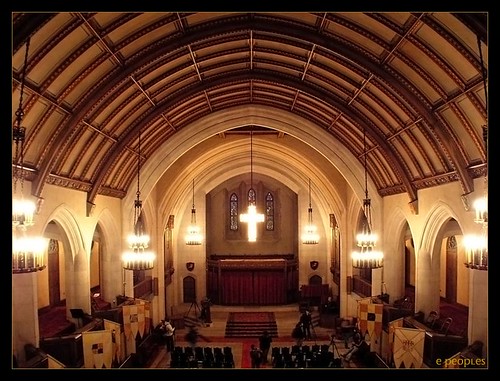
The theater is one of the most beautiful rooms in the cathedral. It is 99 square ft, 45-ft high, and 175-ft from the rear of the stage to the back of the fourth-floor balcony. The arena is 33-square ft and 15-inches below the stage area. The stage is 33-ft deep and 84-ft wide and has enough back-drops for various scenes of the 29 Scottish Rite degrees stored in the ceiling all operated by 12-miles of rope. The theater can seat about 1,100 people and an additional 200 on the chairs in the arena. The architecture is Cathedral Gothic, sometimes referred to as Medieval Gothic, and was patterned in large part after the details of the Cologne Cathedral.

References

1. Scottish Rite Cathedral (Indianapolis, Indiana). (n.d.). Retrieved from Wikipedia: http://en.wikipedia.org/wiki/Scottish_Rite_Cathedral_%28Indianapolis,_Indiana%29

2. Tour the Cathedral. (n.d.). Retrieved from Scottish Rite Valley of Indianapolis: http://www.aasr-indy.org/index.php/scottish-rite/tour-cathedral

Sunday, July 29, 2012

Royal Order of Scotland

The Royal Order of Scotland is a fascinating group from its known history to its legend, and for invitational, honorary groups it sits towards the top, in my opinion. The hard part is there isn't a lot of information on the group, in comparison to other honorary and invitational groups in Freemasonry.

The Grand Lodge of the Royal Order of Scotland is stationed out of Edinburgh. According to the Order, the King of Scots is the hereditary Grand Master. In his absence, the worldwide order is governed by the Deputy Grand Master and Governor of the Order. At every meeting of the Order during the absence of the King, wherever held, a vacant chair or throne must be placed at the right hand of the presiding officer. Currently, the Deputy Grand Master and Governor is Ewan Rutherford. The next organizational tier is the Provincial Grand Lodge and, unique in Freemasonry, there are no constituent Lodges; the Provincial Grand Lodge is the lowest hierarchal tier in the Royal Order of Scotland. There are 88 Provincial Grand Lodges located around the world. The Provincial Grand Lodges are governed by a Provincial Grand Master, which for the United States of America is James E. Winzenreid. The two degrees conferred in this Order are:
  • Heredom of Kilwinning
  • Knight of the Rosy Cross
According to tradition, the degree of Heredom of Kilwinning was established in Judea (Palestine), but if this occurred during the time of the Crusades, tradition is silent. The name Kilwinning refers to the place where the Order was re-established by King Robert the Bruce, where he is said to have presided as the first Grand Master.
The Degree of Heredom of Kilwinning is a peculiarly interesting Degree and full of instruction to Craft Masons, as in its lectures it explains the symbolism and teaching contained in the first three Degrees of what is sometimes referred to as St. John s Masonry.
The Rosy Cross degree is based on the legend of the Battle of Bannockburn.  On St. John's Day in 1314, this degree was created by King Robert the Bruce, who fighting for Scottish independence is said to have received assistance from a group of knights, rumored to have been Knights Templar fleeing the Inquisition in France and mainland Europe. He conferred this Knighthood upon those who assisted as a reward for their service. From the Provincial Grand Lodge of the USA's website:
The number on whom the Knighthood might be conferred was limited to sixty-three, but in years, owing to the large number of worthy Freemasons who coveted this honour, the Grand Lodge of the Order, when it found it necessary to establish Provincial Grand Lodges elsewhere than in Scotland, granted each Provincial Grand Lodge permission to promote sixty-three Freemasons of the Degree of Heredom to the honour of Knighthood under the Grand Lodge. In some of the Provincial Grand Lodges where the members of Heredom number many hundreds, special powers have been given to increase the number of Knights of the Rosy Cross.
This degree as its name implies deals with many things similar to that seen in the Rose Croix degree of the Ancient & Accepted Scottish Rite. This degree is primarily conferred by the Grand Lodge in Edinburgh but can be conferred by a Provincial Grand Master or his deputy on special occasions. Upon investment of this degree, a member is given a characteristic. This tradition comes the limit of sixty-three membership limitation there was in the beginning who each had a given characteristic. Each Provincial Grand Lodge gives its own characteristics.

While the legend takes the Order back to 1314, there exist no records to substantiate such claims.  Early records date the Order back to 18th century Europe. It is said to have flourished in France by Scottish refugees who adhered to the Jacobite cause. The Order took roots in England where it grew for some years which then led to its establishing its headquarters in Edinburgh, Scotland, where it has been stationed since that time. Activity dwindled down to near extinction in the early 19th century, but in the mid-century, there was a resurgence where Provincial Grand Lodges were established.

Originally, membership in the Order was limited to Scotsmen or those of Scottish descent, but later the privilege was extended to Master Masons of other nationalities. Today to be eligible to be invited to this group, one must be a Master Mason in good standing for a minimum of 5-years, be a 32° of the Ancient & Accepted Scottish Rite or Knight Templar of the York Rite, and profess to be a Trinitarian Christian. In addition, they require that the proposed applicant be one who has performed services to the Craft (such as offices held in the various Masonic bodies, or such honors such as KCCH, 33°, RCC, or KYCH), their church (such as offices held), and the public (helping with youth groups or public service such as the military).

References

1. Nisbet, C. C., & Baldwin, R. B. (2006, October). A Brief Historical Sketch. Retrieved from The Provincial Grand Lodge of the Royal Order of Scotland of the USA: http://www.roosusa.org/info.html

2. Royal Order of Scotland. (n.d.). Retrieved from Wikipedia: http://en.wikipedia.org/wiki/Royal_Order_of_Scotland

3. Edward H. Fowler Jr. (2010, June). The Royal Order of Scotland, a brief history. Retrieved from The Knights Templar Magazine: http://www.knightstemplar.org/KnightTemplar/articles/20100621.htm

Tuesday, July 24, 2012

Sights and Places: Salt Lake City Masonic Temple


Even though I've been to Salt Lake City more than I can count, I've never taken the chance to visit the Masonic Temple. It wasn't until some of my Brothers came back from a Scottish Rite meeting. They said it was a very beautiful building so I had to add it to my list of places to talk about.


According to its website, it was completed in 1927 and dedicated to George Washington. It is located along South Temple Street. It houses a great deal of Masonry as it holds the Grand Lodge of Utah, F&AM; Orient of Utah, AASR; Grand York Rite bodies of Utah; El Kalah Shrine; the Grand bodies for all of the Masonic youth groups, and 6 Masonic Lodges. The building consists of lounges, Great and Lesser Halls, a Banquet Room, an auditorium, four Lodge rooms, and administrative offices.

The Temple proper is three stories high, starting at the first floor, and rests on a base or ground story. These three stories are significant of the three degrees of Masonry, and contain all of the tiled or ritualistic rooms. The ground floor has non-ritualistic rooms for administration offices, banquet room, etc.

Entrance to the Temple proper is gained by ascending three, five, seven steps and nine steps. For strict adherence, three, five and seven might be more appropriate, but practical considerations demanded a greater number of steps and additional steps were added in the number nine, which also has considerable Masonic significance, being the cub of the first number three and sometimes, but not always, being assigned as the number of rungs of the mythical Jacob?s ladder reaching to heaven.
From the website:
Each room is adorned uniquely bringing to Salt Lake City artistic and architectural influences from Renaissance Italy, Colonial Virginia, Egyptian Temples, 14th Century English Courts, and Moorish Spain.
The planning for erecting this building came about in 1920 as a result of the previous temple not being able to hold the capacity of members. By 1925 the land had been purchased, and the details of interior furnishings were in the process of finalization.

During the 2002 Winter Olympics, the Temple was re-dedicated in a public ceremony.

Free public tours are available by prior arrangement between 9:00am and 4:00pm.

Here are some pictures of the building:


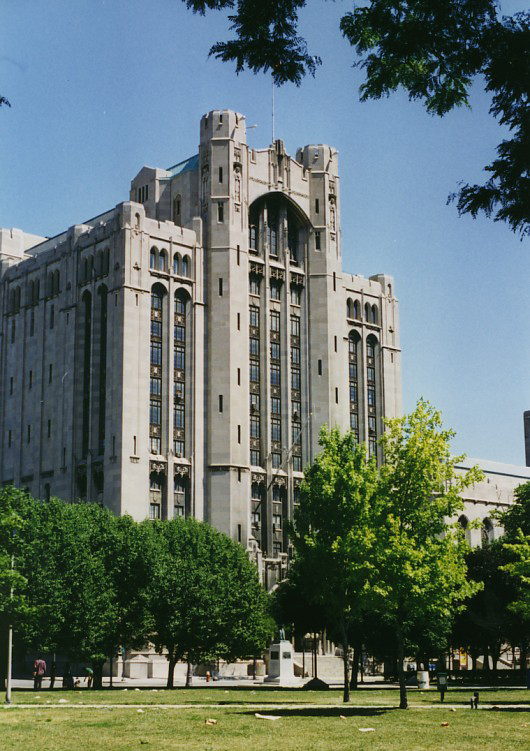
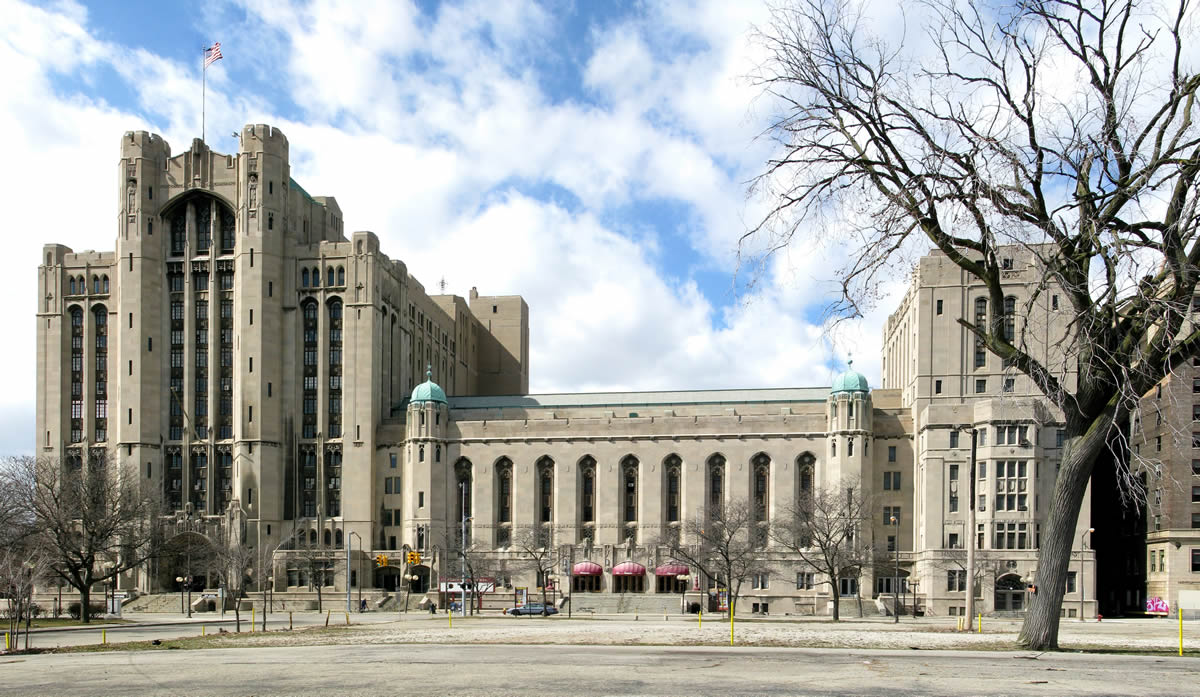
Sights and Places: Detroit Masonic Temple

To kick off this series, as I started in the Intro I'm going to start the world's largest Masonic temple, the Detroit Masonic Temple.


Located at 500 Temple Street, the building serves as a home to various Masonic bodies such several Blue Lodges, York Rite bodies, York Rite College to include the national administrative offices of the York Rite Sovereign College of North America, and the Masonic youth groups (DeMolay, Job's Daughter, and Rainbow Girls). The Masonic temple showcases virtually all forms of live entertainment, musical events, theatrical production and provides an array of cultural activities that build bridges of mutual respect and celebrate the diversity found in this vibrant community.


Dirt was broken on Thanksgiving Day, 1920, and the Corner Stone was placed on September 18, 1922. George Washington's own working tools were brought from Virginia to be used for the ceremony. The Temple was dedicated to a crowd of thousands on Thanksgiving Day, 1926. This building is 14-stories tall (210-ft) and contains over a thousand rooms. These rooms include three auditoriums, 2 ballrooms, a Drill Hall, recreational facilities, several Lodge rooms (each with their own decorative theme), 2 Royal Arch Chapter rooms, a room for the Cryptic Masons Council, a room for a Commandery of Knights Templar,  several administrative offices, dining spaces, rooms for visiting Brothers, and the Masonic Temple Theater. It was designed in the neo-Gothic architectural style, using a great deal of limestone

Here are some great pictures:


Temple Avenue Lobby

Second Avenue Lobby

Crystal Ballroom

Masonic Temple Theater

Commandery Asylum

Commandery Pipe Organ


Prelate's Apartment

English Tudor themed Lodge room

Royal Arch Chapter room


Pictures courtesy of http://www.detroitmasonic.com/pictures.htm

Sunday, July 22, 2012

The Two Tales of the Templars

Many know the story of the founding of the Knights Templar in the early 12th century, but is this the only story?  There exist others who show a different story than the common story.  The most common story of the Templars comes to us from the writings of William, Archbishop of Tyre. Another tale comes from Michael the Syrian, Patriarch of Antioch.  There is a third account given by Walter Map, the Archdeacon of Oxford, but his accounts are disregarded by most historians as he preferred historical fiction to fact.

William tells us that for the first 9-years of the Templar existence they could not raise no more than 9 knights. Michael on the other hand tells us that Hugh De Payen founded this Order with 30 Knights with him. Michael writes:
Now  this man, whose name was Hough de Payen, accepted this advice; the thirty knights who accompanied him joined him.  The king gave them the house of Solomon for their residence, and some villages for their maintenance.  The Patriarch also gave them some villages of the Church.
Stephen Dafoe in the January 2009 edition of the Knights Templar magazine stated that although Michael's accounts receive less attention from the historical community, this story seems much more plausible than the account given by William. Due to the lack of existing records, we may never know the exact number of founding Templars.

Why the inconsistencies and vague establishment?  Well, neither of these men were alive when the Templars started, and one can also look at the bias of William as it is said that he held no love for the Templar Order.

William was born in Jerusalem around 1130. After completing his education in Europe, he returned to the Middle East where he wrote many books, one particularly is a 23-volume history of the Middle East since the time of the conquest of Jerusalem by Umar. Although he never finished it by the time of his death (c. late 1180's).  This book centered around the First Crusade and all the political events that took place in the Kingdom.  He himself was a contender for Patriarch of Jerusalem and had a natural hatred for the hindrance of ecclesiastical authority and thus held no positive opinion of the Templars, and their independence. The reason given to historians siding with William in his account is he said to have been very thorough in collecting information and sifting through sources, as well as interviewing first-hand witnesses.

Michael is believed to have been born around 1126 in the town of Miletene, today known as Malatya (located in SE Turkey). Early on he entered into the service of a local Jacobite monastery and eventually became an archimandrite (an overseer of the monastery, second only to the Bishop). Because of his devotion and zeal, he was eventually elected as Patriarch. He is known for composing the largest chronicle of medieval times, which was written in Syriac. Michael's work is placed behind Williams as it is said he didn't have very accurate information outside of his own personal experiences.

Will we ever find out?

References

1. Dafoe, S. (2008). The Compasses and the Cross: A History of the Masonic Knights Templar. England: Lewis Masonic.

2. Dafoe, S. (2009, January). Were There Really Only Nine? Knights Templar magazine, p. 11.

3. Haag, M. (2009). The Templars: The History and the Myth: From Solomon's Temple to the Freemasons. HarperCollins.

4. Lomas, R. (2009). Turning the Templar Key: The Secret Legacy of the Knights Templar and the Origins of Freemasonry. Fair Winds.

5. Michael the Syrian. (n.d.). Retrieved from Wikipedia: http://en.wikipedia.org/wiki/Michael_the_Syrian

Thursday, July 19, 2012

Kappa Sigma 2012 Western Leadership Conference

At the end of April, I took over as Grand Procurator (Vice President) of the Kappa Rho Chapter-Colony of the Kappa Sigma Fraternity at Boise State University. Well, as an officer, I am attending the Western Leadership Conference being held in Las Vegas.


I arrived today and have spent it walking around as I haven't been to Vegas in a while, and it has changed. I did try my luck at the Craps Table in the Monte Carlo casino, but lady luck was not on my side. I am down $60 at this point and I think I will cut my losses for now. Tomorrow starts with check-in and the fun begins.

Monday, July 16, 2012

Could You Imagine?

Reading through one of the volumes of the "History of Royal Arch Masonry" I came into a chapter discussing the Most Excellent Master degree.  In the second paragraph it states:
Again, we were permitted to witness the conferring of the degree in what was the largest tiled meeting of a chapter ever held.  We refer to the degree conferred in the old Convention Hall in Kansas City, MO, in 1922, at which eight or nine thousand members of chapters, in and near Kansas City, witnessed the conferring the degree upon a class of more than 1,000 candidates.  With a 75 piece orchestra, a chorus of 150 voices, and processions in which two or three hundred participated, it presented a picture which it will take many years to duplicate.
Could you imagine attending such a presentation??  This must have been quite the sight to see. With conducting the research for my book, I have been a little absent on posting articles, but once I read that paragraph that I had to share it with all of you.

Wednesday, July 4, 2012

Happy Independence Day

I wish every American a very Happy Fourth of July! It is good to be home for this one, but I still look back on last year while I was in Iraq.

Surprisingly the enemy didn't hit my base on this day, but less than a week later they hit us with such a devastating blow. The only casualty suffered during my time in Iraq came in the form of my neighbor. In the early hours of the morning, I walked over to the base's Tactical Operating Center (TOC) where I worked. I had not even fully sat in my chair when the incoming alarm sounded. The impacts landed close and shook the TOC, but I wasn't nearly as scared until they announced it had landed in my living area, and that there was a casualty. I was scared it was one of my guys. It wasn't any of my Platoon members, but the rocket had landed right next to my housing unit and killed my neighbor, SGT Talamantez.

I will spare the gruesome details. You could tell that the whole base's attitude had changed that day. While many didn't know him personally, myself included, we all felt the loss. He left a wife, a son, and a daughter. He is, but one example of those who have fallen wearing the uniform. Please remember him and all who have served, and given everything for their country. Celebrate this day to honor their memory.

Remember what our Founders fought for and what so few fight for today!

Sunday, July 1, 2012

The Service of the Templar

From "The Poetry Of Freemasonry" by Rob Morris

I SERVE, and my wages are ample,
I watch by the gate of my Lord;
The innermost joy of his Temple
Not yet does the Master afford.

But I SERVE at His will
And all patiently still,
At the Mystery gate I wait, I wait.

I SERVE, and my service is holy,
Though raiment be scanty and torn;
The crumbs of the feast to the lowly,
The rags to the watcher forlorn.

I SERVE, and if sometimes o'er weary,
Impatient at moments so slow,
My Master sends messages cheery,
"Be vigilant, gallant and true!"

I SERVE, but the long watch is ending,
The waning stars hint of the morn,
My Lord from His palace is bending,
Oh, joy to the watcher forlorn!

For I SERVE at His will
And all patiently still,
At the Mystery gate I wait, I wait.

Thursday, June 28, 2012

The Sword and Trowel

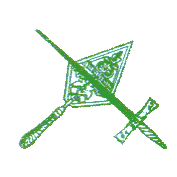
The Sword and Trowel is a prominent symbol of the Cryptic Rite.  Though it is not always the case, this symbol can be displayed with the crossed Sword and Trowel within a broken triangle, within a complete equilateral triangle, and within the circle contained within the square. Most of the time it is seen as it is on the right. Let us delve into each of these symbols with the three exterior symbols: the square, the circle, and the triangle.

The Square, the Circle, and the Triangle

These three symbols have many meanings.  The square is a symbol of security and protection. According to George L. Marshall, Past Grand Commander: "The hollow square (also known as the infantry square) was a formation assumed by the infantry when threatened with a cavalry attack." As I talked about in the last Royal Arch article, the square's four sides signify completion, balance, stability, order, endurance, and the many quadrants of nature (directions, winds, elements, moon phases, and so forth).  The circle has no end and no beginning which represents infinity or eternity.  It has been to many generations a representation of the celestial and Heavenly bodies.  The circle also represents freedom, unity, completeness, and harmony. The circle is also restrictive though, as we are reminded in the 1st degree of Freemasonry and Point within a Circle whereby we are taught to restrain our passions, our prejudices, and our interests from betraying us if we were to go beyond the bounds of this line. The circle, in some cultures, represents the union between Heaven and Earth as well as the psyche. The triangle signifies divinity, harmony, ascension, illumination, and gender (depending on the positioning of the triangle). The triangle and the number 3 represents time: past, present, and future, or the beginning, the middle, and the end. Three is the first number to form a geometric shape -- the triangle.  In Christianity, we see the 3 Wise men or Magi; the 3 realms of the afterlife: Heaven, Hell, and Purgatory (Catholic doctrine); the Holy Family; and the Holy Trinity. In Masonry this number corresponds in the 3 Great Lights, the 3 Lesser Lights, the 3 Principle Officers, the 3 Great Pillars, the 3 Virtues, the 3 Principle Tenets, and the 3 Principle Stages of Human Life. The Broken Triangle represents mortality and death. This symbol is in comparison to Craft Masonry in the Broken Column.

Sir Knight Marshall also points out that the square is the "here and now of this life". I found this intriguing as I read the other day on an article about the Dualism of the Sword and Trowel, that the square is the body, the circle is the mind, and the triangle is the soul. In Buddhism, the square located in the circle indicates the relationship of the human and the divine. We also see the enlightened man within the combination of these 3 symbols; the triangle within the circle within the square.  The square is the man containing the enlightened mind and the faithful soul all within.

The Sword and Trowel

These implements, although not combined, are seen in Craft Masonry. the Sword reminds us of the Tiler and his duties to protect the bounds of the Lodge from the unworthy, uninitiated, and imposters.  The Sword, an emblem of duality, not only symbolizes security, but also light, purification, righteousness, spiritual transition, and from its double-edged, it shows us the defensiveness and destructiveness. The sword is like the mind and knowledge, without proper training and honing of skill, one can cause great damage and face many challenges.  The scholar and the master swordsman alike must be well-trained and keep their metaphorical and physical sword sharp. The Trowel takes us to the Master Mason's degree where the trowel is used as the primary working tool of the degree from which we learn to spread the cement of Brotherly Love which unities all the stones (the Brothers) into one common structure (the Fraternity). The trowel symbolizes completion (whether completion to our spiritual or temporal buildings), spiritual work, and enlightenment.

From the 46th chapter of H.L. Haywood's book "Symbolical Masonry", we see:
The Entered Apprentice, who can make only a beginning at the task of shaping the ashlar, needs only the gavel and the gauge; the Fellow Craft, to bring the stone into completeness of size and form, requires the plumb, square, and level; the Master Mason's task is to set the finished stone in its place, and bind it there, for which purpose the trowel is his most necessary tool. Therefore the Master Mason has been given the Trowel as his working tool because it is most symbolic of his function in the great work of Temple Building; when that tool has done its work there is nothing more to do, because the structure stands complete, a united mass, incapable of falling apart; the stones which were many have now, because of the binding power of the cement, become as one.
 "They which builded on the wall, and they that bare burdens, with those that laded, every one with one of his hands wrought in the work, and with the other hand held a weapon."
Nehemiah 4:17

From Biblical accounts, Nehemiah received from Artaxerxes the position of Governor of Judea, and was permitted to rebuild the walls of Jerusalem, and to restore the city to its former fortified condition, he met with great opposition from the envious Governors and from the heathen tribes. The Governors used deceit and lies to attack the reputation of Nehemiah to Artaxerxes. The tribes obstructed the labor, and openly attacked them. Measures were taken to ensure that the men were armed while they worked with their working tools in one hand and swords in their other.

This Biblical telling of the armed builders is repeated by man, but particularly by Chevalier Andrew Michael Ramsay in his famous 1737 Oration and by Albert Pike in his tome "Morals & Dogma". The former stated, "this union was made after the example set by the Israelites when they erected the second Temple, who whilst they handled the trowel and mortar with one hand, in the other held the sword and buckler." The latter wrote, "Work on, the Sword in one hand, and the Trowel in the other!"  This is taken from the 15º of the Scottish Rite and Albert Pike points out that one of the lessons of this degree is "Constancy and Perseverance under difficulties and discouragement." The Sword and Trowel united remind us that while we are building our buildings through life we will be beset on all sides by the ignorant, the intolerant, fanaticism, and the tyrannical, so should we stay steadfast and overcome the opposition.

Speaking in dualism, Companion Jeff Day of Rogue Council #23, wrote the following:
Well, the Sword keeps people away, and the Trowel binds people together, so these seem to fit the description. Come to think of it, the lessons of Masonry are filled with this statements to this effect. On one hand, we are taught about the Universal Brotherhood of Mankind and on the other hand we are told to keep them in the dark concerning the secrets of Masonry.
The good Companion goes on later to talk about the emblems combined allude to a balance between Severity and Mercy.

With all these symbolic interpretations, one must also look at the basis of the degrees.  In Royal Arch Masonry we learn of the Recovery of the Lost Word and in the Cryptic Rite, we learn of the Preservation. These symbols represent Preservation through the interpretations mentioned above. Brothers, Companions, and Sir Knights remember to persevere by uniting the moral and righteous virtues that make all men great and cutting away the vicious habits that will lead us astray and betray ourselves, and to ruin of our spiritual building! 

References

1. "mahiao". (2008, February 28). Symbolism of Circle, Triangle, and Square. Retrieved from The Process of Doing Assignments: http://fatemehommi.blogspot.com/2008/02/symbolism-of-circletriangle-and-square.html

2. 3 (number): Abrahamic Religions. (n.d.). Retrieved from Wikipedia: http://en.wikipedia.org/wiki/3_%28number%29#Abrahamic_religions

3. Bradley, S. (n.d.). vanseodesign. Retrieved from The Meaning of Shapes: Developing Visual Grammar: http://www.vanseodesign.com/web-design/visual-grammar-shapes/

4. Circle Symbol Meaning. (n.d.). Retrieved from Whats-Your-Sign.com: http://www.whats-your-sign.com/circle-symbol-meaning.html

5. Day, J. (n.d.). Dualism of the Sword and the Trowel. Retrieved from Rogue Council #23: http://rogue.cryptic-masons.org/dualism_of_the_sword_and_trowel

6. Haywood, H. L. (n.d.). Symbolical Masonry.

7. Marshall, G. L. (2011, March). Some Symbolic Interpretations of the Commandery Jewels of Office. Knight Templar magazine, p. 23.

8. Number 3. (n.d.). Retrieved from MysticalNumbers.com: http://mysticalnumbers.com/Number_3.html

9. Pike, A. (1871). Morals & Dogma. Charleston: Supreme Council of the Thirty Third Degree for the Southern Jurisdiction of the United States.

10. Sword and Trowel. (n.d.). Retrieved from The Grand Council, Royal and Select Masters of Texas: http://texasyorkrite.org/council/forms/general/ShortTalk-2.pdf

11. Sword Symbolism. (n.d.). Retrieved from Whats-Your-Sign.com: http://www.whats-your-sign.com/sword-symbolism.html

12. Triangle Meaning. (n.d.). Retrieved from Whats-Your-Sign.com: http://www.whats-your-sign.com/triangle-meaning.html

13. Trowel and Sword. (n.d.). Retrieved from Encyclopedia of Freemasonry: http://encyclopediaoffreemasonry.com/t/trowel-and-sword/