Showing posts with label Johannite. Show all posts

Friday, January 24, 2025

Introduction to Gnosticism

In their book The Templar Revelation, Lynn Picknett and Clive Prince assert that "It is impossible to draw a definite line between Gnosticism and Hermeticism, just as it is impossible to draw a line between religion and magic." While I wrote an article on Hermeticism several years ago, I believe Gnosticism deserves its own exploration, as significant ignorance surrounds this fascinating topic.

Gnosticism is defined as a collection of philosophical and religious movements prominent in the Greco-Roman world during the early Christian era. These movements emphasized "escape from this world through the acquisition of esoteric knowledge." The word "Gnosis" translates to "knowledge" in English, but it is essential to note that "knowledge" has various connotations depending on the context. Two common Greek terms, gnosis and episteme, highlight this distinction. The latter refers to theoretical or book knowledge, while the former describes knowledge derived from direct, personal experience. As Father Anthony Silvia of the Apostolic Johannite Church explains, "Gnosticism has never been a spectator sport. To be a Gnostic means that you actively participate in the work of Salvation."

Contrary to popular belief, Gnosticism is not a unified movement or set of beliefs. Father Silvia identifies four hallmarks of Gnosticism, particularly within the Christian Gnostic tradition:

  1. A remote Divinity, referred to as the Divine Source, known as the Pleroma or the Father, among other names. 
  2. A creation narrative that describes emanations from this singular Divine Source. 
  3. The creation or organization of a less-than-perfect universe by a creator god, or Demiurge, who is imperfect compared to the Divine Source. 
  4. The belief that knowledge (gnosis) of humanity's separation from the Divine Source, combined with an awareness of the Divine spark within, is the key to salvation.

Gnosticism has historically been labeled heretical by religious fanatics. The term heresy originates from the Greek word “hairein,” meaning "to choose." Choice poses a threat to the ignorant, dogmatic, and authoritarian, who often seek control and demand adherence to their interpretations. Though they claim to subject humanity to God's will, in practice, they often impose their own. To the emerging Romanized church, Gnosticism was a significant threat, as it emphasized individual spiritual experience over institutional authority.

Unlike the Roman Catholic Church, Gnosticism lacked centralized authority for doctrine or discipline. Without a unified hierarchy, Gnostic groups exhibited a diversity of beliefs and practices. While this decentralization fostered intellectual and spiritual exploration, it also made Gnostic communities more vulnerable to suppression by the organized institutional church.

Gnosticism was more widespread among early Christians than is often recognized today. Alexandria, Egypt, served as a prominent center for early Christianity and a flourishing hub for Gnostic thought. After the Ascension of Christ, the Apostles dispersed to urban centers to preach the Gospel. St. Mark is traditionally believed to have established Christianity in Alexandria, which subsequently became a vital center for the development of Christian theology and philosophy. During this formative period, Christian theology lacked consensus, and doctrinal diversity flourished. Under these conditions, Gnosticism thrived in Alexandria and expanded beyond it.

Alexandria’s position as a major trade hub connecting Europe, Arabia, India, and Asia facilitated the exchange of goods, ideas, and beliefs. This unique environment nurtured the growth and spread of Gnostic thought. Basilides, a prominent Gnostic teacher of the second century, developed an intricate system of cosmology and soteriology that profoundly influenced later Gnostic traditions. His teachings emphasized the ineffable and incomprehensible nature of the ultimate Divine Source, sharply contrasting it with the flawed Demiurge, the creator god responsible for the material world's imperfections.


Origins and Influences

The roots of Gnosticism are complex and multifaceted. Some scholars suggest that Gnosticism arose as a response to early Christianity, while others argue that it predates Christianity, drawing inspiration from Jewish mysticism, Platonic philosophy, Zoroastrian dualism, and other Hellenistic traditions. Cosmopolitan centers like Alexandria provided fertile ground for the exchange and development of these ideas, fostering the evolution of Gnostic thought. 

Jewish apocalyptic literature, such as the Book of Enoch, and the philosophical writings of Plato and the Neoplatonists significantly shaped Gnostic cosmology and metaphysics. Jewish mysticism’s influence is particularly evident in Gnostic reinterpretations of biblical narratives, including the creation story and the fall of man.  

Zoroastrian dualism, with its depiction of an ongoing struggle between the forces of light and darkness, also influenced the Gnostic worldview. This perspective contributed to the Gnostic understanding of the material world as a realm of ignorance and suffering, governed by inferior or malevolent powers. 

Platonic philosophy provided a metaphysical framework for many Gnostic beliefs, particularly through the doctrine of forms and the concept of the soul’s ascent. The idea that the material world is an imperfect reflection of a higher, perfect reality resonated deeply with Gnostic cosmology. The influence of Neoplatonism further reinforced this view, with its emphasis on the emanation of divine beings from a singular source, each representing different aspects of the divine. 

Hellenistic Egypt served as a melting pot where these ideas could merge and evolve. Alexandria, in particular, became a hub for the blending of Greek, Egyptian, Jewish, and other traditions, creating a vibrant intellectual and spiritual environment. This syncretic setting fostered connections between Gnosticism and Hermeticism, both of which emphasized divine knowledge and spiritual ascent. Mystery religions of the time, such as those dedicated to Isis and Osiris, also played a role in shaping Gnostic practices. Their initiatory rites and esoteric teachings paralleled many Gnostic traditions, contributing to the richness and diversity of Gnostic thought.


Primary Sources

There is a significant issue with primary sources for understanding Gnosticism. Much of what we know about Gnosticism comes from its opponents, such as early Church fathers like Irenaeus and Tertullian, who wrote extensively to refute and discredit Gnostic beliefs. These critical accounts are inherently biased, often portraying Gnosticism in a negative light and framing its ideas as heretical distortions of Christian doctrine. 

The discovery of the Nag Hammadi Library in 1945 has provided invaluable insights into Gnostic texts and traditions, offering a rare opportunity to examine Gnostic beliefs from the perspective of their adherents. However, the reliance on hostile sources for much of the historical understanding of Gnosticism continues to pose challenges, particularly in reconstructing its diverse sects and practices with accuracy.


Gnostic Texts and Traditions

Much of what we know about Gnosticism comes from the Nag Hammadi Library, a collection of texts discovered in Egypt in 1945. These texts, including the Gospel of Thomas, the Gospel of Philip, and the Apocryphon of John, provide a unique window into Gnostic beliefs and practices. Gnostic traditions emphasized personal spiritual enlightenment, often challenging rigid doctrinal structures. The texts frequently use allegory and metaphor to convey esoteric truths, encouraging seekers to engage deeply with the material to uncover its insights.

The Gospel of Thomas presents a collection of sayings attributed to Jesus that diverge from the narrative structure of the canonical Gospels. These sayings focus on self-discovery and direct experience of the divine, as reflected in passages like "The kingdom of God is inside you and all around you." The Apocryphon of John offers a detailed cosmological framework, describing the emanations from the Divine Source and the creation of the material world by the Demiurge. It also introduces prominent Gnostic figures, such as Sophia, whose fall and redemption symbolize the soul's journey. 

The Gospel of Philip explores themes of sacred union and spiritual transformation. Its poetic and symbolic language reimagines traditional Christian rituals, such as Baptism and the Eucharist, as processes of inner awakening and self-realization. These texts were likely intended for initiates who had undergone preparatory teachings and rites. The use of symbolic language and complex metaphors ensured that only those with the requisite spiritual insight could fully understand their meanings. This underscores the Gnostic emphasis on personal enlightenment and experiential knowledge. 

In addition to the Nag Hammadi Library, fragments of Gnostic thought survive in the writings of early Church fathers. Although these polemical accounts are biased, they offer valuable insights into the diversity of Gnostic beliefs and the challenges Gnosticism posed to early Christian orthodoxy.


Gnostic Cosmology

Central to Gnostic belief is a dualistic cosmology that highlights a stark contrast between the material and spiritual realms. To the Gnostics, there is one true God who transcends the material universe. This God emanated or brought forth from within Himself all things. Among these emanations were the Aeons, divine beings who exist with God in the Pleroma (the realm of fullness).

One of these Aeons, Sophia (Wisdom), created her own emanation, which was imperfect. This flawed creation became known as the Demiurge. Unaware of his origins, the Demiurge believed himself to be the ultimate power. He created the physical world, but its imperfections reflected his own. To maintain control over the material realm, the Demiurge also created Archons, beings who act as guardians of the material world and obstruct the divine spark within humans from returning to its source. 

According to Gnostic belief, the Demiurge created humanity, leaving it marked by his imperfection. However, because all material ultimately originates from the true God, humanity retains a fragment of the divine essence. Most people remain ignorant of this spark, a state perpetuated by the Demiurge and his Archons to sustain their control over the material realm. At death, the divine spark may be released, but without achieving Gnosis it is unlikely to escape the confines of the material universe.

To aid humanity’s liberation from the Demiurge, God sent "Messengers of Light" to awaken and guide people toward Gnosis. These Messengers include figures such as Seth (son of Adam) and Mani (founder of Manichaeism). Among Gnostic Christians, Jesus is often regarded as a Savior, though interpretations of his role vary. Some view him as an enlightening teacher, while others see him standing alongside Sophia at the entrance to the Pleroma, awaiting those who have achieved liberation from the material world. 

Salvation in Gnosticism is deeply individualistic. It requires awakening the divine spark within, recognizing the flaws of the material world, and transcending it through Gnosis. This spiritual journey involves breaking free from the illusions created by the Demiurge and ascending beyond the Archons to reunite with the fullness of the Pleroma.


Gnostic Sects and Movements

Gnosticism was not a monolithic movement but comprised various sects and schools of thought. The Valentinian Gnostics, founded by Valentinus in the second century, developed a sophisticated theology. Their teachings centered on the Pleroma and the Aeons, emanations of the Divine Source. Valentinian Gnostics often integrated elements of Christian theology, reinterpreting canonical texts through a Gnostic lens. Valentinian rituals included complex initiatory rites designed to facilitate the soul's journey toward reunion with the Pleroma.

The Sethians, a prominent sect, revered Seth, the third son of Adam and Eve, as a spiritual progenitor. They saw him as a divine guide sent to lead humanity toward enlightenment. Sethian cosmology highlighted Sophia's role and the fall of wisdom, often portraying the material world as a domain of ignorance and suffering shaped by the Demiurge. 

The Carpocratians, a controversial sect, offered radical interpretations of Gnostic principles. They believed that salvation required experiencing all aspects of existence (good and evil) and thus advocated the complete transcendence of societal norms and laws. This stance brought them into conflict with other Gnostic groups and the broader Christian community. 

The Ophites, from the Greek word “ophis” meaning “serpent,” regarded the serpent in the Garden of Eden as a symbol of knowledge and enlightenment. They interpreted the serpent’s role in the biblical narrative as pivotal, viewing it as a liberator that revealed divine truth to humanity. Their rituals often included elaborate symbolic practices involving serpents. 

Each sect uniquely interpreted Gnostic principles, enriching the diversity of the movement. While these groups shared core themes, they frequently adapted Gnostic teachings to their cultural and philosophical contexts. This diversity resulted in a rich tapestry of beliefs and practices that defy simple categorization.


Gnosticism and Early Christianity

In its early stages, Gnosticism coexisted with mainstream Christianity, and many Gnostic Christians considered themselves adherents of Christ’s teachings. They emphasized the esoteric aspects of Jesus' message, interpreting his role as both Savior and revealer of hidden truths. Gnostics often referenced passages like 1 Corinthians 3:2, where Paul speaks of feeding believers with "milk" rather than "solid food," as evidence of a deeper, hidden wisdom reserved for the spiritually mature. Similarly, they saw the Parables of Christ as layered teachings containing esoteric truths accessible only to those with spiritual insight. According to Gnostic belief, Jesus imparted secret teachings to his closest disciples (knowledge deemed essential for spiritual liberation). Texts such as the Gospel of Judas and the Pistis Sophia reflect this perspective, presenting alternative narratives that delve into the mystical dimensions of Christ's message and challenge traditional Christian orthodoxy.

As the early church worked to establish orthodoxy, Gnostic interpretations of scripture and theology came under intense scrutiny. Church fathers like Irenaeus, Tertullian, and St. Justin the Martyr wrote extensively against Gnosticism, branding it heretical. Irenaeus’s ‘Against Heresies’ stands as one of the most comprehensive refutations of Gnostic doctrines. Similarly, Tertullian, renowned for his sharp rhetoric, attacked Gnostic views on the material world and their rejection of church authority. 

The institutionalization of Christianity played a significant role in marginalizing Gnosticism. Communal worship, adherence to creeds, and hierarchical authority sharply contrasted with Gnosticism’s individualistic and esoteric nature. Church leaders further solidified their stance by consolidating the biblical canon, excluding Gnostic texts and branding them apocryphal and dangerous. 

Despite these efforts, Gnostic ideas persisted and influenced mystical traditions within Christianity and beyond. Monastic practices, while not explicitly Gnostic, reflected similar ideals, such as renouncing the material world and seeking spiritual enlightenment. During the Renaissance, Gnostic principles resonated with movements like Rosicrucianism, which emphasized secret knowledge and spiritual transformation. Gnostic thought also shaped the writings of Christian mystics like Meister Eckhart and the practices of medieval sects such as the Cathars. In modern times, Gnosticism has experienced a revival, inspiring contemporary spiritual movements and continuing to challenge traditional religious paradigms.


Persecution, Decline, and Legacy

The formalization of Christian doctrine in the early church councils marked the beginning of the end for Gnosticism as a widespread movement. The Council of Nicaea in AD 325 and subsequent ecumenical councils unified Christian doctrine while condemning Gnostic interpretations. When Emperor Constantine adopted Christianity as the state religion of the Roman Empire, the suppression of dissenting beliefs intensified.

Church authorities systematically persecuted Gnostic communities, seeking to eliminate heterodox teachings. They ordered the destruction of texts deemed heretical, forcing Gnostic adherents to hide their writings. This effort to preserve their teachings led to the burial of collections like the Nag Hammadi Library. Rediscovered centuries later, these texts became vital resources for understanding Gnostic beliefs. 

The rise of institutional Christianity further marginalized Gnostic practices, which operated outside the church's hierarchical structures. Gnostic spirituality, with its emphasis on direct experience and personal revelation, sharply contrasted with the orthodoxy’s reliance on ecclesiastical authority and standardized doctrine. 

Regardless of these efforts to extinguish Gnosticism, its core themes endured in esoteric and mystical traditions. For example, the Cathars of medieval Europe echoed Gnostic dualism and rejected the material world, earning the ire of secular and ecclesiastical authorities. The Albigensian Crusade, sanctioned by the Catholic Church, brutally suppressed the Cathars in an attempt to eradicate their beliefs.

During the Renaissance, a renewed interest in ancient texts and esoteric knowledge again brought Gnostic ideas to the forefront. Mystics explored themes reminiscent of Gnosticism, incorporating them into broader intellectual and spiritual movements. Hermeticism and alchemy, deeply influenced by Gnostic cosmology, shaped Renaissance mysticism and its quest for spiritual transformation. 

Gnosticism has experienced a revival in modern times, inspiring contemporary spiritual movements such as Theosophy, Anthroposophy, and New Age philosophy. The rediscovery of the Nag Hammadi texts has rekindled academic and popular interest, affirming Gnosticism’s enduring relevance in the quest for personal and cosmic transcendence. 

Gnosticism’s legacy endures as a testament to humanity’s relentless search for understanding and spiritual liberation. It continues to challenge dogma and affirm the transformative power of personal spiritual experience.


References

1. Arendzen, J. (1909, September 1). Gnosticism. Retrieved from The Catholic Encyclopedia: https://www.newadvent.org/cathen/06592a.htm

2. Cole, D. (n.d.). Gnosticism Origins, Beliefs & Conflicts. Retrieved from Study.com: https://study.com/academy/lesson/gnosticism-definition-history.html

3. Elsner, R. (2023). Heresies of the Christian Church, Part 2. Knights Templar magazine, 9–10.

4. Gnosticism. (n.d.). Retrieved from Merriam-Webster Dictionary: https://www.merriam-webster.com/dictionary/gnosticism

5. Gnosticism. (n.d.). Retrieved from Wikipedia: https://en.wikipedia.org/wiki/Gnosticism

6. Hoeller, S. A. (n.d.). The Gnostic World View: A Brief Summary of Gnosticism. Retrieved from Gnosis Archive: http://gnosis.org/gnintro.htm

7. Lewis, N. D. (2013, August 26). Gnosticism. Retrieved from Oxford Bibliographies: https://www.oxfordbibliographies.com/view/document/obo-9780195393361/obo-9780195393361-0168.xml

8. Mark, J. J. (2023, July 18). Alexandria. Retrieved from World History Encyclopedia: https://www.worldhistory.org/alexandria/

9. Moore, E. (n.d.). Gnosticism. Retrieved from Internet Encyclopedia of Philosophy: https://iep.utm.edu/gnostic/

10. Owens, L. S. (n.d.). The Nag Hammadi Library. Retrieved from Gnosis Archive: http://gnosis.org/naghamm/nhlintro.html

11. Rowlatt, M., & Mackie, J. (n.d.). Alexandria Egypt. Retrieved from Encyclopaedia Britannica: https://www.britannica.com/place/Alexandria-Egypt

12. Silva, T. (2013). Sanctuary of the Sacred Flame. CreateSpace Independent Publishing Platform.

13. Williams, M. (n.d.). Gnosticism. Retrieved from Encyclopaedia Britannica: https://www.britannica.com/topic/gnosticism


Thursday, May 30, 2024

Corpus Christi

Today is the Feast of Corpus Christi, which means "Body of Christ" in Latin. This feast day, also known as the Solemnity of the Most Holy Body and Blood of Christ, celebrates the Eucharist, particularly the presence of the body and blood of Jesus Christ in the consecrated elements of bread and wine.

This feast day originated in the 13th century when a Belgian nun named Juliana of Liège had a vision in which she was instructed to institute a feast in honor of the Blessed Sacrament. After several years of effort, Pope Urban IV established Corpus Christi as a universal feast on August 11, 1264, with the papal bull "Transiturus de Hoc Mundo." Interestingly, Urban's papal bull would be confirmed by Pope Clement V at the Council of Vienne in 1311. It was at this ecumenical council that the Knights Templar were formally suppressed by the Roman Catholic Church which led Pope Clement to issue the papal bull "Vox in Excelso" that dissolved the Templar Order.

Corpus Christi is typically celebrated on the Thursday after Trinity Sunday, which falls 60 days after Easter Sunday, though in some countries it is observed on the Sunday following that Thursday. The date may vary depending on local ecclesiastical calendars.

The celebration often includes a solemn procession in which the consecrated host, contained in a monstrance (open or transparent receptacle), is carried through the streets, accompanied by clergy, musicians, and members of the congregation. This procession symbolizes the public proclamation and veneration of the Real Presence of Christ in the Eucharist.

In addition to processions, Corpus Christi may also involve special Masses, prayers, hymns, and other religious ceremonies. It is considered one of the principal feasts of the liturgical year, emphasizing the central importance of the Eucharist in Catholic theology and practice. It serves as an opportunity for believers to deepen their faith and devotion to the mystery of the Holy Eucharist.


References

1. Council of Vienne. (n.d.). Retrieved from Encyclopedia Britannica: https://www.britannica.com/event/Council-of-Vienne

2. Feast of Corpus Christi. (n.d.). Retrieved from Encyclopedia Britannica: https://www.britannica.com/topic/Feast-of-Corpus-Christi

3. Mershman, F. (1908). Feast of Corpus Christi. Retrieved from New Advent Catholic Encyclopedia: https://www.newadvent.org/cathen/04390b.htm

Saturday, December 31, 2022

What a Year!

While I've seen a few memes saying that 2022 sucked, this year was great for me. I did start it off still recovering from a partially torn ligament, but I was on the mend and the year kicked off with work trips to Wyoming, Alaska, and Oregon. During the Wyoming trip, this site crashed and it took weeks to get it back up. I came really close to shutting it all down for good.

With February came Masonic Week where, among other meetings, I received the Fourth Grade (Councillor) of the Royal Order of the Masonic Knights of the Scarlet Cord. The rest of the month I spent in California for work.

I attended the Grand York Rite of Alaska during the first weekend of March. The next weekend was the Special Conclave for the Grand Encampment of Knights Templar in Indiana where Sir Knight Michael Johnson was removed as Grand Master. While what was done was necessary, I still consider this one of the lowest points of my Masonic career.

April, May, and June were filled with work trips as well as attending the Grand York Rite of Oregon, Grand York Rite of Idaho, Grand York Rite of Washington, Grand Chapter of Royal Arch Masons of Saskatchewan, Grand York Rite of Montana, and the College of Montana, SRICF.

After working most of the month of July in Louisiana and California, I took the last weekend off and attended the SE SRICF Regional Conference in Birmingham, AL.

The last two weekends of August were filled with York Rite appendant bodies in Idaho and the Convent General of the Knights of the York Cross of Honor in Salt Lake City.

I attended the Grand York Rite of Colorado and the Grand York Rite of Wyoming in the first half of September. Wyoming was a bit tense as the Grand Master that was removed back in March is from Wyoming and was present at the Grand Commandery of Wyoming, as was his right.

With October came the annual Northwest York Rite Conference in Boise where I presided over the Chapter portion. I'd like to thank Chad Burks, General Grand Scribe for his assistance and educational presentation.

I along with three other Fratres flew out to Kentucky to attend the annual meeting of the High Council of the Societas Rosicruciana in Civitatibus Foederatis where I presided over the conferral of the VIII° (or Magister) on several worthy candidates on Friday, presented a paper on the Mithraic Mysteries on Saturday, and was appointed Guardian of the Caverns for the 2022-2025 Triennium. Following this meeting, I spent the night in Manhattan before flying out to Israel where I spent 9-days touring the Holy Land.

On the first Friday in December, I was asked to give the Staircase Lecture in the Fellow Craft degree. I did pretty well considering that I had not given it in 14 years. The next day was the first weekend in December which brought the meetings of Tri-Valley College No.178 of the York Rite Sovereign College of North America, Redemption Tabernacle No.XL of the Holy Royal Arch Knights Templar Priest where I was appointed V Pillar, and St. Michael Conclave of the Red Cross of Constantine where I was elected Puissant Sovereign.

I spent 211 days on the road, 5,694 miles driven (not counting drives into work or around town), and 78,426 SkyMiles flown.

I hope you all have a wonderful New Years' Eve and New Years' Day! I'll be spending the evening with some old Army buddies who always throw a New Years' Eve Party.


My Top Posts from 2022

The Rite of Baldwyn: https://www.travelingtemplar.com/2022/06/the-rite-of-baldwyn.html

Templar Titles and Terms: https://www.travelingtemplar.com/2022/05/templar-titles-and-terms.html

Temple Church: https://www.travelingtemplar.com/2022/07/temple-church.html

What is Monasticism? https://www.travelingtemplar.com/2022/02/what-is-monasticism.html

Tuesday, November 22, 2022

A Knights Pilgrimage

Today marks 14 years as a Sir Knight of the Valiant and Magnanimous Order of the Temple or Knights Templar. The symbolic progenitors of our Masonic knighthood protected pilgrims and crusaders on their way to the Holy Land, but today we Knights display our courage and goodwill in a number of ways like the Eye Foundation and the Holy Land Pilgrimage. During the 68th Triennium, the program was expanded to allow non-ministers to go at their own expense in what is called In the Footsteps of Jesus. The first one was in 2019 and due to COVID-19, the second one was not held until this year. I had the pleasure of being one of the Pilgrims to the Holy Land. I've been anticipating this since March 2020 when I first registered, but due to COVID-19, it was postponed until this year. Once the day arrived, I departed my house, went to the SRICF High Council, and stayed the night in NYC before heading to the Holy Land. At JFK Airport I met up with my tour group and we made the 10.5-hour flight over to Tel Aviv. Once on the ground, we got some much-needed sleep.


Day 1 - Via Maris

The first day of touring started with walking around the ancient Port of Joppa (also spelled Jaffa or Yafo) where Peter stopped by the House of Simon the Tanner. At this house, the apostle Peter received a vision from God which led him to promote the message of Christ to non-Jews. After this vision, Peter traveled to Caesarea and baptized a Roman Centurion named Cornelius. While in Joppa we also crossed the Wishing Bridge, which has zodiacal symbols on it and climbed to see the view from Abrasha Park. This park also has an archway on it that is carved to show Jacob's Dream, the Sacrifice of Isaac, and the Fall of Jericho. You will notice in several photos that there is a lot of blue. Blue is often used in Middle Eastern cultures to repel evil.

We followed in the steps of Peter to Caesarea Maritima where we were taken to the National Park. It was here we saw the amphitheater and hippodrome as well as the palace ruins where Paul was put on trial. 

My fellow pilgrims and I then traveled to Mt. Carmel, the site where the Prophet Elijah defeated the Priests of the Canaanite god, Baal. Today, the Discalced Carmelite Order runs a monastery on Mt. Carmel which is an impressive building that overlooks the Jezreel Valley or Valley of Megiddo (Greek: Armageddon).

Another bus ride and we arrived at Tel Megiddo, the site of ancient Megiddo. There is archaeological evidence that dates Megiddo back to the Neolithic era. This place held such prominence as it sits along an important trade route that connected Asia Minor, Phoenicia, Egypt, and Mesopotamia. After walking around the ruins, we descended the 180 steps (8-9 floors) into the water tunnel that would have fed fresh water to the ancient fortress.

The last place we visited that day was Mt. Tabor which is the site of the Transfiguration of the Lord. The Transfiguration (also called the Metamorphosis) is where we see the divine and mundane meet in Christ in witness of the Apostles Peter, James, and John. On Mt. Tabor is found the Church of the Transfiguration which is run by the Franciscan Order. I received one shock when I saw the Grand Captain General of the Grand Commandery of DC walking by. He was apparently there with a tour sponsored by the Episcopal Church.

We then traveled to Nof Ginosar, a comfortable kibbutz along the shore of the Sea of Galilee.


Day 2 - The Land of His Ministry

After going through the museum about the Ancient Boat of Ginosar, we took a boat ride on the north side of the Sea of Galilee. Once back on land, we traveled to the Mount of the Beatitudes where Christ gave the Sermon on the Mount. Atop this mount, is the Church of the Beatitudes. It was a beautiful area and interesting being on a hill that is still below sea level.

The rest of the day we visited Korazim (one of the villages cursed by Jesus), Magdala (possible birthplace of Mary Magdalene and an important fishing village in Christ's time), and Capernaum (hometown of Simon Peter, Andrew, James, and John). The day ended with a drive to Yardenit (Little Jordan) where I was baptized in the River Jordan. While not exactly the spot where St. John baptized Christ, it was still one of the highlights of the trip and my life.


Day 3 - Iter Hierosolym

Some of our plans from Day 2 were changed because of how busy some of the sites were so we made a quick trip to the Church of the Multiplication before going to Cana to see the Church of the Wedding where Christ turned water to wine, His first miracle. We then made our way over to Nazareth where we walked to the Church of the Synagogue and the Church of the Annunciation. The Synagogue Church was said to have been a synagogue that Christ studied and preached. The Basilica of the Annunciation was built over the ruins of the house of the Virgin Mary and where she received the message from the archangel Gabriel that she would birth the Son of God. This church was amazing and it was amazing seeing the blend of old and new architecture in one structure.

We then traveled down to the ruins of Beit She'an, much of which has only been recently discovered and excavated, before we traveled through the West Bank to Jerusalem. Before checking into the hotel, we visited the Garden Tomb which is an alternate site to where Christ was buried and resurrected; the primary site for this is the Church of the Holy Sepulchre.


Day 4 - Primum et Ultimum Dierum

We visited the Church of St. Peter Gallicantu first thing in the morning of the fourth day of touring. This church commemorates Peter's three denials of Christ when the latter was arrested. This church is also said to be the site of the house of the High Priest Caiaphas.

On our way to the Cenacle or Upper Room (Room of the Last Supper), we passed the Dormition Abbey. The Upper Room is said to be where Christ held the Last Supper with his apostles and where the apostles gathered after the events following the Last Supper. The Dormition Abbey marks the spot where the Virgin Mary died. Beneath the Upper Room is the Tomb of King David. While it is debated whether or not it is the actual tomb, it was likely selected as Jews were restricted from entering the Old City for a time; for a few years in the 20th century, it was the holiest place for Jews.

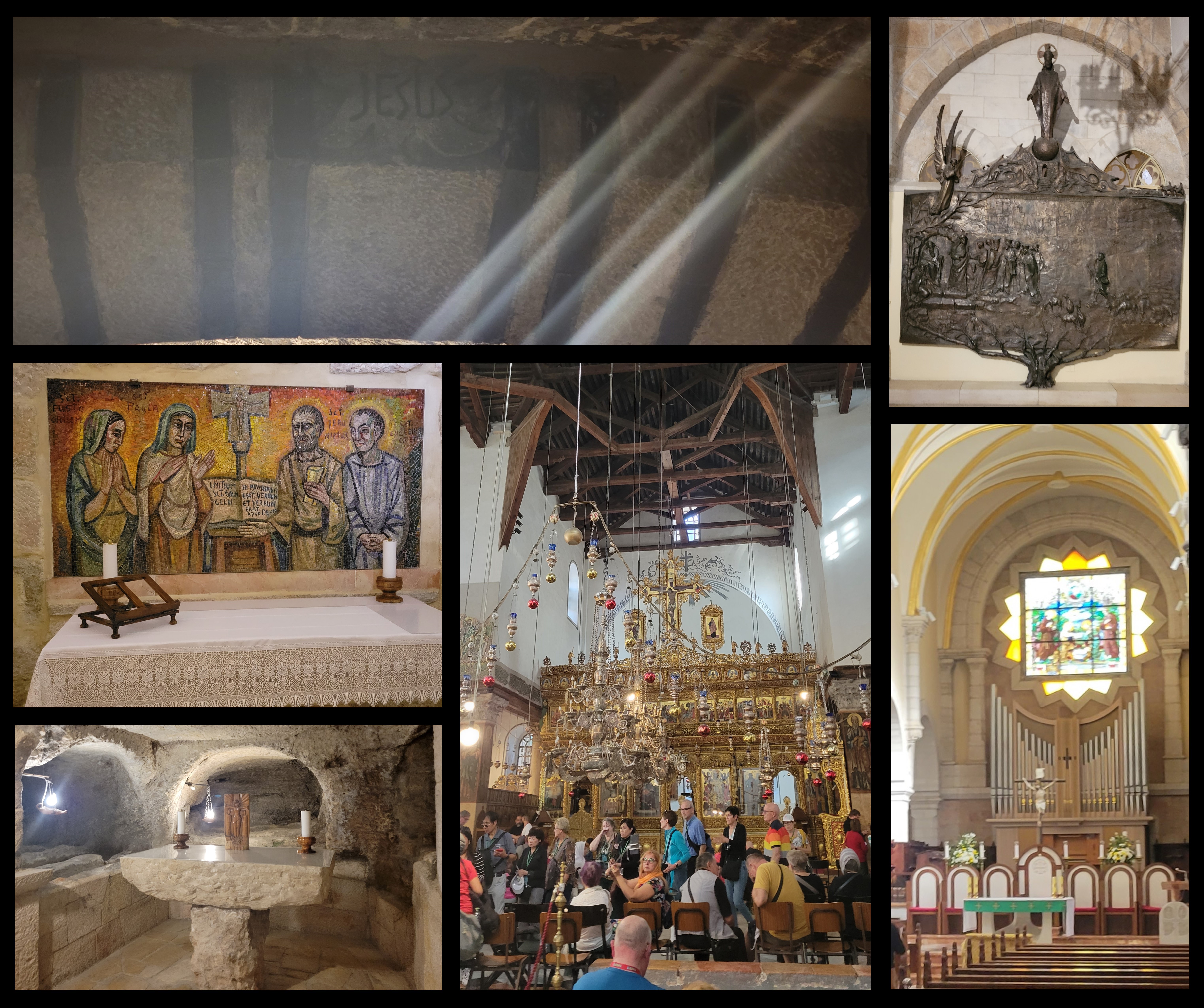
At this point, we had to leave our guide behind as he is Israeli and could not enter Bethlehem with us which is controlled by the Palestinian Authority. Inside Bethlehem, we went to the Fields of the Shepherds and the Church of the Nativity. The Fields were where the angels announced the Birth of Christ to the Shepherds and also where Ruth gleaned grain in the fields of Boaz. While at the Fields of the Shepherds, we also visited the Chapel of the Shepherds' Field (also called the Church of the Angels) where we sang "The First Noel" and "Angels We Have Heard On High."

The Church of the Nativity is actually three different churches operated by the Roman Catholic Church, the Armenian Apostolic Church, and the Greek Orthodox Church. All three churches have access to the cave or grotto which all three agree is the birthplace of Jesus Christ.

After a short walk and bus ride, we went to the New Bethlehem Store which is run by the Nisan Brothers who specialize in olive wood carvings.


Day 5 - On Our Own

Being Sunday, we started the day with a church service at the Seventh Station of the Cross where a small chapel exists. Station 7 is where Christ left Jerusalem and the remnants of the old gate are where the chapel was built and is today maintained by the Franciscans.

A small group of us made it over to the Church of the Holy Sepulchre where, after a 2-hour wait, we made it into the Shrine that houses the tomb that held Christ's body after his Crucifixion and Death. This, by far, was the highlight of the trip for me. While not as grand in appearance as some cathedrals and churches in Europe, without this holiest of places and events that occurred there, places like St. Peter's Basilica in Rome would not exist.

After lunch, a few of us wandered the Old City of Jerusalem and the four quarters that compose it (Christian Quarter, Muslim Quarter, Jewish Quarter, and Armenian Quarter). I was disappointed to hear that Zedekiah's Cave was closed due to construction as this cave was where the stone for the Temple of Solomon was quarried.


Day 6 - Via Dolorosa

This day began with a visit to the Western Wall (also called the Wailing Wall). This wall is a small remnant of the wall that once surrounded the Jewish Temple. Due to the restrictions placed on the Temple Mount, the wall is the holiest place in Judaism where Jews can still pray. While I was there, it was packed full of Orthodox Jews praying. It is common practice to leave notes with prayers in the cracks of the Western Wall. Twice a year, a Rabbi collects the notes and buries them on the Mount of Olives.

We then made our way to the Temple Mount where Al Aqsa Mosque and the Dome of the Rock now sit where King Solomon's Temple was once. Al Aqsa is said to mark where Muhammed was transported from Mecca to Jerusalem in one night. The Dome of the Rock is said to be the place where Muhammed ascended to heaven. This same rock, the Foundation Stone, is said to be where Abraham was going to sacrifice Isaac, where Jacob had his dream, where the Ark of the Covenant resided in the Holy of Holies in King Solomon's Temple, and the Axis Mundi.

We then proceeded to the Lions Gate and St. Anne's Church. St. Anne's had great acoustics and several groups sang many hymns in their native tongue. This church is built next to the ruins of the Pools of Bethesda (Hebrew for "mercy") and over the ruins of what is believed to be the birthplace of the Virgin Mary. The church is dedicated to St. Anne, the mother of Mary.

We then started the Way of Sorrow with the Churches of the Condemnation and Flagellation which serve as the First and Second Stations of the Cross. Traveling through the Old City we traveled to each Station of the Cross before ending at the Church of the Holy Sepulchre which holds the last stations within its hallowed walls.


Day 7 - In the Wilderness

This morning we made our south to Masada, the ancient fortress built by Herod the Great (great in that he built great structures, not great in his deeds). While you can walk to the fortress ruins, it is more expedient to take the cable car as you are going from -33 meters to 257 meters. This fortress was also besieged by the Romans in 73 AD and marked the end of the First Jewish-Roman War. Masada today serves as one of the locations for the swearing-in ceremony for the Israeli military.

After a quick lunch, we toured Qumran and learned about the Essenes and the Dead Sea Scrolls. The day ended with a swim in the Dead Sea. The Dead Sea is around 34% salt while the ocean is between 3-5% salt. This abundance of salt allows the body to float. It was weird, but fun to be so buoyant. After showering off, a few of us had a beer at the Lowest Bar in the World.


Day 8 - A Legacy of Agony

This day was a somber day as we went to the Israel Museum where we saw a scale model of Jerusalem during the 2nd Temple and the Shrine of the Book that houses, among other documents, the Dead Sea Scrolls and the Aleppo Codex. The Dead Sea Scrolls are a collection of ancient manuscripts of canonical books of the Old Testament, apocryphal texts, and extra-biblical texts, some of which date back to the 2nd century BC. The Aleppo Codex is a 10th-century AD manuscript of the Hebrew Bible.

Next on our tour, was the Yad Vashem Holocaust Memorial. I toured the Holocaust Memorial in Washington DC when I was 16 and this memorial was just as moving. It was sobering to see such evil that was perpetrated by the Nazis and their allies. Both those who committed these atrocities and those who today deny that they happened are some of the purest forms of evil we have in our world.

In the afternoon, we went to the Church of All Nations or Church of the Agony then to the Garden of Gethsemane. The current Church is built on the ruins of two previous Christian churches that were built to commemorate Christ praying in the Garden before his arrest. The Garden of Gethsemane was an ancient orchard of olive trees where Christ underwent agony and then where He was arrested by the Romans. My tour group was able to spend time in a private section of the Garden and have a moment of reflection.


Day 9 - Lehitra’ot Israel

The previous day was cut short because of the long lines of other tourists, so this last morning in Israel, we visited the Ascension Chapel and Pater Noster Church on the Mount of Olives. The church is said to be the place where the Savior ascended to Heaven. The chapel is simple, but holds a stone that contains a footprint marking the spot of His Ascension. The chapel today is under Islamic control, but it is open to tourists and for Christian use. The Pater Noster Church sits on a cave or grotto where Jesus taught the Lord's Prayer. The church sits next to the ruins of the Byzantine Church of Eleona. On the walls of the church are translations of the Lord's Prayer (Pater Noster) in 140 languages. Eusebius wrote this of the cave: “in that cave the Saviour of the Universe initiated the members of his guild in ineffable mysteries”.

To get one last look at the Old City, we went to the Haas Promenade Overlook (due south of the Old City). 

Going to the newer part of Jerusalem, we had lunch at the Machaneh Yehuda Market.

As we were technically on the Pilgrimage an extra day, our hosts took us to the Abu Gosh - Saxum Visitor Center. This center gives visitors the ability to tour through history using timelines, maps, interactive screens, models, recreations, and video mappings.

We then made our way to Tel Aviv where we had a group dinner before going to the airport for home. Once I landed back in Idaho, I made for southern Idaho as the next day Idaho College SRICF was going to meet. By the time I made it home on Saturday evening, I was exhausted.

This trip was truly once in a lifetime and I am so thankful for the opportunity to walk where the Savior walked. I cannot recommend it enough to anyone, whether a Sir Knight, a member of the clergy, or otherwise to go on this Pilgrimage.

Saturday, August 13, 2022

Holy Esclarmonde de Foix

Today is the Feast Day of Esclarmonde de Foix, a Cathar priestess from the 12th and 13th centuries. Before I had joined the Apostolic Johannite Church I had never heard of her. I found in my research that there were several women of noble birth named "Esclarmonde" which made it difficult to trace her history. She is remembered for her fervent support of the Cathar faith, her presence at the Council at Pamiers 1207, and her part in the renovations to the fort of Montségur which would help shield her people during the Albigensian Crusade

It is believed that she was born after 1151 to a noble family in what is now southern France; some give a date range of ~1151 to 1165 and I found several sources that dated her birth to 1154 or 1155. She was the daughter of Roger Bernard I, Count of Foix (a vassal of the Count of Toulouse), and Cécile Trencavel, daughter of Raymond I Trencavel, the Viscount of Agde, Béziers, Albi, Carcassonne, and Razès. Her name, Esclarmonde, means "clarity or light of the world". Some theorize that her name comes from the Visigothic words "Is Klar Mun".

Growing up in Occitania afforded her an education in language, poetry, music, history, philosophy, and politics. At the age of 12, she was consecrated by Nicetas, Bogomil Bishop of Constantinople and Patriarch of the Cathars during the synod of Saint-Félix de Lauragais. For those unfamiliar with the Cathars, they were a sect of Christianity that did not adhere to the Roman Catholic doctrine and were seen as heretical by the Roman church.

In 1175, she was married to Jourdain III, the Lord of L'Isle-Jourdain, the Viscount of Gimoez, which was an unusual older age for her to marry. Although the marriage seems to have been politically motivated, as they were at that time, the marriage was fruitful and joyful as they had 6 children:

Bernard-Jourdain
Escaronia
Obica
Jordan
Othon-Bernard
Philippa

Little is known about Esclarmonde during the 25 years of marriage, but there are some stories. Anti-Cathar beliefs had started before they were married. In 1163, during the Council of Tours, Pope Alexander III condemned Catharism as heresy and by 1180 persecution was common. In 1181, a papal legate attacked Castres and Lavaur (both East of Toulouse and South of Albi). Legend has it that with these attacks, Esclarmonde helped the survivors, the refugees, flee from the onslaught of the Roman Catholic Church. She was accused of heresy but was defended by her husband (who was Roman Catholic).

In 1200, Jourdain III died and Esclarmonde devoted her life to Catharism. Jourdain had bequeathed his titles and property to Esclarmonde, but she turned it over to her children. In 1204, she received by Guilhabert de Castres, the Cathar Bishop, the Consolamentum, a sacrament taken for those becoming a Cathar Prefect. This action speaks highly of her character and resolve as most widows of nobility would live out their lives in comfort and she was choosing not only a life of service, but one that was facing severe backlash and persecution. As a Prefect, she was trained in the art of healing, medicine, herblore, weaving, agriculture, geology, mathematics, and astronomy as well as the sacred texts of the Cathars. As a Prefect of her faith, she established girls’ schools, hospitals, and homes for aging Prefects.

In 1204, Esclarmonde, foreseeing further aggression by the Catholics, suggested to the nobility to fortify their castles, and one such lord to take her words seriously was Raymond de Pereille who then owned Montségur.

Esclaramonde was said to have attended or even organized the Council of Pamiers in 1207 where a debate between Catholics and Cathars occurred. The Catholics were represented by the Bishop of Toulouse, the Bishop of Navarre, the Abbott of the Augustinians in Pamiers, and several others, including Dominic Guzman, the founder of the Dominican order who would lead the Inquisition. For the Cathars, there were several Prefects, both men and women, including Esclarmonde. There seem to be conflicts as to her contribution to the Council as one account says she delivered a brilliant lecture while another account says she was shut down and prevented from speaking by the Catholics who would not allow a woman to speak about matters they saw above her gender.

The years following saw the ruthless hand of ignorance and the destruction of brutal force with the Albigensian Crusade that would officially last until 1129. The name Albigensian comes from the town of Albi which was a center of Catharism.

Esclarmonde became a rebel and even had a bounty put on her head by the Pope and became a symbol of resistance. Through the years she avoided capture and assisted surviving Cathars. This Crusade was different as it was against Christians and fellow Europeans, but the Occitania was rich in resources, culture, and wealth, and the Catholic Army composed of the dregs of society pillaged and plundered their way through the region. In the face of such wanton destruction, many Cathars fled the Montségur which would fall to the Catholics, but not until 1244.

Some believe that Esclarmonde died in 1215, but some believe that the story was invented by her brother, Raymond-Roger, who was trying to get his lands in Foix restored to him as they had been taken during the crusade and given over to the papal legate. There is one legend that she attended the wedding of Roger-Bernard, the new Count of Foix and her nephew, to Ermengarde de Narbonne in 1232. In this legend, it is believed that she died in 1240 which would mean she was into her 80s well above the average lifespan of the time. No trace of her body or burial has ever been found.

Esclarmonde de Foix leaves a legacy of feminine strength, leadership, the Cathar religion, and of religious freedom. Such was her character that she is mentioned in several pieces of poetry and literature to include being a Keeper of the Holy Grail legends and in Gnostic revival literature. Her importance was so strong that even in recent years the Roman Catholic Church has opposed any statue or monument being made in her honor. Supposedly there is a statue of her in Foix, but I cannot find anything to corroborate this.


References

1. Barber, M. C. (1977). Women and Catharism. Reading Medieval Studies, 45-62.

2. d'Honore, R. (2007). Esclarmonde de Foix. Retrieved from Laconneau: http://laconneau.org/womensaffairsEsclarmonde.html

3. Esclarmonde de Foix c. 1154-1232. (2021, March 29). Retrieved from The Thelemic Order: https://www.thelemicorder.io/2021/03/29/esclarmonde-de-foix/

4. Esclarmonde of Foix. (n.d.). Retrieved from Academic Dictionary and Encyclopedia: https://en-academic.com/dic.nsf/enwiki/5423843

5. Graham-Leigh, E. (2005). The Southern French Nobility and the Albigensian Crusade. Woodbridge: Boydell Press.

Thursday, February 24, 2022

What is Monasticism?

Introduction

The medieval Knights Templar are routinely referred to as ‘warrior monks’ because they blended the asceticism and piety of medieval monks with the intensity and zealotry of the crusading knight. Their monastic lifestyle was heavily influenced by the Cistercian order, which was, at that time, led by St. Bernard who wrote the original Latin Rule of the Templar order. As a Knight Templar in the York Rite of Freemasonry and a Frater of the Rose and Cross, I had done only a minimal amount of research on monasticism, but with getting more involved with the Apostolic Johannite Church and the Oblates of the Temple and St. John, I've started looking more and more into the practice and I can't say, that amid the chaos of the world, that it hasn't crossed my mind that living in an isolated monastery wouldn't be the worst thing for me.

Monasticism isn’t a cooky-cutter tradition and is found not just in Christianity, but also in Buddhism, Hinduism, Taoism, Manichaeism, and Jainism, and as such it is hard to have a definition that truly covers all facets of monasticism in all of these religions. A definition would need to be very broad and leave the particulars to a specific religion. One that I found is:

“Religiously mandated behaviour (orthopraxy), together with its institutions, ritual, and belief systems, whose agents, members, or participants undertake voluntarily (often through a vow) religious works that go beyond those required by the religious teachings of the society at large.”

Some practices are universal practices such as asceticism which is “a lifestyle characterized by abstinence from sensual pleasures, often for the purpose of pursuing spiritual goals.” It is important to note that while monasticism incorporated asceticism, it does not mean that all forms of asceticism are monastic. Seclusion is also universal, but may take different forms. Some types of monasticism are completely isolated (as seen in early monasticism) while some may be located near towns/villages, but are secluded within a walled sanctuary. Celibacy is not universal to all monastic orders, but a clear majority of monastic traditions do practice celibacy. Celibacy shouldn’t be practiced to spite the rite of marriage or conception (as some have seen it), but rather a practice is to rid oneself of material distractions and as a show of one’s love to God. One last characteristic that seems universal across monastic traditions is that it doesn’t exist in societies that lack written religious text. Christian monasticism developed early in the history of Christianity, but it is not mentioned in the Scriptures.

The word “monasticism” is derived from the Greek word “monachos” meaning “living alone”. Men who practice monasticism are monks and women are referred to as nuns. While monasticism is found in various world religions, the focus of this article is that found in Christianity and then primarily Western Christianity. To its practitioners, Christian monasticism is a way of life, a vocation from God where one sought a state of freedom from the material world and to reunite with God. Although monks and nuns are or were often viewed as extreme in their practices, they were instrumental in preserving and transmitting knowledge, skills, cultural goods, arts and sciences, and artifacts through the generations.

As Christian monasticism developed and evolved, regulations were created. These regulations would become known as “Rules,” the most famous of which is the Rule of St. Benedict, the Rule of St. Augustine, and the “Masters Rule”. Monastic life, as regulated by the Rules, usually consisted of prayer (lots of praying), reading, studying, and manual labor.

Within Christian monasticism, monks were considered equal in status, and although some were called to serve in various offices of the monastery, authority rested solely in the title, not the man himself. Depending on the time and the rule they followed, in addition to the Abbot, you could also find the following positions:

Almoner: Manages the alms to the poor 

Cantor: Supervises the choir 

Cellarer: The logistician of the monastery 

Chamberlain: In charge of clothing 

Circuitor: In charge of discipline 

Hegumen: In charge of several monasteries in a given jurisdiction in some forms of monasticism; sometimes called an “Archimandrite.” 

Infirmerer: In charge of the sick and elderly 

Kitchener: In charge of food preparation 

Librarian: Keeper and manager of the books 

Mother Superior: in charge of an abbey or convent of nuns. 

Prior: A high officer in a monastery, under the abbot; often used with military orders and mendicant orders 

Sacrist: In charge of everything holy; second only to the prior and sub-prior 

Treasurer: In charge of the monies and manages the properties of the monastery

It should be noted that monks can be both laymen and clergymen. Often monks who were priests were known as “hieromonks.” I would also like to note that Oblates are laypersons who are affiliated with a monastery but are not monks. Oblates helped extend the Rule of their respective monastery to other regions, churches, parishes, and other organizations. If one is seeking admission to be a monk, they are first referred to as a postulant before being a novice for a predetermined period of time.

“Monastic life is the Christian life in its fullness.”


Rome becomes Christian

To understand how Christian monasticism came about and evolved, I will briefly discuss the earliest years of Christianity following the Crucifixion and Ascension of Jesus Christ. With the Apostolic Age (years between the ascension of Christ to the death of the last of the 12 Apostles) came a great amount of missionary work and the spread of Christianity throughout and beyond the Greco-Roman Empire. By the end of the First Century, 40 known churches were established. Originally considered a sect of Judaism, a decade after Jesus, the term "Christianity" was used to describe this movement and Christian converts included not just Jews but gentiles.

Originally, persecution of Christians by the Roman Empire was sporadic, but the first recorded act of persecution by an Emperor was in 64 AD by Nero who blamed the Great Fire of Rome on Christians. It was during the first year of the reign of Emperor Trajan Decius that the most fierce persecution occurred, but his reign was short-lived. However, with the outbreak of a plague, Christians in several areas of the Roman Empire were blamed and persecuted. Persecutions of Christians also occurred under Emperor Valerian and Emperor Diocletian, the latter had Christians arrested, tortured, burned, starved, and used as a sport in gladiatorial games. With the rise of Constantine to the imperial Tetrarchy in 306 AD and then becoming sole Emperor in 324 AD, policies and edicts much more tolerant to Christians were issued such as the Edict of Milan (313 AD) which occurred after Constantine's vision before the Battle of Milvian Bridge. A year after Constantine became sole Roman Emperor, the Council of Nicaea convened to determine the formal beliefs of and to unify Christianity. While Constantine was tolerant of Christians, he did not convert until his deathbed in 327 AD. It wasn't until the Edit of Thessalonica (380 AD) was issued during the reign of Theodosius I that all pagan worship was outlawed, and Christianity took over as the religion of the empire.

The end of persecution and the legalization of Christianity meant that martyrdom was no longer a primary option for one to prove their piety and faith in Christ. Rather than being persecuted and tortured as the Savior and the Apostles were, some Christians took to the ascetic life as a "long-term martyrdom." Once Christianity became mainstream or an accepted religion within the Roman Empire, some saw laxity among the common worshipper and so sought to seclude themselves therefore to dedicate themselves solely to God and maintain a rigid orthodoxy.


Desert Fathers and Christian Eremitism

While there are examples of what could be called "proto-monasticism" and secluded monks, monasticism as we know it today didn't exist until the end of the 3rd Century. Some early Christians chose to imitate the Savior and his 40 Days in the Desert by secluding or isolating themselves from society and living in the desert, but Jewish Prophets and Patriarchs like Enoch, Melchizedek, and Elijah were important role models for Christian monasticism.

At first, these "Desert Fathers" (as they are known now as) lived ascetic lives as hermits which is the first form of monasticism "eremitism". The etymological root of "Hermit" is the Greek word "eremites" which means "person of the desert." Some of the earliest practitioners of eremitic monasticism were Paul the Hermit, Pachomius of the Thebaid, and St. Anthony the Great, the latter of which is called the "Father of Christian Monasticism." These Desert Fathers lived a solitary life, though sometimes they had visitors who adored them and wished to emulate them.

This eremitic monasticism focused more on a rigorous, but contemplative life. It was a tough life to live as you had to protect and provide for yourself. Depending on the location, nearby villages would furnish the hermit with food and provisions, but that wasn't always the case.

St. Anthony the Great (251 AD to 356 AD) was a native of Alexandria (Egypt). At the age of 15, he chose the life of the hermit and remained in the desert for the next 90-years of his life. Purely hermit-like in the beginning, he eventually established a colony that allowed for their protection and to better organize them. These early communities though were loosely organized and had no hierarchies nor administrative links to a mother institution. It is interesting to note that the Monastery of St. Anthony in Egypt (334 km southeast of Cairo) is the oldest Christian monastery in the world.


Development into Communal Life

With this development of communities, cenobitic monasticism was born. Cenobitic is rooted in the Greek words "koinos" meaning "common" and "bios" meaning "life." The development of this form of monasticism is given to Pachomius of the Thebaid (290 AD to 346 AD), a follower of St. Anthony. Aside from the greater protection, it gave the monks, this form was considered superior to eremitic monasticism as there was more obedience practiced and as a group, a hermit was less likely to stray from doctrine and practice anything considered heretical by the church.

Cenobitic monks lived in individual huts or rooms, but worked, ate, and worshipped in a shared place.  These communities were often a collection of buildings surrounded by a wall. Some of these monasteries would contain up to 30 houses that could each hold up to 40 monks. These houses were often divided according to the work the monks would perform for the monastery (carpentry, farming, etc.).  This form made monasticism very industrious and thereby reduced the reliance monks had on the charity of the public.

Basic guidelines or "Rules" began to emerge that dictated a monk’s daily life and even established communities for women. It was during this time that the term Abba was first used to describe the head of the monastery. Abba comes from the Syriac meaning "Father" and where we get the English "Abbot."

Pachomius's model became so successful that he began establishing them all over Egypt and by the time of his death in 346 AD, there were said to be around 3,000 communities in Egypt. From Egypt, cenobitic monasticism spread to the Levant, North Africa, Mesopotamia, Persia, the Roman Empire, and even as far East as India and China. Within a generation of Pachomius's death, the number of communities had grown to 7,000. St. Jerome, known for the Latin translation of the Bible, later translated the rule of Pachomius into Latin.


East vs West

Before going into the spread of monasticism to Western Europe, I want to briefly touch upon monasticism as practiced in Greek and Russian Orthodox churches. Both Eastern and Western monasticism traces their origins back to St. Anthony the Great and Pachomius of the Thebaid, but just as there are differences between the Roman Catholic Church and the Orthodox churches, so too are their difference between their forms of monasticism.

While most Western Christian monasticism utilized the cenobitic monasticism, a third form was created called skete which combined the best aspects of both eremtic and cenobitic monasticism. Within skete monasticism, the practitioners would pray privately for the week, and then on Sunday (as well as on Feast Days), they would assemble together. St. Theodore of Egypt, a follower of Pachomius, is considered the father of skete monasticism, but St. Basil of Caesarea is considered the founder of monasticism within the Eastern Orthodox churches.

St. Basil traveled throughout the Holy Land and Egypt where he visited several monasteries. He was impressed by the rules laid down by Pachomius. St. Basil wrote his own regulations which emphasized a unified community and strong central leadership. St. Basil’s Rule was strict but not severe (in comparison to the Desert Fathers).

While in the West, monks were not always clergy, in the East monasticism became inextricably linked to the clergy and in most Orthodox churches it became law that all bishops must be monks.

Eastern Christian monasticism still exists today and since the fall of the Soviet Union, there has been a resurgence has occurred in the former Soviet states allowing many empty or defunct monasteries have been reopened.


Spread to Europe

Monasticism grew out of the Middle East and to the rest of the Roman Empire through its existent infrastructure. The most well-known figures of monasticism in Western Europe were Martin of Tours, John Cassian, and Honoratus of Marseilles. Some date the introduction of monasticism to the West to a visit to Rome by St. Athanasius in 340 AD who was accompanied by two monks who were followers of St. Anthony the Great. Others believe that monasticism came to the West through John Cassian. Martin of Tours was a pagan convert to Christianity and established monasteries in Milan, Liguge, Poitiers, and Marmoutiers near Tours. Honoratus would establish monasteries in Lérins (an island near the city of Cannes). John Cassian started as a monk in the Middle East, but moved to Gaul (now France) and established monasteries in Marseilles. John published his “Institute and Conferences” which had influenced the Rule of St. Benedict.


Irish Monasticism

The first non-Roman country to adopt monasticism was Ireland. Monasticism in Ireland was unique as it developed a form closely related to its rural clan system. Irish monasticism more closely resembled the monasticism found in Egypt rather than in mainland Europe. As Ireland was not conquered by the ancient Roman Empire, it was unaffected by its fall and so did not develop in the same way the rest of Western Europe did.

Irish monasteries became the spiritual focus or center of the clan or tribes. These monasteries were often on lands granted by the local nobility and many of the abbots and abbesses were members of the noble family; this was done due to legal traditions to keep land within the family. In many ways, abbots were considered superior to church bishops and were the supreme authority of the monastery. Bishops were usually located in urban centers and Ireland was primarily rural. Some monasteries were just for men, some just for women, and a few were mixed.

Irish monasticism spread to Scotland and northern England before spreading to places like France and Italy. Monasticism spread rapidly through Ireland and then to the British Isles. When Benedictine monks traveled to the British Isles in 597 AD, they had found Irish monasteries well established.


Rule of St. Benedict

After the rules of Pachomius and St. Basil, the Regula Magistri or Master’s Rule was considered one of the most important rules of monasticism in Western Europe. It was believed to have been written somewhere south of Rome around 500 AD (though the precise date is problematic). It was composed of 95 chapters, 20 of which were dedicated to the Divine Office (also called Canonical Hours or Office of the Hours). This rule added legalistic elements that were not found in earlier rules, defining the activities of the monastery, its officers, and their responsibilities in great detail. Historically, this rule was never used in any specific monastery, but was an influence on the Rule of St. Benedict.

St. Benedict of Nursia is considered one of the most important monks of Western monasticism and is considered the Patron Saint of Europe. Benedict was from a noble family, but after meeting a monk chose to be a hermit for a few years before becoming an abbot of a monastery in Vicovaro. Apparently, his governance was severe as the monks tried to poison him and, according to legend, each attempt was defeated by some miraculous intervention. He established several monasteries throughout Italy, but his most important achievement was the publication of what would be known as the “Rule of St. Benedict” in 516 AD (although some date it to 530 AD).

His rule is composed of 73 chapters which are similar to the Master’s Rule in what they define. It was considered a middle ground between individual zeal and formulaic institutionalism (functional, yet practical) which caused it to be very popular and become one of the most used rules in monastic life. In the final chapter, St. Benedict acknowledges and applauds the Rule of St. Basil, but St. Benedict’s Rule was clearly influenced by the Master’s Rule, St. Augustine, John Cassian, and Pachomius.

Its popular adoption was not just due to its content, but also because it was sponsored by Pope Gregory I (who was a Benedictine monk) and Charlemagne the Great (who was educated by a monk), the latter had it copied and distributed throughout the Holy Roman Empire. His Rule has been utilized for 15 centuries by several monastic orders and knighthoods including the Knights Templar.

Even though it came to Western Europe long before him, but because of his Rule, St. Benedict is considered the “Father of Western Monasticism” and his Feast Day is celebrated on March 21 (the anniversary of his death).


Evolution of Monasticism

Monasticism continued to evolve, adapting to the environment it existed in. The stability and exemplary conduct of the monasteries attracted many bright minds and it was during this time that monasteries became storehouses and producers of knowledge. Lords and nobles started giving land and monasteries became wealthy.

In some instances, monks didn’t have to work the land, but had a non-monastic workforce that left more time for the monks to study and pray. Subjects that were studied included Latin, Greek, Hebrew, grammar, rhetoric, poetry, arithmetic, chronology, the Holy Places, hymns, sermons, natural science, history, and especially the interpretation of Sacred Scripture. Monasteries became centers of education. In many locations, monastic schools led to the establishment of a university in the region during the 12th and 13th centuries.

Monasteries even started taking charge or began social services such as medical, healthcare, and education. Having such farming operations, monasteries led the development of agricultural techniques to include fermentation (wine), brewing (beer), and distillation (alcohol).

Monks even contributed to the arts as a way of praising God and one example of this is the Gregorian chant (a favorite of mine).

Royal and noble families also utilized the monasteries for housing their children. For daughters, it was a place to educate them in an environment where they could remain chaste. For the second sons, it was a bit less pleasant as monasteries were used to keep the second sons from any inheritance. Political prisoners were also kept at monasteries, depending on their crime and social status. Monasteries also provided refuge for those who were tired of the troubles of life (as seen with Charles V, Holy Roman Emperor who retired to Yuste monastery in Spain in his late years). Several monasteries are comparable to modern retirement homes for nobility.


Mendicant Orders

As the religious and geopolitical landscape continued to change so too did monasticism. In the 11th century, you see the Great Schism between the Roman Catholic Church and the Eastern/Greek Orthodox Church. Many monasteries had accumulated a great amount of wealth and relaxed the ideals/principles of monasticism which earned them the criticism of many across Christendom and new orders emerged such as the Cistercians that focused more on the manual labor of the monks and more austere life. The term “Cistercian” comes from the word “Cistercium” which is Latin for Citeaux (near Dijon) where the order was founded.

Around this time, you also saw the rise of mendicant orders such as the Franciscans or Dominicans. Mendicants (practitioners were called friars) were ascetics like monks, but instead of isolating themselves, mendicant orders were dedicated to traveling and living in urban areas as their primary mission was preaching, evangelizing, and ministering to the poor. Where monasticism was about finding a personal, private way to devote themselves to God, mendicants were all about the public service to others.

Some mendicant orders would also provide other services to the church thought they may have called it a public service. The Dominicans were an order established to preach the Gospel and oppose heresy. This order would become known for running the Inquisition (today called the Congregation for the Doctrine of the Faith and is still a part of the Roman Curia of the Vatican). The Dominicans were instrumental in the attack on the Cathars and the Albigensian Crusades.

For good or bad, mendicant orders were contributed to the colonization of the new world, eastern Asia, and the South Pacific. In these places where only diplomatic relations existed or even where Western powers had conquered the land, governance was often truly centered on the Friars and not the civil government. If you are interested in this subject area, I’d recommend “Noli Me Tángere” by José Rizal.


The Crusades and Warrior Monks

Like most of Europe, monasteries faced attacks by Vikings in the 9th through the 11th centuries, and you saw the emergence of professional fighting forces and the mounted knight during this time. After the abatement of the Viking invasions, many soldiers were unwilling to put down the sword. The Viking invasions had militarized Europe and there were many Lords who were willing to buy their swords to form their own army to force their will upon the peasants and to attack other nobility. This resultant savagery led the Church to establish rules that these knights must live by or face ex-communication. Pax Dei (Peace of God) was established in the 10th century and proclaimed that certain individuals, particularly the defenseless (peasants and clergy), should not be attacked by knights. Treuga Dei (Truce of God) was established in the 11th century and proclaimed that certain times should be void of fighting by knights (such as the Sabbath Day). The Truce of God seemed particular to focus on preventing Christian knights from fighting each other. These helped the Church redirect the knight’s fighting energy and stem the violence of private wars in a Feudal society. This redirection would soon be pointed towards the Middle East when a call for help came from the Byzantine Emperor and that led to the Crusades. The Crusades would see the emergence of a new monk: the warrior-monk.

Once the call from the Byzantine Emperor, Alexios I Komnenos, the Pope convened the Council of Clermont in southern France in November 1095 where he urged the masses commoner and nobility alike to defend and retake the Holy Land. This call was taken up by many, the most well-known cheerleader of the First Crusade was Peter the Hermit, an Augustinian monk.

After the capture of Jerusalem in 1099, many knighthoods were established such as the Teutonic Knights, Knights Hospitaller, and the Knights Templar who were called warrior-monks. Like traditional monasteries, Templars took oaths of poverty and lived ascetic lives. Their commanderies/preceptories were also their monastery. The Templars, in their early formative years, were championed by St. Bernard of Clairvaux, a Cistercian monk, who was the nephew of Andre de Montbard. St. Bernard would go on to write the Rule of the Knights Templar which was heavily influenced by the Rule of St. Benedict. This military monasticism became very popular and the membership of these orders swelled in the 12th and 13th centuries.

These military monks have changed from protection through isolation to protection through warfare.


The Decline of Monasticism, the Renaissance, and the Reformation

Up to the 14th century, Europe was starting to climb out of the darkness left in the wake of the collapse of the ancient Roman Empire, but then economic downturn, political instability, and disease started occurring. Between the 11th and 14th centuries, the population had grown around 250%, and finding good land to farm is hard and only the elite, the nobility and church, own the land. The climate started to cool off as well and it got wetter which shortened the harvesting season and decreased food production. Starvation became an issue, particularly for the peasants who became malnourished, and which stunted their growth. People begin moving to cities and urban centers looking for work and food. The cities become overcrowded with malnourished and weakened people, and Europe is about to be ravaged by the Black Death.

Officially known as Yersinia pestis, the Black Death was a bubonic and pneumonic plague. It was carried by fleas who infected rats who, in turn, infected humans. It spread so rapidly due to the established trade infrastructure of Europe as well as by refugees. Ships carried the plague into a port where the sailors and merchants would disembark to go see their families or go to bars (or brothels) where they spread the infection.

It hit Italy around 1347 before it hit France the following year and England after that. Once infected, life expectancy was 1.8-days. The Italian writer Boccaccio said that its victims "ate lunch with their friends and dinner with their ancestors in paradise.” Hygiene was poor and with poor health, it is not surprising that it killed so quickly. The response was also poorly handled as the church dictated that bodies couldn’t be burned, and the mass casualties just exasperated the spread of the plague. The church also said that the Black Death was God’s Wrath on mankind. One-third to half of the population died and this had a massive impact on religion, society, education, technology, and the economy.

Economically, the Black Death destroyed serfdom. Before the plague, serfs were tied to the land of a lord and were in a contract (which could last generations). After the plague, there were fewer people to work, and workers now had more choices. Aristocrats had to start paying and treating the workers better than before. Former peasants could now find better jobs and could even amass wealth. With fewer people, this also prompted people to find or invent mechanisms to do work with fewer people (necessity is the mother of invention).

Within society, the survivors now had more choices as so many had died, more jobs were now available. You also see that a fear of an early death leads to early marriages and consummation. Some even adopt the Carpe Diem (Seize the Day) mentality where debauchery and partying become commonplace; what we would call YOLO today. A negative impact on society is that they looked for a scapegoat for the disease and it usually fell upon a minority or outcast group such as the Jews or Romani.

Many have a crisis of faith and begin to criticize the religious institutions: if they were doing the right thing then this should not have happened. Zealotry in religion and society occur and this is seen with the emergence of the flagellant movement. These zealots would travel city-to-city whipping themselves to atone for everyone’s sins. The irony was that they were likely to further spread the plague than stop it.

If the plague wasn’t bad enough, you saw a great amount of political violence occurring during the same time. You see the arrest and dissolution of the Knights Templar and its properties. The Hundred Years War surrounded the elites fighting over the crown of France. With this war, you see the decline of the mounted knight and the rise of the use of archers and canons on the battlefield. The common people were getting sick of war as they often suffered no matter who won, and uprisings started happening in England, France, the Holy Roman Empire, and the Italian city-states.

The Roman Papacy is both a religious and global power, but is facing criticism from within and without because of some glaring corruption and big bureaucracy that ran the church throughout all of Christendom. Bribery was commonplace and nobility could impact even papal elections. In 1305, the Avignon Papacies began with Clement V who was, in my opinion, a puppet of King Philip of France. Clement didn’t want to move to Rome and his successor John XXII decided to stay in France as well. This leads to other nations denouncing the French Papacy. This leads to the Great Schism where Cardinals in Rome elect a new Pope and now there are two Popes then a third Pope is elected. They excommunicate each other and cause a great deal of confusion within the church. No one truly knows which Pope is valid and Bishops don’t know who to follow.

Some may not see this as a positive, but wealth became concentrated in fewer hands. This allowed the wealthy to patronize the arts. Trade was also improved and opened to new areas which then exposed the West to new advancements such as in math (the use of Arabic numerals instead of Roman). Both the increase in art and trade helped launch the Renaissance.

As seen with the Templars, nations, and monarchies were being threatened by the changing environment and by the wealth and power of religious orders. The depopulation caused by the Black Death couldn’t support the monasticism that existed before the plague. Less population to pull from, competition with mendicant orders, relaxation of monastic rules, and poor leader, it was inevitable that monasticism declined in both membership and appeal.

In 1517, Martin Luther, a former Augustinian monk, published his 95 Theses on October 31st in Wittenberg, Saxony, which sparked the Protestant Reformation. Protestantism emphasized active engagement in the world rather than seclusion. In most Protestant nations, monasteries were closed, their members mistreated, and their lands and assets seized by the state. The closure of so many monasteries disrupted parish activity. In response, the Council of Trent was convened in 1545 which reformed, centralized, and attempted to revitalize monasticism and save Catholicism against the rise of Protestantism. Monasticism continued to play a role in Catholic-controlled nations, but in Protestant and Anglican states, they were only a memory.

Monasticism would face possible extinction again with the French Revolution and Napoleonic Wars ravaged France and Europe, but monasticism would also see a revival in the 19th century among Protestants and Anglicans. Surprisingly, the first Anglican monastic movement was started by women.


The Legacy of Monasticism

Monasticism has impacted our modern world in a variety of ways and much of Western civilization owes its life to the monks of medieval Europe. The biggest example that I want to highlight is our education system. Many modern universities are built in the gothic style of 12th-century monasteries, but this isn’t the only way. Anyone who has attended a college graduation ceremony should be aware of the cap and gown used by faculty and graduates alike and how they can become more and more elaborate as one advance in degrees. Most may be unaware of the history of such regalia though. Looking back at the establishment of medieval universities, monks played an important part in the continuation of education and knowledge, but medieval universities offered an alternative pathway to knowledge rather than adopting the strict monastic lifestyles, one could simply attend the university and then return to their life once one graduated. However, in the early years of medieval universities before monastic schools were displaced, most professors/teachers were priests and/or monks. As seen with the history of monasticism, monks wore robes (of various colors) that dictated their order and priests wore robes as well that signified their religious status. So today, as we graduate, we wear robes/gowns of differing colors and cuts to differentiate the school we studied under, the degree we are receiving, and the university we attended.

While many see Christianity as oppressive and antithetical to the progress of knowledge, monks were critical to keeping the flame alive during the dark ages. The fact that so many ancient documents were written or preserved through monasteries is another way that our education system today was influenced by monasticism.

Monasticism has also left a legacy of agricultural and culinary development, pharmaceutical and medicinal development, and the precursor to social services.


Monasticism Today

In the post-Protestant Reformation world, monasticism declined and, in many areas, died out, but interest in monasticism has increased since the second half of the 20th century though that is primarily through the laity and oblates; for the former Soviet States, not only has an interest has grown since the fall of the Iron Curtain, but membership has increased.

Whether in decline or revival, monasteries still rely heavily upon the support of the laity, but this isn’t anything new. Medieval monks still needed a non-monastic workforce to work the lands, to trade with, and in some area areas for sustenance (as seen with the Desert Fathers). As an Oblate of the Temple and St. John, I find it my duty to serve my church and the congregation. The biggest monastic value is hospitality and making everyone feel welcome.

In today's world where governments provide a whole host of social services, I'm not surprised that mendicant orders had to change and completely rely on their respective church for their continued existence. With the revival and rise of Gnostic Christian churches such as the Apostolic Johannite Church, I can see the need for a monastic order that assists in spiritual mentoring and publishing contemplative books.

Monasticism is a living thing and must adapt to its environment. In this modern world of advancing technology and instant gratification, monasticism must still adapt, but the motivation of monasticism remains the same: the love of God and the desire to be a devoted servant of the Logos as best we can in this imperfect life.


References

1. Asceticism. (n.d.). Retrieved from Wikipedia: https://en.wikipedia.org/wiki/Asceticism 

2. Asceticism. (n.d.). Retrieved from Merriam Webster Dictionary: https://www.merriam-webster.com/dictionary/asceticism 

3. Asceticism vs. Monasticism. (2014). Retrieved from StackExchange: https://english.stackexchange.com/questions/152216/asceticism-vs-monasticism 

4. Benedict of Nursia. (n.d.). Retrieved from Wikipedia: https://en.wikipedia.org/wiki/Benedict_of_Nursia 

5. Bharati, A. (2020, November 20). Monasticism. Retrieved from Encyclopedia Britannica: https://www.britannica.com/topic/monasticism 

6. Christian Monasticism. (n.d.). Retrieved from Wikipedia: https://en.wikipedia.org/wiki/Christian_monasticism 

7. Christian Monasticism. (2015, March 17). Retrieved from ReligionFacts: https://religionfacts.com/christianity/monasticism 

8. Daileader, P. (2020, May 19). The Rise and Fall of Benedictine Monasticism. Retrieved from The Great Courses Daily: https://www.thegreatcoursesdaily.com/the-rise-and-fall-of-benedictine-monasticism/ 

9. Harper, D. (n.d.). Cenobite. Retrieved from Etymology Online: https://www.etymonline.com/word/cenobite 

10. Harper, D. (n.d.). Hermit. Retrieved from Etymology Online: https://www.etymonline.com/word/hermit 

11. Harper, D. (n.d.). Monastery (n.). Retrieved from Etymology Online: https://www.etymonline.com/word/monastery#etymonline_v_17431 

12. Huddleston, G. (1911). Monasticism. Retrieved from The Catholic Encyclopedia: https://www.newadvent.org/cathen/10459a.htm 

13. Mark, J. J. (2019, June 24). Monastic Orders of the Middle Ages. Retrieved from World History Encyclopedia: https://www.worldhistory.org/article/1407/monastic-orders-of-the-middle-ages/ 

14. Miller, T. (n.d.). Asceticism and Monasticism. Retrieved from Northumbria Community: https://www.northumbriacommunity.org/articles/asceticism-and-monasticism/ 

15. Monasticism. (n.d.). Retrieved from Wikipedia: https://en.wikipedia.org/wiki/Monasticism 

16. Monasticism. (n.d.). Retrieved from Vocabulary.com: https://www.vocabulary.com/dictionary/monasticism 

17. Rule of St. Benedict. (n.d.). Retrieved from Wikipedia: https://en.wikipedia.org/wiki/Rule_of_Saint_Benedict 

18. Ryan, A., & Butcher, C. A. (2007). Christian History Timeline: Benedict and the Rise of Western Monasticism. Retrieved from Christian History Institute: https://christianhistoryinstitute.org/magazine/article/a-devoted-life-christian-history-timeline 

19. Sorabella, J. (2001, October). Monasticism in Western Medieval Europe. Retrieved from The Met Museum: https://www.metmuseum.org/toah/hd/mona/hd_mona.htm 

20. The History of Graduation Caps and Gowns. (n.d.). Retrieved from Herff Jones: https://www.herffjones.com/resources/graduation/the-history-of-graduation-caps-and-gowns/ 

21. Timeline: Monasticism. (2012). Retrieved from Oxford Reference: https://www.oxfordreference.com/view/10.1093/acref/9780191737237.timeline.0001 

22. Trueman, C. N. (2015, March 05). The Organisation Within A Monastery. Retrieved from The History Learning Site: https://www.historylearningsite.co.uk/medieval-england/the-organisation-within-a-monastery/