Showing posts with label reading. Show all posts

Monday, June 3, 2019

Enoch

While not mentioned in the legend of Ancient Craft Masonry, the legend of Enoch has a strong correlation to the Masonic fraternity: a foreseen destruction, a need to safeguard and preserve esoteric and sacred knowledge, the construction of vaults, and its ultimate discovery. In the Hebrew language, the name "Enoch" means "to initiate" or "to instruct," and some consider him to be the father of the initiatic rite. Some attribute the invention of astrology, writing, math, and masonry (construction) to Enoch. Enoch has been compared to a number of other mythical figures such as Hermes Trismegistus, the Greek god Atlas, and Thaut to the Phoenicians. 

Enoch was said to have been born in the 622nd year after the creation of the world. He was the father of Methuselah and great-grandfather of Noah is a mysterious and enigmatic character in the Antediluvian (Pre-Flood) Era. This Enoch is descended from the line of Seth and not to be confused with the Enoch who was the son of Cain.


In Enoch's time, the people were idolatrous and wicked. God revealed to Enoch that He would destroy the world with a great flood; some consider Enoch to be the First Prophet of the Lord. Inspired by the Most High God, Enoch built an underground Temple located on Mt. Moriah on the place where King Solomon would erect a Temple to God. The Temple consisted of nine vaults, situated perpendicularly beneath each other. Enoch then had an equilateral triangular plate of gold to be made. It was covered with precious stones and jewels and upon it was engraved the Ineffable Name of God. This plate was placed upon a marble pedestal inside the ninth and deepest vault. Upon completion of this secret temple, he enclosed it with a stone door and covered it so it could not be discovered.

The use of vaults has been used throughout history and is tied with many esoteric mythologies as they were deemed sacred. A vault is defined as an "arched or dome-shaped structure of masonry usually forming a ceiling or roof." The word "vault" comes from the Latin "volutus" meaning "bowed or arched." In the legend of Hermes Trismegistus, the Great Halls of Amenti were hidden under the Great Pyramids in Egypt in order to safeguard the ancient wisdom of Atlantis. In RosicrucianismChristian Rosenkreutz was buried in a vault that contained not only his body, but many scrolls and books of ancient knowledge. In Mithraism, adherents met in Mithraeum which was usually natural caves or small rooms beneath existing structures. In Freemasonry, vaults are used in the Capitular and Cryptic Rites as well as the Order of the Holy Sepulchre in the Red Cross of Constantine and the 13° in the Scottish Rite. Albert C. Mackey stated the following concerning vaults: "The vault was, therefore, in the ancient mysteries, symbolic of the grave; for initiation was symbolic of death, where alone Divine Truth is to be found."

To ensure the arts and sciences would live on after the Destruction by the Flood, Enoch had made two pillars within the Temple: one of marble to withstand fire and the other of brass to withstand water. 
On both pillars were engraved the history of the creation as well as the principles of the arts and sciences.


Enoch then called his family around him and admonished them to return to the worship of the One True and Living God. It is then said that he disappeared from the Earth. Legend has it that at 365-years of age, he "walked with God; then he was no more for God took him" meaning that God took him, body and soul, to Heaven, one of two to have done that; the other is Elijah. It is interesting to note that only having lived on Earth for 365-years is far less than the other patriarchs in the period before the Flood, but still significant being the number of days in the solar calendar.

While not universally accepted, there are a number of works attributed to Enoch that are dated between the 3rd century BC and the 5th century AD. These books consist of five quite distinct major sections:
The Book of the Watchers (1 Enoch 1–36)
The Book of Parables of Enoch (1 Enoch 37–71) 
The Book of the Heavenly Luminaries (1 Enoch 72–82)
The Book of Dreams (1 Enoch 83–90)
The Epistle of Enoch (1 Enoch 91–108) 
Among other things, these books are important in regard to angel and demon lore. It heavily influenced later Jewish Apocrypha and the New Testament.

References

1. Book of Enoch. (n.d.). Retrieved from Wikipedia: http://en.wikipedia.org/wiki/Book_of_Enoch 

2. Enoch. (n.d.). Retrieved from Dead Sea Scrolls: http://www.ibiblio.org/expo/deadsea.scrolls.exhibit/Library/enoch.html 

3. Enoch. (n.d.). Retrieved from Masonic Dictionary: http://www.masonicdictionary.com/enoch.html 

4. Enoch (ancestor of Noah). (n.d.). Retrieved from Wikipedia: http://en.wikipedia.org/wiki/Enoch_%28ancestor_of_Noah%29 

5. Hall, M. P. (1928). Freemasonic Symbolism. Retrieved from The Secret Teachings of All Ages: http://www.sacred-texts.com/eso/sta/sta43.htm 

6. Masonic Legends. (n.d.). Retrieved from MasterMason: http://www.mastermason.com/brothergene/craft/masonic_legends.htm 

7. The Book of Henoch (Ethiopic). (1907). In The Catholic Encyclopedia. New York: Robert Appleton Company. Retrieved June 3, 2019 from New Advent: http://www.newadvent.org/cathen/01602a.htm

8. The Vault and the Mysteries. (n.d.). Retrieved from General Grand Council, Cryptic Masons International: https://ggccmi.org/index.php/en/the-vault-and-the-mysteries 

9. Vaughn, P. A. (2004). Early Ritual of the Holy Royal Arch. Retrieved from Andrews Press: http://andrewspress.com/Research/EarlyRoyalArchRitualPaper.pdf 

10. Vault. (n.d.). Retrieved from Merriam-Webster Dictionary: https://www.merriam-webster.com/dictionary/vault 

11. Vault. (n.d.). Retrieved from Etymology Online: https://www.etymonline.com/word/vault

Thursday, March 1, 2018

Grand College of Rites of the USA

Today I received the latest release of the Collectanea which is the official Transactions of the Grand College of Rites of the United States of America and which is privately printed for members of this organization. The Collectanea contains the rituals of various organizations lawfully deposited within the archives of the Grand College of Rites. Among the rituals overseen by the Grand College are those of the Rite of Strict Observance, the Ancient and Primitive Rite, the Primitive Scottish Rite, and many others. All dues current members (or Fellows as we are called) receive a copy of the current volume of Collectanea during the first quarter of each year. In addition to all his work for the Scottish Rite, Arturo de Hoyos, the Premier Knight Grand Cross, is the Grand Archivist for the Grand College of Rites who spearheads the effort that makes the Collectanea possible.

As a Masonic researcher, I love the Grand College of Rites. I first heard of the Grand College of Rites when I was researching the appendant bodies and research organizations of Freemasonry. I cannot speak any higher of this group. Any Master Mason that is slightly interested in Masonic history to the most hardcore Masonic scholars, I urge you to join.

For those unfamiliar with the Grand College of Rites, it is an organization dedicated to preserving the history and rituals of defunct and inactive Masonic orders. As one Brother puts it: “The GCR guides you through some odd and forgotten side streets in Masonic history.” It meets annually at the time and place of the Annual Meeting of the Grand Council of Allied Masonic Degrees of the United States of America during “Masonic Week.”

Membership is available for any Master Mason holding membership and in good standing in a regular symbolic Lodge recognized by a majority of the Grand Lodges of Freemasonry in the United States of America.

For any Master Mason interested in joining, you can now fill out a petition online: http://grandcollegeofrites.org/membership/petition-to-join/


Sunday, September 6, 2015

King Arthur: The Man and the Myth

The legendary character known as Arthur is a romanticized character in the modern world, but in reality, Arthur is a mysterious, elusive character. In the book The Life of King Arthur (1825), Ritson states, “No character, eminent in ancient history, has ever been treated with more extravagance, mendacity, and injustice, than the renowned Arthur, the illustrious monarch and valiant commander of the Britons.” When searching through the historical documents, one is faced with many issues such as political and religious motivations of the authors, chronological discrepancies, the lack of uniformity among titles and personal names, and an attempt to translate a variety of languages without losing the context of the message. The works of Gildas, Bede, Nennius, Monmouth, Troyes, Mallory, and others show us the evolution of this figure throughout the ages as well as these issues facing the research of Arthur.

Many events and actions attributed to Arthur were discussed by a British cleric known as Gildas. In his document De Excidio Britanniae, Gildas never mentions or uses the name Arthur, but rather speaks of Ambrosius Aurelianus, but this is not sure if designating him Roman was to refer to his ethnicity or political inclination. Gildas’ work is vague and falls short of giving appropriate detail such as who the commander was at the famous battle of Mt. Badon. His poor record-keeping may be due to the fact that he was not motivated to write this document for posterity or for future ages, but as a social and religious commentary of his time and the troubles facing Britain because of their sinful ways.

Britain had been occupied by Roman forces since the first half of the 1st century AD and with the decline and end of the Roman Empire the “protective legions were gone.” In her last days, Rome gave some assistance to England when they were invaded by the Saxons, the Scots, and the Picts, but eventually, Rome refused to assist and the citizens were put between a rock and a hard place or, in this instance, between barbarians and the sea. Without the assistance of the Roman legions, a vacuum was created as problems could no longer be referred to a higher authority, but a man is said to have emerged that would rally the Britons and halt the invasions. Gildas refers to a “proud tyrant” who made an agreement with the Saxons to stop the northern invasion. When the alliance fell apart, the people fled and one of those was Ambrosius Aurelianus who would organize resistance against all invaders, including the Saxons. Some speculate that since Ambrosius was the only one named by Gildas that he may be the man who commanded the troops at Mt. Badon.

Bede, another historian and cleric in Britain, wrote a document that was very similar to Gildas’, but this one seems to be historically motivated. Bede does give a name to the “proud tyrant” and he is known as “King Vortigern” and the Saxons who he allies with gain names as well. Just like Gildas, he does not name Arthur as the commander at Mt. Badon. According to Sheila Brynjulfson, the first mention of Arthur in recorded history did not occur until the compilation by Nennius was published around 796 AD. In Nennius’ writing, a man referred to as “Arthur dux Bellorum” was in charge at Mt. Badon as well as eleven other battles that had led to a climactic battle at Mt. Badon. There are some inconsistencies found in Nennius’ work as he compiled his information from a number of sources, but did not reconcile any of the information after he compiled it chronologically. With these errors, what is known is that the Arthur named was not king, but the commander of the troops; it may be for this reason that Gildas did not name him as he may not have been one of high status. The concern is could this Arthur have been the same person as the timeline of the 12 battles would have spanned several years, and would be highly unlikely that one person led for all of the campaigns. Nennius’ writing may be an example of interpolation as numerology of 12 is powerful in Christianity and Nennius may have attributed other battles to his Arthur to give it importance within the Christian community. It is probable that he took battles from previous documents.

As the years went by Arthur would transform from a military commander to a legendary king, and with the evolution of “courtly love” and “chivalry,” Romantic notions would be attached such as the tales of Lancelot and Guinevere as well as the Knights of the Round Table as seen in the works by Monmouth and Troyes. The legacy of such tales and stories stood as a standard for future chivalric orders. These tales may have been exaggerated to increase the pedigree of their order by promoting it as something reminiscent of the Knights of the Round Table.


There are many issues when researching this figure and one such issue is that with the chronology as there conflicts with the dates of events. Though she was referring to the Easter Annals, Leslie Alcock makes an excellent statement with, “Despite this chronological problem, no reasonable arguments can be advanced for regarding the British Easter Annals as anything other than a trustworthy historical document.” Timekeeping is not nearly as advanced as it was and it is reasonable that events and persons named did in fact happen, but that they have been using erroneous methods to tell the dates. Critics do warn against interpolation as compilations that are written long after the event are “susceptible to amendment.”

The language barrier plays a part in the confusion and errors found in the historical documents. Among different languages of the day or the same language over time, slang and phrases, change and vary, taking on new meanings and interpretations. Past historians and writers may use a certain phrase that seems highly unlikely to a modern reader, but in its own time may have not been taken literally and instead used to impart the importance of that person in the event. With the complexity of languages, we fall into the trouble of taking references as literal names or titles of office. An example is seen with Vortigern which translates into “high chief”.

It is highly likely that the figure today known as Arthur is a compilation of actions by several men through Arthurian England. According to Mike Ashley, there are 12 men who could have been the mythical Arthur, the most likely having been Arthrwys ap Meurig who lived in the 7th century and fought against the Normans and Saxons. He did not fight at Mt. Badon and he also lived centuries after many Arthurian events happened which supports the idea that Arthur is a character of many historical men.


In conclusion, Arthur is more than just a fictional character, but has become a standard for knighthood and in some instances acted as a source of legitimacy for kings attempting to justify their reign. He has transcended history as someone who has been portrayed as performing great acts of heroism as well as making foolish, very human, decisions. The Arthur of legend is most likely a composite of acts of several men who over time have been stacked upon one another and through the acts of motivated writers and historians has morphed into the common story of a boy who pulled the sword from the stone, the boy who would be King of England, and who would establish an order of knighthood whose fabled deeds would stretch far across borders and time.

References

1. Alcock, Leslie. Arthur’s Britain. New York: Penguin Books, 2002.

2. Ashe, Geoffrey. “The Origins of the Arthurian Legend.” Arthuriana 5, no. 3 (1995): 1-24.

3. Ashley, Mike. The Mammoth Book of King Arthur. New York: Carroll & Graf, 2005.

4. “Building Blocks: Interesting Events in Early British History.” Britannia.com. Accessed March 16, 2014. http://www.britannia.com/history/bb438.html

5. Gildas. De Excidio Britanniae. Translated by J.A. Giles. Edited by Karen Wadley. 2013.

6. Hopkins, Annette B. “Ritson's Life of King Arthur” Periodicals of the Modern Language Association 43, no. 1 (1928): 251-287.

7. Kurt Hunter-Mann. “The Last of The Romans: The life and times of Ambrosius Aurelianus.” The Heroic Age. Accessed March 16, 2014. http://www.mun.ca/mst/heroicage/issues/4/Hunter-Mann.html

8. Sheila Brynjulfson. “Artorius, Ambrosius, Arthur: Questing for the historical Arthur, King of Britons.” Vortigern Studies. Accessed March 16, 2014. http://www.vortigernstudies.org.uk/artgue/guestsheila2.htm

9. Williams, Mary. “King Arthur in History and Legend.” Folklore 73, no. 2 (1962): 73-88.

Wednesday, August 28, 2013

The Pelican

Those who are members of the Scottish Rite should recognize the Pelican from the 18°, or Knight Rose Croix, that teaches us to practice virtue that it may produce fruit, labor to eliminate vice and purify humanity, and be tolerant of the faith and creed of others. The jewel of this degree has on the reverse, a pelican, piercing its breast to feed its seven young in a nest under it. To the Scottish Rite Mason, the pelican symbolizes every philanthropist and reformer who has offered up his life for the benefit of humanity, and so teaches us never-ending munificence toward all men, especially the needy and defenseless. It also represents the large and bountiful beneficence of nature, from whose bosom all created things draw their sustenance. The pelican has been adopted as an icon by several cultures, groups, organizations, and religions around the world to include the Christian religion.

The name comes from the Ancient Greek word 'pelekan' (πελεκάν), which itself is derived from the word 'pelekys' (πελεκυς) meaning "ax". In classical times, the word was applied to both the pelican and the woodpecker. Pelicans are a large water bird from the family Pelecanidae. They are characterized by a long beak and large throat pouch used in catching prey and draining water from the scooped up contents before swallowing. They have predominantly pale plumage except for the Brown and Peruvian Pelicans. The bills, pouches, and bare facial skin of all species become brightly colored before the breeding season. The eight living pelican species have a patchy global distribution, ranging from the tropics to the temperate zone, though they are absent from interior South America as well as from polar regions and the open ocean. They are ancient animals, fossil evidence dating them back as far as 30-million years. They also have a long history of significance in mythologies.


Heraldry used in Hungary
To the Christian, the Pelican represents the Savior hat the pelican feeds her young with her blood, as the Savior shed his blood for mankind; and hence the bird is always represented as sitting on her nest, and surrounded by her brood of young ones, who are dipping their bills into a wound in their mother's breast. Centuries ago some fabled that:
"It is said, if it be true, that the pelican kills its young, and grieves for them for three days. Then she wounds herself, and with the aspersione of her blood resuscitates her children."
The Pelican was seen as a natural symbol of Christ. There are also variations that believe it was the male pelican that killed the young and then the female brought them back. Variations of this legend are also found in India and this legend though long preceded the establishment of the Christian faith. Dante Alighieri referred to Christ as "our Pelican" in the Divine Comedy. Some believe the myth of a pelican feeding blood to her young stems from the Dalmatian Pelican which has a blood-red pouch in the early breeding season. Some also state that because the pelican collects and stores in its bill it must force it against its breast to get the contents out which makes it appears as if it is stabbings itself to feed its young.

To the ancient Egyptians, the Pelican is associated with death and the afterlife. It was also used as a protective symbol against snakes.

Pelicans are found heavily in heraldry, particularly with Christian heraldry, for reasons as explained above. It is used as a national bird for Romania as well as countries in the Caribbean and, here in the US, the Pelican is closely associated with the State of Louisiana.


Aside from the more known sacrificial symbolism, the Pelican is seen also as a symbol of nourishment, opportunism, healthy relationships. One can observe the pelican flying as a group around fisherman intent on using the efforts of the fisherman to accomplish the goal of nourishing the group. This animal has also been used as a symbol for constancy, preparation, magic, focus, wisdom, safety, humility, charity, humanity, nurturing, direction, resources, generosity, camaraderie, friendliness, and responsibility.

It was and is used by alchemists. This bird was associated with the Philosopher's Stone and the stages of transformation. The red stage is the feeding stage and the predecessor to rebirth and associated with the majestic pelican. The pelican also symbolizes making sacrifices to perfect one's inner self. In his book, The Birds in Alchemy, Adam McLean states:
"The alchemist must enter into a kind of sacrificial relationship with his inner being. He must nourish with his own soul forces, the developing spiritual embryo within."
This bird has been adopted by the Masons as a symbol used most notably in the Scottish Rite, but is said to have been seen in early Knights Templar Encampments (today known as Commanderies). Let us all remember the lessons of self-sacrifice of the Pelican that we may transform into a better man emblematically represented by the resurrection of the Phoenix as reminded by the 18° of the Scottish Rite.

References

1. Mackey, Albert G. Pelican. n.d. http://www.phoenixmasonry.org/mackeys_encyclopedia/p.htm. 


2. McLean, Adam. The Birds in Alchemy. 1979. http://www.levity.com/alchemy/alcbirds.html. 

3. Newell, Barry. Chapter of Rose Croix. October 28, 2012. http://www.travelingtemplar.com/2012/10/chapter-of-rose-croix.html. 

4. Panek, Joe. The Pelican (As a Symbol). August 21, 2011. http://www.aseekersthoughts.com/2011/08/pelican-as-symbol.html. 

5. Pelican. n.d. http://en.wikipedia.org/wiki/Pelican. 

6. Pike, Albert. "18°." In Morals & Dogma. 1871. 

7. Saunders, William. The Symbolism of the Pelican. n.d. http://www.catholiceducation.org/articles/religion/re0682.html. 

8. Symbolic Pelican Meaning. n.d. http://www.whats-your-sign.com/symbolic-pelican-meaning.html.

Thursday, May 30, 2013

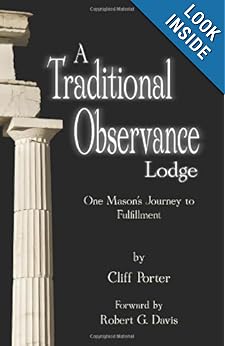
A Traditional Observance Lodge

W:. Bro. Cliff Porter has published another book. This one "A Traditional Observance Lodge: One Mason's Journey to Fulfillment" is about his experiences, but it also "breaks down the various ceremonies with how-to advice and actual ceremonies, a discussion of the philosophies and traditions, etc." The book is given the following description:
The author's home lodge is different. They suffer from higher than 100% attendance, men wait periods of longer than a year to get initiated, they have never lost a single Entered Apprentice, they have nobody on the roles who is NPD or has been dropped for NPD. Men arrive on lodge days at 8:00 a.m. and are often reluctantly leaving for home near midnight or 2:00 a.m. Their dues are high by American standards, the background check is rigorous, and the initiations are solemn and serious. Every lodge meeting is treated as an event and celebrated as such. Dinner is treated as a feast with all its positive connotations. Freemasonry is celebrated in every aspect of the lodge. From the artwork, the furnishings, the set up and the atmosphere; all aspects of the lodge meeting are intentional and meant to create an experience. The Lodge is a Traditional Observance Lodge or T.O. Lodge as it is called by some. Like all labels, the Traditional Observance label has caused fear and fright, anger and frustration, confusion, and edicts. It has also helped to define the practices that make the author's lodge one of the most successful lodges in the United States by any standard one might choose to measure it. This book does not claim to provide a Masonic magic pill for the ailing lodges of the world. Nor does it claim in any fashion or form that the way this author's lodge operates is the only way or the best way to operate. What this book does is explain the the Traditional Observance model and encourages ideas in the area of increasing the lodge experience and allowing quality to become the watchword over every aspect of Freemasonry. The writings contains a mixture of personal experiences, practical advice, and real life examples for creating a Traditional Observance lodge or increasing your lodges fulfillment.
You can find this book on Amazon and will eventually be on Kindle. I suggest this book as it appears to be a great resource for the Lodge, but can easily be adopted for all of the various orders of Freemasonry.

Friday, December 21, 2012

Freemasonry & the Founding of the United States

When discussing the Founding of the United States of America and the influence of those who were members of the Masonic fraternity one may hear that all the Founding Fathers were Masons and that America is just one Masonic experiment. Well, when I was approached to speak at a local school on the subject of Masonry in American history, and I decided I would research and present on the subject on those men who were Masons and their influence during the Revolutionary War.

The following images are taken from the PowerPoint presentation I created:


Freemasonry is composed of three degrees that one progresses through and which imparts lessons of morality and virtue.  These lessons are illustrated by a number of symbols. When one becomes a Master Mason, they are capable of joining several different concordant and appendant bodies.

One of the early milestones in Masonic history occurred on St. John the Baptist’s Day (24 June), 1717, when four Lodges came together at the Goose & Gridiron Ale House in St. Paul’s churchyard and formed what they called the Grand Lodge of England. Freemasonry had existed long before the establishment of this first Grand Lodge, but this would lead to the formalization of ritual and the expansion of the Fraternity around the world.

Freemasonry came to the American colonies from England, Ireland, and Scotland via the British military around the 1730s, but there are discrepancies of where it first occurred as there doesn't exist many records from that time.

According to Ben Franklin's Gazette on December 8th, 1730, "there are several Lodges of Freemasons erected in this Province." Contradictory to this we see that in 1733 Henry Price, Provincial Grand Master over all of North America for the London-based Grand Lodge granted a charter to a group of Boston Freemasons.  This Lodge was later named St. John's Lodge and is said to be the first duly constituted Lodge in the colonies.

Everett Turn and Ray Denslow summarize the foggy history of the Masonic fraternity with the following quote:
The story of today is a history of tomorrow. When that story is written there is sufficient information to make a history. Where it is not written, then much must be supplied by our imagination. Such is the condition in which your committee found itself when they started to prepare this. Our Masonic ancestors, whether through indolence, or a fear of making public their secrets, failed to leave sufficient records whereby the true story of Freemasonry could ever be written.
Here is my depiction of the degrees and orders within the Masonic fraternity:


The Masonic family is truly a complicated system that composes what I consider the "tree of Masonry". This illustration doesn't even show the system of governance of each of the Masonic bodies.

Although not tied to the Founding of the United States, here is a list of those Freemasons who have also served as the President of the USA:


As we can see Truman was a very active Freemason.  While President, he served as the Worshipful Master of the Missouri Lodge of Research for several years.  When he passed away he was buried with Masonic rites in Independence, MO, in a televised ceremony. I find it ironic that the 33rd President would be a 33° Scottish Rite Mason.


It is curious to note that Garfield only went through the 14° within the Scottish Rite.


It is interesting to note that Johnson received the Scottish Rite degrees while in the White House.


A Major General in the War of 1812, Jackson became a national hero when he defeated the British at New Orleans.


There is no record of his taking any further degrees, but the records of Cumberland Lodge No.8 in Tennessee on June 8th, 1819, show a reception for Monroe as "a Brother of the Craft." It's believed that he was Raised to the Sublime Degree of Master Mason in 1776.


While President, he would act as Grand Master in leveling the cornerstone of the US Capitol in Washington DC on September 18th, 1793.

Below I will list those Freemasons who were involved in particular aspects of Freemasonry and, while each one of them has its own story, I will only be expounding upon a few of them.


William Ellery, from Newport, RI, was a signer of both the Declaration of Independence and the Articles of Confederation. After graduating with honors from Harvard College, he tried a number of careers before deciding to study law. He left his thriving practice to join the Sons of Liberty and was elected to the Congress each year until 1786. When signing the Declaration of Independence, he is quoted as saying the following:
I was determined to see how they all looked as they signed what might be their death warrant. I eyed each closely as he affixed his name to the document. Undaunted resolution was displayed in every countenance.
Even though he was considered a very influential member of Congress, William Ellery decided to retire early in 1786 and would accept an appointment, from President George Washington, to be a Collector of Customs for the District of Newport which was a busy port.

It could take me all day to discuss Benjamin Franklin; he was an amazing man and Mason. He was a printer (where he published the first Masonic book to come off the press in the colonies which were "Anderson's Constitutions of 1723"), author, diplomat, philosopher, inventor,  scientist, and signer of both the Declaration of Independence and US Constitution. He is ranked among the most well-known and one of our country's greatest statesmen because of his contributions to the Revolutionary cause. He was also a devoted Mason and would serve as Grand Master of Pennsylvania.

John Hancock was the first signer of the Declaration and his famous large and stylish signature is remembered so much that the term "John Hancock" has become, in the US, a synonym for signature. He also served as President of the Continental Congress and served for nine terms as Governor of Massachusetts.

The son of Quakers, Joseph Hewes was born in Princeton, NJ. At the age of 30 he would move to North Carolina where he would be elected to the legislature after only residing in that colony for 3-years. He would be later be elected to serve as a representative to the Continental Congress in 1774. In 1776, he was appointed as Secretary of Naval Affairs Committee. It is said that he laid the foundation and cornerstone for the American Navy since he was faced with such a daunting task. Hewes was given essentially a "ragtag" and ill-equipped navy which would eventually have to face the British Naval might. To fix this, he spent a great deal of his own money to provide an extensive fleet of ships that were outfitted and properly equipped. He also had the duty of choosing those who would captain the ships and John Paul Jones, who will be talked about later, was among those chosen.

Joseph Hewes is quoted as saying, "…if our Situation was ten times worse I would not agree to give up our cause.”

In 1779 he finally served his last few months in the Congress and on November 10, 1779, he died just before his fiftieth birthday. He was buried with Masonic rites.

Richard Stockton has an interesting yet sad story. He would serve the colonies as a lawyer, jurist, congressman, and signer of the Declaration of Independence. He was one of the founders of the College of New Jersey at Princeton (what is now Princeton University). In 1776, Richard Stockton was elected to the 2nd Continental Congress and was the first person from New Jersey to sign the Declaration of Independence. He was appointed by the Congress to go to the north to Fort Ticonderoga, Saratoga, and Albany to assist the Continental Army. After surviving this exhausting journey he sought to return to Princeton. On his way down he traveled 30-miles east to the home of John Covenhoven, a friend, to assist in evacuating his family to safety and out of the way of the British Army. On the night of November 30th, 1776, in the midst of the evacuation from the home, he and his friend were captured by loyalists and taken to Perth Amboy to be turned over to the British. Stockton, and all the other prisoners, was offered a pardon for their treason if they would sign papers that stated they would be willing to remain in peaceable obedience to the King. Many signed, but Stockton refused. While at Perth Amboy he was brutally beaten, starved, and subjected to freezing cold weather. The mistreatment of men such as Stockton prompted the Continental Congress to pass a resolution directing General Washington to inquire into the circumstances, and not long afterward Stockton was paroled in the winter of 1777 (after nearly 5-weeks of abuse). As he had signed a parole document to gain his freedom, he resigned from Congress as he promised to not further meddle in the war. It took nearly 2-years for his health to improve, but he was never the same.  When his health permitted he earned a living by practicing law and teaching new students. He would in that time also develop cancer in his lip that would spread to his throat, and he lived in pain until his death on February 28th, 1781. His funeral was held at Nassau Hall, where it is said a large audience was composed of citizens, friends, family, and students of the college. The eulogy was delivered by the Reverend Doctor Samuel Smith, Vice President of the College, where he said the following:
The remains of a man who hath been long among the foremost of his country, for power, for wisdom, and for fortune; and who, if what honors this young country can bestow, if many and great personal talents, could save man from the grave, would not thus have been lamented here by you. Behold here 'the end of all perfection.' The office of a judge of the province, was never filled with more integrity and learning than it was by him, for several years before the revolution. Since that period, he hath represented New-Jersey in the congress of the United States. But a declining health, and a constitution worn out with application and with service, obliged him, shortly after, to retire from the line of public duty, and hath at length dismissed him from the world.
Richard Stockton and his wife, Annis, were close friends of General George Washington. After Stockton's death, Annis, one of America's first published female poets and became a favorite correspondent of General Washington. Washington and his wife, Martha, were frequent visitors to Morven, the Stockton home.

Born in 1730 in Maine, William Whipple owned a mercantile business in New Hampshire, served in the Continental Congress, and was a Brigadier General in the New Hampshire militia.  He is most remembered for his service during the Battles of Stillwater and Saratoga, where he arranged the surrender of General Burgoyne.  He served in Congress until 1782 at which time he was appointed Judge of the Superior Court in New Hampshire.


Gunning Bedford, Jr. was a lawyer and politician from Wilmington, Delaware. He served in Delaware General Assembly, in the Continental Congress as a representative from Delaware, and as a delegate to the US Constitutional Convention of 1787. He is often confused with his cousin, Gunning Bedford, Sr. an officer in the Continental Army during the American Revolution and Governor of Delaware. At the Constitutional Convention, he was a staunch supporter of giving small states equal power to the large states in the Federal government. His experience in local politics, along with his service in the Continental Congress, taught him much about the political and economic vulnerabilities of states like Delaware. Even though he sought equality among representation he was not one who wanted an extremely strong central government, but rather wished for a government with limited powers. On September 24th, 1789, the Judiciary Act was signed that further defined the judiciary branch as laid out in the Constitution. On this same day, Bedford was nominated by President Washington to serve as the first judge for the US District Court of Delaware. He was confirmed by the Senate 2-days later and served in that position until his death. In Freemasonry, Bedford served as the first Grand Master of the Grand Lodge of Delaware.

John Blair is remembered as a US Supreme Court Justice and member of the Constitutional Convention. He was a famous legal scholar who seems to have avoided dealing with state politics and preferred to remain behind the scenes. He is not remembered so much for his contributions at the Constitutional Convention, but rather for his time as a jurist on the Virginia Court of Appeals and later on the US Supreme Court, where he influenced the interpretation of the Constitution in a number of important decisions such as Chisholm v. Georgia (1793), which held that a state could be sued in federal court even if it objected to the suit. The outcry at this opinion led to the adoption of the Eleventh Amendment in 1798. Blair resigned from the Supreme Court on October 25th, 1795, and died in Williamsburg in 1800. In Freemasonry, he was unanimously elected as the first Grand Master of the Grand Lodge of Virginia.

David Brearley was an avid Revolutionary who spoke out, for many years, against the British Parliament.  He was eventually arrested for high treason, but was rescued by a group of fellow Patriots. He served as a Colonel in the New Jersey militia where he saw action at Brandywine, Germantown, and Monmouth. In 1779, he resigned from military life to serve as Chief Justice of the New Jersey Supreme Court. He decided on the famous Holmes v. Walton case where he ruled that the judiciary had the authority to declare whether laws were unconstitutional or not. He held the seat until 1789. At the Convention, Brearly opposed proportional representation of the states and favored one vote for each of them in Congress. While at the Constitutional Convention in 1787, he chaired the Committee on Postponed Parts, which played a substantial role in shaping the final document. As for Freemasonry, Brearley was the first Grand Master of the Grand Lodge of New Jersey. 

Daniel Carroll was a member of the Continental Congress from 1780-1784 and a delegate to the convention that framed the US Constitution. Carroll was also a representative in the First Congress in 1789-1791. President George Washington appointed him commissioner for surveying the District of Columbia in 1791, which he served until 1795. He was a cousin of Charles Carroll, signer of the Declaration of Independence. Daniel Carroll was one of only five men to sign both the Articles of Confederation and the Constitution of the United States. He was a prominent member of one of the United States' great colonial Catholic families, whose members included his younger brother Archbishop John Carroll, the first Catholic bishop in the United States and founder of Georgetown University. Carroll was a planter who supported the cause of American independence, risking his social and economic position for the Patriot cause. As a friend and staunch ally of George Washington, he worked for a strong central government that could secure the achievements and fulfills the hopes of the Revolution. Carroll was convinced that a strong central government was needed to regulate commerce among the states and with other nations. Carroll also fought in the Convention for a government responsible directly to the people of the country. He wanted governmental power vested in the people, and he quaffed James Wilson on his career and campaigning for popular sovereignty. When it was suggested that the President should be elected by the Congress, Carroll, seconded by Wilson, moved that the words "by the legislature" be replaced with "by the people“. He and Thomas Fitzsimons were the only Roman Catholics to sign the Constitution, a symbol of the advance of religious freedom in America during the Revolutionary period.

Jonathan Dayton was the youngest person to sign the US Constitution and was a member of the US House of Representatives (where he served as the Fourth Speaker of the House), and also served as a Senator. He was arrested in 1807 on the charge of treason in connection with Aaron Burr's conspiracy. Although he never went to trial his political career was over. Dayton was a graduate of what would become Princeton University in 1776 and immediately join the Continental Army where he was most notably at the Siege of Yorktown as a Captain. After his military career, he practiced law and was active in politics.  He was also involved with land speculation and he owned a huge tract of land in what is now known as Ohio.

John Dickinson was an American lawyer and politician from Philadelphia, Pennsylvania, and Wilmington, Delaware. He was a militia officer during the American Revolution, a Continental Congressman from Pennsylvania and Delaware, a delegate to the U.S. Constitutional Convention of 1787, President of Delaware Supreme Executive Council, and President of Pennsylvania. Dickinson was among the wealthiest men in the British American colonies and he was appointed to represent Delaware at the Annapolis Convention, where he served as its President. In 1787, Delaware sent him as one of its delegates to the Constitutional Convention of 1787 where he supported the effort to create a strong central government, but only after the Great Compromise assured that each state, regardless of size, would have an equal vote in the future United States Senate. Following the Convention, he promoted the resulting Constitution in a series of nine essays, written under the pen name, Fabius.

A graduate of Harvard, Rufus King, was a Captain and appointed Aide-de-Camp to General Glover of Massachusetts, and he served in this position through July 1782. King’s knowledge, bearing, and oratorical skills soon launched him on a political career. From 1783 to 1785, he was a member of the Massachusetts legislature, after which that body sent him to the Continental Congress. There, he gained a reputation as a brilliant speaker and an early opponent of slavery.  He was elected to the legislature (1789-90), and in the former year was picked as one of the state’s first US Senators. In 1791, King became one of the directors of the First Bank of the United States. Reelected to the U.S. Senate in 1795; he served only a year before he was appointed as Minister to Great Britain. He then returned to the US in 1803 and retired to his estate “King Manor” on Long Island where, like George Washington before him, he devoted himself to agricultural pursuits. During the War of 1812, he was again elected to the US Senate. In 1825, President John Quincy Adams again appointed him to become Minister to Great Britain, but King’s health deteriorated, and he had to return within a year. Shortly thereafter, in 1827, he died at his beloved estate on Long Island.

James McHenry was a surgeon in the American Revolution and a private secretary to Generals Washington and Lafayette. Fort McHenry in Maryland, where the "Star-Spangled Banner“ comes from, was named after this US Secretary of War.

William Paterson was a New Jersey statesman, a signer of the U.S. Constitution, and Associate Justice of the United States Supreme Court, and served as the 2nd governor of New Jersey. He entered the College of New Jersey (now Princeton University) at age 14. After graduation, he studied law with the prominent lawyer Richard Stockton. After Independence, Paterson was appointed as the first Attorney General of New Jersey, serving from 1776 to 1783. He was sent to the Constitutional Convention in Philadelphia where he proposed the New Jersey Plan for a unicameral legislative body with equal representation from each state which was struck down and later replaced with the Great Compromise that established a bicameral legislative body. As a member of the Senate Judiciary Committee, he played an important role in drafting the Judiciary Act of 1789 that established the federal court system. The first nine sections of this very important law are in his handwriting. George Washington nominated Paterson for the Supreme Court on February 27, 1793. The nomination was withdrawn by the President the following day since Washington had realized that since the law creating the Supreme Court had been passed during Paterson's current term as a Senator, the nomination was a violation of Article I, Section 6 of the Constitution. Washington re-nominated Paterson to the Court on March 4, 1793, after his term as Senator had expired. He was immediately confirmed by the Senate and received his commission.

We again come to George Washington who led the Continental Army during the Revolution.  His leadership was crucial during the early years that established the "tone" for the newly established nation.

The best way to describe him comes from the George Washington Masonic Memorial website where it says:
In Masonic terms, he remained "a just and upright Mason" and became a true Master Mason. Washington was, in Masonic terms, a “living stone” who became the cornerstone of American civilization. He remains the milestone others civilizations follow into liberty and equality. He is Freemasonry's “perfect ashlar” upon which countless Master Masons gauge their labors in their own Lodges and in their own communities.
One of my favorite quotes of Washington came during an address to a Rhode Island Synagogue where he stated:
It is now no more that toleration is spoken of as if it was the indulgence of one class of people that another enjoyed the exercise of their inherent natural rights. For happily, the government of the United States, which gives to bigotry no sanction, to persecution no assistance, requires only that they who live under its protection should demean themselves as good citizens...

While you cannot excuse what the traitor Benedict Arnold did, you can't help, but feel sorry for some of the problems he faced. Often it is ignored that Arnold was among the greatest of military men fighting on the side of the Revolution and without whose service, the 'patriots' might have easily lost their lives. He was one of several leaders during the American Revolution who were whipsawed back and forth by political intrigue and infighting, causing him to be both hurt and resentful at the manner in which he was treated. At times a hero and at times totally shunned such as when his contributions at the capture of Fort Ticonderoga were marginalized, Arnold ultimately decided that the 'cause' for which American patriots were fighting was wrong and he defected to the side of the British, while in command of West Point. In so doing, he actually became a hero for the British resulting from his military actions in Canada. His later life was filled with problems and from the side of the American, Arnold "did the wrong thing". His military actions, however, were executed in a way as to save many lives and it is because "victors write history" that he is now regarded as an arch-villain by Americans.

James Clinton was an American Revolutionary War officer who obtained the rank of Major General.  He was born in the colony of New York, in a location now part of Orange County. He was the brother of George Clinton, who was governor of New York from 1777 to 1795 and US Vice President from 1805 to 1812. James Clinton's wife was Mary DeWitt, daughter of an old Dutch family, and his second son was DeWitt Clinton, later Governor of New York. In 1776, Clinton took command of the 2nd New York Regiment and, later that year, was promoted to Brigadier General in the Continental Army. He served most of the war in the Northern Department, along the New York frontier. He participated in a successful effort to prevent British General Sir Henry Clinton from rescuing General John Burgoyne at Saratoga, but he and his troops were unable to hold Forts Clinton and Montgomery.

Mordecai Gist, a resident of Baltimore, ran a successful shipping business. In 1775, he took part in organizing the Baltimore Independent Company of Militia which, in 1776, was part of the contingent sent to help Washington in New York where they played a crucial role in delaying the British at the Battle of Brooklyn Heights. In 1780 there was a Convention of Military Lodges at Morristown, NJ. Gist attended it and was elected as its President. One of the resolutions that were proposed during this assembly was to establish an American Grand Lodge with George Washington as the Supreme Grand Master, although this was unsuccessful. Gist became Worshipful Master of the Maryland Military Lodge whose records were captured by the British at the Battle of Camden, South Carolina. However, these records were later returned to Gist by Lord Cornwallis, himself a Mason, who surrendered at the Siege of Yorktown.

Nathanael Greene was a Major General of the Continental Army. When the war began, Greene was a private in the militia. He would emerge from the Revolutionary War with a reputation as George Washington's most gifted and dependable officer. Many places in the United States are named for him. Greene took part in Battles in Boston, New York, Philadelphia,  and Rhode Island. He was given power over the entire Southern Army where he split the Army, and retreated into the woods, and gained victory over the British at Kings Mountain and Cowpens. Greene headed North crossed the Dan River to put a barrier between his Army and Lord Cornwallis. Once the split Army was reunited, Greene and the main army re-crossed the Dan River into North Carolina.  Greene then pursued Cornwallis and gave battle on March 15, 1781, at the Battle of Guilford Court House in North Carolina. At the height of the battle as the Continentals started to turn the British flank, Cornwallis ordered his artillery to fire grapeshot into the thick of the battle killing as many of his own men as Greene's. Three days after this battle, with his army battered and exhausted, Cornwallis withdrew toward Wilmington, North Carolina. Greene's generalship and judgment were again conspicuously illustrated in the next few weeks, in which he allowed Cornwallis to march north to Virginia and himself turned swiftly to the reconquering of the inner country of the Carolinas. Greene led the unsuccessful Siege of Ninety-Six, a village in South Carolina. These actions helped force the British to the coast. Greene's Southern Campaign showed remarkable strategic features such as the successful division, eluding and tiring of his opponent by long marches, and in actual conflict forcing the British to pay heavily for a temporary advantage. However, he was defeated in every pitched battle he fought against the British during his time as a southern commander. Greene suffered financial difficulties in the post-war years and died suddenly of sunstroke in 1786.

Henry Knox was a hero of the Revolutionary War and the first Secretary of War under the US Constitution. Knoxville, Tennessee, and the famous "Fort Knox" were named in his honor. He played an important role at one battle where he moved cannons to Dorchester Heights to help secure Boston from the British. British General Howe looked up at Dorchester Heights and remarked, "The rebels did more in one night than my whole army would have done in one month."

A Masonic lodge named in his honor was constituted on the gun deck of the USS Constitution ('Old Ironsides') in 1926.

John Peter Gabriel Muhlenburg was the son of Henry M. Muhlenburg, the founder of the Lutheran Church in America. He traveled to Germany to study theology and returned to the Colonies in 1766 to become a pastor of Lutheran Churches in New Jersey. He moved to Woodstock, Vermont, in 1772, but in accordance with the practice of the day, he was required to go to England to be ordained an Episcopal priest before he could collect tithes.

When he returned to America, he was assigned to an Episcopal parish in Virginia. A friend of George Washington and an ardent patriot, he became a Colonel in the Continental Army. He dramatically ended a famous sermon with these words: "There is a time for all things—a time to preach and a time to pray; but there is also a time to fight, and that time has now come.“ He quickly removed his clerical robes, revealing his Colonel's uniform, proceeded to the door, ordered drums to beat for recruits, and 300 members of his congregation responded. This group became the 8th Virginia Regiment or "German Regiment," and Bro. Muhlenburg successfully engaged in a number of battles. After the War, he returned to Pennsylvania to become a US Congressman and later was elected as a Senator, but never served.  He never served because he resigned to accept an appointment from President Jefferson as Supervisor of the Revenue for Pennsylvania and collector of customs at the port of Philadelphia.


Israel Putnam was a Massachusetts farmer who volunteered to serve in the French and Indian Wars. He was made a Mason by a British Army Lodge, he performed so well militarily that he was named to head the Connecticut Militia. He was captured by the Indians in a skirmish, but was rescued by French officers and eventually was released in a prisoner exchange. During the Revolutionary period, he heard there was fighting at Lexington and Concord. He left the field he was plowing, saddled his best horse, and joined Joseph Warren in Massachusetts. He was placed in charge of training the volunteers and was directly involved in the Battle of Bunker Hill. He was at Warren's side when Warren fell and was the only Major General to serve from the start to end of the Revolution. When he died in 1790, over 3,000 people attended his funeral in Brooklyn, Connecticut, a small rural town.

Rufus Putnam was a General who would be later referred to as the "Father of the Northwest Territory" and was the first Grand Master of Masons in Ohio.

John Stark was a frontiersman from New Hampshire and a veteran of the French and Indian War. In 1775, he was commissioned as a Colonel, fought at Bunker Hill, helped the fortifying of New York, and then joined General Gates in the Canadian Expedition. He returned to participate in the battles of Morristown and Short Hills. When he died in 1822, he was the last surviving General Officer of the Revolution

Friedrich Wilhelm August Heinrich Ferdinand von Steuben was a Prussian-born military officer who served as Inspector General and Major General of the Continental Army during the Revolutionary War. He is credited with teaching the Continental Army the essentials of military drills, tactics, and disciplines. He wrote the Drill Manual that served as the standard United States drill manual until the War of 1812.


William Davis is on the earliest records for receiving the “four steps” (Excellent, Super Excellent, Royal Arch, and Knight Templar) in St. Andrews Royal Arch Chapter. He owned an Apothecary shop on Prince Street near the Charles River Bridge in Boston. William Davis was very active in local politics, and from May to November 1776, he was a member of the Committee on Correspondence in charge of inspection and safety in the area. Military life must have fascinated him as well, for it was he who proposed the Barrel Defense used at the Battle of Bunker Hill on June 17th, 1775. This was a simple but effective defense and consisted of barrels filled with stones and earth rolled down on the attacking units.

Paul Revere was a silversmith, engraver, and Revolutionary hero who on April 18, 1775, made his famous ride to warn "The British are coming!" as celebrated in a poem by Longfellow. Paul Revere was a Grand Master of the Grand Lodge of Massachusetts and was another early recipient of the "four steps".

Joseph Warren was a noted physician and General during the Revolution. Led the troops in the Battle of Bunker Hill where he was killed. At the time of his death, he was serving as Grand Master of the Grand Lodge of Masons in Massachusetts.

John Paul Jones was a Scottish-born sailor and became a naval hero. He is considered the "Father of the US Navy". He later commanded Russian naval ships in their war against the Ottoman empire.

Charles Wilson Peale was an artist from Maryland who studied under the famous artist Benjamin West in England, perhaps becoming exposed there to other Masons who were forming an opposition to their colonial status. While back in Annapolis around 1774, he began his career as a portrait painter, but then volunteered for service in the Revolutionary War. He served as a Captain in the Battle of Trenton and Germantown before being elected to the Maryland State Legislature. As America's most accomplished formal portraitist, he was much in demand by the celebrities of that period and managed 14 sittings with George Washington, who was well known for limiting such imposition on his time  He also painted many other famous Freemasons, including, but not limited to John Hancock, Frederick von Steuben, and Ben Franklin.

Samuel Nicholas was a successful businessman from Philadelphia. On November 10, 1775, Congress commissioned him to organize and train five companies of Marine forces, skilled in the use of small and large firearms, to protect America's ships at sea. They demonstrated these capabilities and were successful in forays in the Bahamas where they captured a large number of military supplies sorely needed for the war effort. During the winter of 1776 and 1777, they provided reinforcements for Washington's Army, helped with the boats for crossing the Delaware River at Trenton, and fought in the Battle of Princeton. Though he never carried the title while he lived, Nicholas is considered the first Commandant of the Marine Corps. His achievements certainly exemplify the Marine motto Semper Fidelis.

Robert R. Livingston was a well-known New York lawyer, diplomat, and statesman. He served in the Second, Third, and Fourth Provincial Congress of New York from 1775 to 1777. He also served as a delegate from New York to the Continental Congress for the same years. Although he was a member of the Committee which drafted the Declaration of Independence, he did not sign the final document due to his absence in New York to attend a meeting of the Fourth New York Provincial Congress. He became the first Chancellor of the State of New York and, as such, he administered the oath of office to George Washington at the 1st Presidential inauguration in New York on April 30, 1790. He later became Minister to France and, in association with James Monroe in 1803, brought about a great bargain for the US...the Louisiana Purchase. He had broad interests and, after retiring in 1804, became involved in improving agriculture, such as introducing gypsum as a fertilizer  He was also instrumental in the development of the steamboat with Robert Fulton.

John Marshall was a lawyer who as a young man had little formal education, but read as much as he could before attending a 6-week course at William and Mary College, and then accepted to the bar. He joined the "Minute Men" after being inspired by Patrick Henry's memorable speech of "Give me Liberty or give me Death!" He enlisted alongside his father and they both served at battles at Great Bridge, Norfolk, Valley Forge, Brandywine, Monmouth, Germantown, Stony Point, and Yorktown. After his military career was done, Marshall returned to the House of Burgesses and served in the US House of Representatives and as US Secretary of State before becoming Chief Justice of the US Supreme Court. In this position, he ruled on fundamental legal decisions that have shaped our nation ever since. Some of these decisions include:
Marbury v Madison: Judicial review of laws enacted by the United States Congress
Dartmouth College v. Woodward: Settled the nature of public versus private charters and resulted in the rise of the American business corporation and the free American enterprise system
Cohens v Virginia: Supreme Court had jurisdiction to review state criminal proceedings
McCulloch v. Maryland: Addressed two questions: 1) whether Congress had the authority under the Constitution to commission a national bank, and 2) if so, whether the state of Maryland had the authority to tax a branch of the national bank operating within its borders
US v Hudson: Held that Congress must first enact a law criminalizing an activity, attach a penalty, and give the federal courts jurisdiction over the offense in order for the court to render a conviction
Barron v Baltimore: Bill of Rights restrained only the national government and not states and cities
James Jackson was an Englishman who immigrated to Georgia at the age of 15. He was placed with a prominent Georgian family and began reading the law at the Savannah firm of Samuel Farley, a Freemason. When the war came to Georgia, he already had demonstrated his strong belief in the cause and was instrumental in framing Georgia's first State Constitution.  He had enlisted early in the militia, and when the British took Georgia, he rose to the rank of Colonel in the Georgia militia with distinguished service in battles in Georgia, South Carolina, and North Carolina. When the British were forced from Savannah, at the young age of 25, he was assigned command of the city and eventually was promoted to Major General in the Georgia militia. After the war, he embarked on a political career as Governor, US Congressman, and US Senator. He died in Washington and is buried in the Congressional Cemetery.


When the first Grand Lodge was established in 1717, they did not create a Constitution and went without one for some time. Anderson's Constitutions were based on the old masonic manuscripts (also called "Gothic Constitutions") and on the General Regulations which had been compiled first by George Payne in 1720. This document was created to standardize the rituals and practices of Freemasonry among Lodges under the jurisdiction of the Grand Lodge. There would be a few more editions published later throughout the 18th century.

While Alice von Kannon is a very intelligent woman, I think there is much more to what influenced America than just Anderson's Constitution. This quote has actually prompted me to start researching Freemasonry, the Age of Enlightenment, and whether there is causation or correlation between the two.

Not necessarily a new concept, many today enjoy religious freedom in America.  Within Anderson's Constitution, Part 1 (Concerning God and Religion) of the Charges says the following:
…tis now thought more expedient only to oblige them to that Religion in which all Men agree, leaving their particular Opinions to themselves ; that is, to be good Men and true, or Men of Honour and Honesty, by whatever Denominations or Persuasions they may be distinguish’d...
In Part 4 (Of Masters, Wardens, Fellows, and Apprentices) and Part 5 (Of the Management of the Craft in working) of the Charges speaks of Constitutional governance and how those who are to lead are chosen. This excerpt from Part 4 I found particularly interesting:
Therefore no Master or Warden is chosen by Seniority, but for his Merit.
From Part 5, we see:
When a Fellow-Craftsman is chosen Warden of the Work under the Master, he shall be true both to Master and Fellows, shall carefully oversee the Work in the Master’s Absence to the Lord’s Profit ; and his Brethren shall obey him.
In Section 1 of the General Regulations speaks about the authority of the Grand Master and his Deputy. Section 2 dictates the authority of the Master of a Lodge, the duties of the Wardens, and ascension of command of the Lodge. Section 3 essentially establishes the Secretary with the following statement:
The Master of each particular Lodge, or one of the Wardens, or some other Brother by his Order, shall keep a Book containing their By-Laws, the Names of their Members, with a List of all the Lodges in Town, and the usual Times and Places of their forming, and all their Transactions that are proper to be written.
Section 12 of the General Regulations governs how many votes there are in Grand Lodge and Section 10 establishes Lodge representation by the following:
The Majority of every particular Lodge, when congregated, shall have the Privilege of giving Instructions to their Master and Wardens, before the assembling of the Grand Chapter, or Lodge at the three Quarterly Communications hereafter mention’d, and of the Annual Grand Lodge too; because their Master and Wardens are their Representatives, and are supposed to speak their Mind.
Part 6 of the Charges governs the Behavior of the Brethren and Section 1 (In the Lodge while Constituted) spells out specific judicial regulations and processes. Section 9 of the General Regulations speaks of how to deal with an unruly Brother.


Prince Hall was born around 1735 in Massachusetts. He was a tireless abolitionist, noted for his leadership in the free black community in Boston, and most notably as the founder of what is now known as Prince Hall Freemasonry. He wanted to gain a foothold for enslaved and free black men in crucial social spheres to include the military and Freemasonry. Hall formed the African Grand Lodge of North America. Prince Hall was unanimously elected its Grand Master and served until his death in 1807. He also lobbied tirelessly for education rights for black children and a back-to-Africa movement. Many historians regard Prince Hall as one of the more prominent African American leaders throughout the early period of the United States.

Prince Hall was enslaved to the tanner William Hall at age of 11 in Boston. Prince Hall may have become literate on his own, or through the direct help of his owner. Some New Englanders made a point of teaching slaves and Free Blacks to read and write. Documents in Massachusetts show that slave-owner William Hall freed a man named Prince Hall on April 9, 1765. Although this cannot be conclusively linked to any one individual as there exists a record of no fewer than 21 males named Prince Hall, and several other men named Prince Hall were living in Boston at that time.

After gaining his freedom, Hall urged the enlistment of both enslaved and freed blacks for the attempt to free the American colonies from British control. Hall was concerned with the development of the colonies if they gained independence. He was certain that the involvement of blacks in the construction of the new nation would be the first step toward complete freedom for all blacks.

On March 6th, 1775, Prince Hall and 14 men of color were made masons in Lodge No.441 of the Irish Registry attached to the 38th British Foot Infantry at Castle William Island in Boston Harbor, Massachusetts. It marked the first time that Black men were made masons in America under the banner of African Lodge No.1.

During the Revolutionary War, he served in the Continental Army and is believed to have fought at Bunker Hill. Despite the African Lodge's segregated status, Prince Hall Masonry was a bastion of abolitionism. Its leader affixed his name to some of the republic's earliest anti-slavery petitions in 1777 and 1778. As such, African Lodge No. 1 represented the first black-led abolitionist movement in American history.

In this connection, George W. Williams, historian, wrote in 1884:
That he saw hard service we know by the record of the two regiments he served in, always distinguished for steadiness and valor. Prince Hall was not only a good soldier, he was a statesman.
After the Revolutionary War ended, Prince Hall decided to approach England again. On March 2nd, 1784, he wrote a letter to William Moody, Worshipful Master of Brotherly Love Lodge No. 55 in London, England, stating that African Lodge had been in operation for 8-years and they had only "a Permit to walk on St. John’s Day and to bury their dead in manner and form" and he thought it "best to send to the Fountains from whence he received the Light for a Warrant.“ This warrant or charter was prepared but was not sent. Three years passed yet the payment for it had not been received in London. It seems that Prince Hall had sent it but it had not been delivered.

Finally, after careful consideration, he selected Captain James Scott, brother-in-law of Governor John Hancock of Massachusetts, a signer of the Declaration of Independence, to be his messenger. Captain Scott delivered the letter and the money and received a Charter.

Prince Hall acknowledged this receipt and added in this letter to England, "By the grace of God, I shall endeavor to fulfill all that is required of me in the Charter and I shall make the Constitution my guide." He added, "I hope we can adorn our profession as Masons." This Charter, under lock and key, is in the possession of the African Lodge of Massachusetts. 

Prince Hall died on December 4, 1807. The year following Prince Hall’s death, as a memorial to him, and by an act of the General Assembly of the Craft, the name was changed to the Prince Hall Grand Lodge of Massachusetts.

These last slides will cover 3 famous conspiracies surrounding the Freemasons during the Founding of the American nation.


Conspiracy theorists, whether anti-Masonic or not, assert that the Boston Tea Party was organized and carried out by the Freemasons. Is this true?

St. Andrew’s Lodge owned and met in the Green Dragon Tavern. St. Andrew's Lodge members included some well-known revolutionaries such as Paul Revere, John Hancock, and Joseph Warren.

On November 29th, the Tea Ship Dartmouth arrived which spurred the already riled Joseph Warren, leader of the Committee of Correspondence, to call a massive town hall meeting to discuss returning the tea to Britain. The minutes of St. Andrews Lodge for November 30th minutes state:
Lodge adjourned on account of the few Brothers present. Consignees of TEA took the Brethren’s time.
Then December 16th, the night of the Tea Party, came around, and the minutes of the Lodge state:
Present [5 officers]. Lodge closed on account of the few members in attendance, until to-morrow evening.
It should be pointed out that this tavern was home to such groups as the North End Caucus, the Sons of Liberty, and the Boston Committee of Correspondence, whose membership was composed of Masons and non-Masons. It is likely that members of the Lodge did take part in the Tea Party, but many non-Masons also took part and probably planned the event. The fact that the tavern was owned by the Mason is incidental. This event occurred at a time when the Colonists were tired of the British Crown's sudden interest in the affairs of the American colonies.

For too long the colonists lived relatively isolated from Great Britain and the Crown practiced essentially "salutary negligence" which forced the colonists to govern themselves. Until the time of the wars of the kings of France and England, the British Crown and Parliament never levied taxes upon the colonies.  Once the Crown was bankrupt it attempted to pull revenue from the colonies to reimburse the costs of war. Through various passed laws and colonist reactions, we see a handful of men send a powerful message to the Crown. This act would lead to the Coercive and Intolerable Acts that would further strip long-held colonist power and degrade the relationship that led to the Revolutionary War.


This conspiracy theory is my absolute favorite of the three. Conspiracy theorists allege that it was Masons who designed the street layout of Washington DC and in that design created intricate designs to create certain symbols. What are these symbols they say?  According to the theorist there are Satanic symbols placed in the street design which proves we Masons are really followers of Satan. I always get a good chuckle out of this when someone approaches me with this one.

Here are the facts. George Washington appointed Pierre Charles L'Enfant to design Washington DC, which was established in 1790 when an act of Congress authorized a federal district along the Potomac River and conveniently situated between the northern and southern states.

Thomas Jefferson had created a sketch of the city comprised of a square grid street system. L'Enfant took these designs further and applied radials upon them. From each of these radials stemmed streets that would shoot diagonally across the city intersecting the grid system. L'Enfant placed Congress on a high point with a commanding view of the Potomac, instead of reserving the grandest spot for the leader's palace as was customary in Europe, to display the American attitude of reserving the high point of the city for the Legislature whose duty it is to represent the People and the States. These wide boulevards stemming from the radials allowed for easy transportation across town and offered views of important buildings and common squares from great distances.

Eventually, L'Enfant's headstrong behavior earned him the ire of Washington, who fired him after one year of employment. According to the Encyclopedia Americana:
L'Enfant forged ahead regardless of his orders, the budget, or landowners with prior claims.
When he left the US, he took his designs with him. The duty of remaking the plans fell upon Andrew Ellicot and Benjamin Banneker (a freed black man). Banneker was able to recreate the plans in their entirety from memory.

Of all the men who dealt with the designs, of this future Seat of Government, was George Washington. Some have stated that L'Enfant was a Mason, but according to Brent Morris in his book, The Complete Idiot’s Guide to Freemasonry, stated:
Eager Freemasons with more enthusiasm than facts have claimed L’Enfant as a brother. It is unfortunate for them that there are no documents, either primary or secondary, showing L’Enfant was a Mason.
To counter this, Pierre F. de Ravel d’Esclapon, of New York, wrote an article called "The Masonic Career of Major Pierre Charles L’Enfant" who states there exist minutes of Holland Lodge in NY that show L'Enfant getting proposed and initiated, but makes no more further statements as to whether he made it to become a Master Mason. I find his article intriguing, but the evidence is circumstantial and muddies the water.  Even if he had been initiated, if he had not progressed any further he would not have been considered a full member nor entitled to the rights of membership. Regardless of his affiliation, he was fired and the designs remade from Banneker are what we see today.

The conspiracy theorist states that there exists an inverted pentagram (as seen in the picture above), but if you notice I have one line that is blue. I made that line blue because Rhode Island Ave NW doesn't go all the way through to K St NW.  Rhode Island Ave NW stops when it runs into Connecticut Ave NW. The pentagram is not complete.

Some also state that you can find the Square and Compasses (one of the most prominent Masonic symbols out there), but I'd like to point out that when you place a radial street system upon a grid system, you'll find the Square and Compasses. With an intricate crisscross of streets, you're bound to find various images. In fact, as you can see in the picture above, you can spell "JESUS" in the streets of Washington DC, but you don't hear anyone condemning it as some deviant scheme of the Christian faith.

I personally find this theory to be illogical and unfounded, but even faced with the facts some people will hold tight to their theories.


I saved this one for last as it is one of the most used theories from anti-Masons who speculate that the Masons created this seal to show our domination and control over the American nation and that we seek to establish the fabled "New World Order".

The first mention that the Great Seal was connected to the Freemasons came in 1884 when Harvard Professor Eliot Norton wrote that the reverse of the Great Seal of the US was a “dull emblem of a Masonic fraternity.” It seems the good Professor was a little lacking in knowledge and didn't have all the facts surrounding the creation.

The first committee charged with creating the Great Sea was established on July 4th, 1776, and was composed of Benjamin Franklin, Thomas Jefferson, and John Adams with Pierre du Simitiere as the artist. Ben Franklin was the only Freemason. Franklin  proposed a design a scene similar to Moses at the Red Sea with the Egyptian Pharoah being overwhelmed with the phrase “Resistance to Tyranny is Obedience to God.” Jefferson's proposal was Israel being led through the wilderness while Adam’s was of Hercules between the rugged path of Virtue and the flowery meadow of Sloth. These were all rejected.  Du Simitiere contributed much to the future design, such as “E Pluribus Unum”, the shield, the Eye of Providence in the radiant triangle.

The second committee was composed of James Lovell, John Morin Scott, and William Churchill Houston with the help of Francis Hopkinson (Signer of the Declaration of Independence, helped design the American flag, and designed many government seals). Hopkinson's first design had a shield with thirteen diagonal red and white stripes, supported on one side by a figure bearing an olive branch and representing peace, and on the other an Indian warrior (which later be replaced with a soldier) holding a bow and arrow, and holding a shiver. The crest was a radiant constellation of thirteen stars. The motto was "Bello vel pace paratus", meaning "prepared in war or in peace“ (a theme used later with the Eagle holding the olive branch and arrows). The reverse, in Hopkinson's words, was "Liberty is seated in a chair holding an olive branch and her staff is topped by a Liberty cap. The motto `Virtute perennis' means `Everlasting because of virtue.' The date in Roman numerals is 1776.“ From this committee, the following would be incorporated into the final design: the white and red stripes within a blue background for a shield, a radiant constellation of 13 stars, and an olive branch.

The third committee was composed of John Rutledge, Arthur Middleton, and Elias Boudinot with the help of William Barton (a heraldic expert). This time, the figures on each side of the shield were the "Genius of the American Confederated Republic" represented by a maiden, and on the other side an American warrior. At the top is an eagle and on the pillar in the shield is a "Phoenix in Flames". The mottos were "In Vindiciam Libertatis" (In Defense of Liberty) and "Virtus sola invicta" (Only virtue unconquered). On the reverse, there was used a pyramid of thirteen steps, with the radiant Eye of Providence overhead, and used the mottos "Deo Favente" (With God's Favor, or more literally, God Favoring) and "Perennis" (Everlasting). The pyramid had come from another Continental currency note designed in 1778 by Hopkinson, this time the $50 note, which had a nearly identical pyramid and the motto "Perennis". Barton had at first specified "on the Summit of it a Palm Tree, proper", with the explanation that "The Palm Tree, when burnt down to the very Root, naturally rises fairer than ever", but later crossed it out and replaced it with the Eye of Providence, taken from the first committee's design. Again, Congress rejected the submitted design. From this committee, the following would be incorporated into the final design: eagle and a pyramid of 13 steps.

The fourth and final committee was composed of only Charles Thomson, Secretary of the Congress, who took elements of the previous committees and added “Annuit Coeptis”, “Novus Ordo Seclorum” and finally came out with the design we have today. Charles Thomson had received classical training and worked as a Latin tutor at the Academy of Philadelphia.


So many theorists believe that "Novus Ordo Seclorum" translates into "New World Order" when in reality it translates to "New Order of the Ages" and America was. With assistance, we had trounced on one of the mightiest empires the world had seen in a long time. The country had limitless potential and we were establishing a "government of the people, by the people, for the people."

Some of the theories include the number 13 which many speculate is a very significant number with Freemasonry.  I've read about all sorts of elaborate measures taken to saturate the Great Seal with 13 because it correlates to something within Freemasonry, yet they always seem to dismiss the simple and obvious explanation of the original 13 colonies.

Many point out that because Freemasonry today uses the All-Seeing Eye as a symbol and that the Great Seal has the Eye of Providence above the pyramid that they must be connected. One thing I have learned in my research and time in Masonry is that symbols do not have a singular or exclusive meaning, interpretation, or use. While both interpret to represent God, the Divine, this doesn't constitute a direct connection or that the Masons are somehow involved with the design. Symbols for a long time were the preferred method of non-verbal communication as so many were illiterate.

Again, as I said above, even faced with the facts some people will hold tight to their theories.