Monday, April 8, 2013

History of York Rite Masonry in Idaho - Part II: Chivalric & Cryptic Masonry

Continuing from History of York Rite Masonry in Idaho - Part I: Royal arch Masonry, here is the history of Cryptic and Chivalric Masonry in Idaho

Instead of continuing this series by starting with the Cryptic Masons just as it is presented to a new initiate, I will be starting with the Knights Templars for reasons which will be explained below.

Templar Masonry

Though third-in-line of the York Rite bodies the Templar orders stand as second oldest of the York Rite bodies in Idaho (and in most of the US), but the Grand Commandery of Idaho sits as the oldest Grand body of the three York Rite organizations in Idaho.

There existed five Commanderies in Idaho before a Grand Commandery was formed. The first Commandery was given dispensation on May 24, 1882, and chartered as Idaho Commandery No.1 on September 11, 1882; 14-years after the first Royal Arch Chapter was established in Idaho. This Commandery existed just under 22-years prior to the formation of the Grand Commandery.

It would be nearly 9-years before the next Commandery was formed and on August 20, 1891, Lewiston Commandery No.2 was chartered. The third Commandery, Moscow Commandery No.3, was established on August 11, 1892. Gate City Commandery No.4 was the fourth Commandery that was chartered in Idaho and that occurred on August 29, 1895. The final Commandery to be chartered prior to the formation of the Grand Commandery was Coeur d'Alene Commandery No.5 and this occurred on August 4, 1904.

According to the Proceedings on August 31, 1904, Sir Knights from these five Commanderies met and organized the Grand Commandery of Knights Templar of the State of Idaho. Assembling in the Asylum of Idaho Commandery No.1 where the Eminent Commander, John McBirney, called a meeting to order and on motion, Sir Knight James A. Pinney was chosen as Chairman and J.O. Baker as Secretary. After reading the warrant issued by the Most Eminent Grand Master of the Grand Encampment, it was moved to form the Grand Commandery. Sir Knight James Pinney acted in place of the Most Eminent and filled the chairs and held the first elections where he was elected as the first Grand Commander. The officers were as follows:
George H. Olmstead, Deputy Grand Commander
Edward L. Ligget, Grand Generalissimo
John McBirney, Grand Captain General
Daniel W. Church, Grand Senior Warden
Hiram T. French, Grand Junior Warden
John D. McConkey, Grand Prelate
Charles Himrod, Grand Treasurer
J.O. Baker, Grand Recorder
Fred G. Rice, Grand Standard Bearer
I.C. Hattebaugh, Grand Sword Bearer
F.G. Boston, Grand Warder
N.W. Hawn, Grand Captain of the Guard (modern day Sentinel)
Those present were installed in their respective chair and those not present were by order of the Grand Commander to be installed in their respective Asylum. Sir Knight Robert B. Horrie as acting Grand Marshal, proclaimed the officers installed for the first Grand Conclave.

I am happy to say that the original 5 Commanderies are still in operation today. Idaho has never been a large state, our population today is just over 1.5-million people, and our Masonic membership has never been as large as some other states. As with many Masonic bodies across the US and globally, we saw a large decline in our membership and for a while, many Commanderies closed or came close to losing their charter, but in Idaho, a few Commanderies have stayed open due to the hard work of the Sir Knights. One such instance I recall was when a new Eminent Commander started attending my Commandery's meetings and practices, to observe and learn. To do this he had to drive 6-hours (one way) to do so, but in doing this he gained a stronger understanding of the ritual and Drill and Ceremony that he was able to revitalize his Commandery to keep it running.

Cryptic Masonry

The last body to form in Idaho was the Council of Cryptic Masons (or commonly referred to as a Council of Royal and Select Masters).

The first Council in Idaho, Idaho Council at Pocatello was issued a Dispensation by the Officers of the General Grand Council on December 15, 1896. This Dispensation was annulled on October 11, 1897, however. On January 24, 1912 the General Grand Council reissued a Dispensation to Idaho Council No.1 in Boise and chartered it on September 27, 1912. This Council existed 22-years prior to the formation of the Grand Council of the State of Idaho.

On August 31, 1916, Bannock Council No.2 was founded in Pocatello, 18-years prior to the establishment of the Grand Council. A third Council was established in the northern town of Coeur d'Alene who charter was arrested prior to the Grand Council formation. The fourth Council was King Solomon No.4 which was chartered in Payette on September 21, 1921. Meneleck Council No.5 was formed in Gooding on September 9th, 1924, but would later combine with Twin Falls Council No.7.

Cryptic Freemasonry came to Idaho due to the efforts of the Companions of Cyrus Chapter No.2, Royal Arch Masons, who requested that the Chapters in the Idaho Territory be empowered to confer the degrees of the Cryptic Rite and that the same was referred to the Committee on that subject.

Once these 4 Councils were formed they would eventually petition the General Grand Council, of Royal & Select Masters of the United States of America, and receive permission from the Most Puissant General Grand Master, Robert A Woods, to form the Grand Council of Idaho. This would happen upon the call from Companion William Wallin and the Companions assembled at the Hall of King Solomon Council No.4 in Payette, ID, on the 16th of May, 1934.

Companion Wallin was selected by those present to preside over the committee that would establish the Grand Council and Companion Frank Ensign was chosen to serve as Secretary. The meeting proceeded with all the formalities that were needed to form the Grand Council that would conform with the General Grand Council and with the consent of the constituent Councils. Elections were held and the following officers were elected to serve the first Grand Council:
William Wallin, Most Illustrious Grand Master
Albert E White, Right Illustrious Grand Deputy Master
John W Shore, Right Illustrious Grand Principle Conductor of the Work
Edward H Way, Illustrious Grand Treasurer
Frank G Ensign, Illustrious Grand Recorder
J Glover Eldridge, Illustrious Grand Chaplain
Albert W Stone, Illustrious Grand Captain of the Guard
Dell O Bellamy, Illustrious Grand Conductor of the Council
Edward CS Brainard, Illustrious Grand Steward
Jesse E Retherford, Illustrious Grand Sentinel
These officers were installed by Robert A. Woods, General Grand Master, and Albert A Jessup, Installing Grand Marshal.

Three of the four founding Councils are still in operation today. As I noted above, Meneleck Council No.5 would eventually merge into Twin Falls Council No.7 since it put too much strain on the membership to have 2 Councils exist in such close rural proximity and Twin Falls won out due to it being a regional hub.

It's interesting to note that York Rite Freemasonry has always been small in Idaho and that we see similar names appear across the bodies as we do today.

References

1. Denslow, R. V., & Turnbull, E. R. (1956). History of Royal Arch Masonry (Vol. 2). VA. 882

2. Freemasonry in Idaho. (n.d.). Retrieved from Eagle Rock Lodge No.19: http://www.eaglerock19.org/history.php

3. Hodson, J. M., Upton, W. H., Brown, J. W., & Hedges, C. (n.d.). Masonic History of the Northwest. Retrieved from Grand Lodge of Ohio: http://www.freemason.com/library/norwst01.htm

4. Idaho. (n.d.). Retrieved from Encyclopedia of Freemasonry: http://encyclopediaoffreemasonry.com/i/idaho/

5. Proceedings Grand Commandery of the State of Idaho. (1904-1910). Boise, ID, USA.

6. Proceedings of the Grand Council of Royal and Select Masters of the State of Idaho. (1934). Payette, ID, USA.

Tuesday, April 2, 2013

The Escallope Shell

Since I was invited to join the Commemorative Order of Saint Thomas of Acon I was interested in the particular logo, the Escallope Shell. Last Saturday I was initiated into this Order and I have researched much on this peculiar emblem.

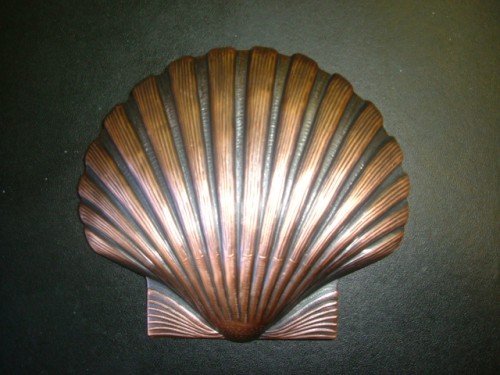
By definition, an escallope shell is a decoration in the form of a scallop shell. A scallop is a marine bivalve mollusk that has a radially ribbed shell with the edge undulated (as seen on the right). Shells, regardless of shape, are normally seen as a positive symbol and have been used throughout the history of man for various purposes.

According to Christian tradition, the scallop shell was an emblem of James the Greater and is a popularly used icon by pilgrims on the way to St. James shrine at Santiago de Compostela in Spain. The pilgrims would wear the scallop shell on their hat or clothing, as a mark of their pilgrimage, and later would become a symbol for any pilgrimage in general. One could also carry a scallop shell with and use it when asking for food as even the poorest should be able to afford to offer the pilgrim a scoop of food without burdening their own household so we see the shell emerge as a symbol of charity, even in the smallest way. The scallop shell is associated with this James as legend holds that a knight, or sometimes thought to be a bridegroom, fell into the ocean. Through the miraculous power of St. James (Santiago) the man emerged covered in scallops. To some pilgrims the shell's design symbolizes the many starting points from which medieval pilgrims may begin their journey and that all the roads, like the radial ribs on the shell, are drawn to a single point, the shrine of St. James.

Along with St. James the Greater, the scallop shell is also an emblem of his brother St. John the Evangelist, both of whom were early followers of St. John the Baptist and of Jesus Christ. Many early Christian artworks may show the Baptist pouring water from a scallop shell during Christ's baptism at the River Jordan.


The scallop shell is also a symbol of Baptism and one can also see that priests use scallop shell-shaped dishes to pour water over the heads of the catechumen. A catechumen is one receives instruction from a catechist in the principles of the Christian religion with a view to baptism.

Shells have long been used throughout history which shows that Stone Age people used seashells to adorn their jewelry, homes, and boats. In many cultures, shells were used as money or emblems of various pagan gods. In Roman mythology, shells were symbols of prosperity, regeneration, nurturing, and fertility for which reasons the shell is a representative of Venus, the goddess of love and fertility. Venus is said to be created from the foam carried ashore atop a scallop shell.


In the Order of St. Thomas of Acon, there are three types of escallope shells used to describe one's position: Bronze, Silver, and Gold. Those who wear Bronze shells are members or officers in the local Chapel. Those with Silver shells are Provincial Grand officers. Lastly, the Gold shells are worn by Grand officers. Each of these 3 metals has its own symbolic meaning. Like the symbolism of the shell, I will just cover the metal symbolism briefly as there are many avenues I could discuss with this subject.
Bronze: This metal is a dualistic symbol of human nature, wisdom, warfare, judgment, and humility.

Silver: Through its bright appearance this metal is emblematic of purity, truth, clarity, awareness, vision, and strength.


Gold: Considered the most precious metal, it represents divine nature, perfection, justice, power, strength, success, and immortality.
As Freemasons, let us remember that we start out as Bronze, malleable and impressionable, and through the tests of time, education, and with the guiding hand of God, may we be like the brilliant Silver that when the end of our days comes and we pass beyond the veil of mortality may we flourish in Golden immortality with Him who sits as Judge Supreme.

References

1. The Bronze Snake. (2010, September 27). Retrieved from The Honest Truth: http://verses10.blogspot.com/2010/09/bronze-snake.html

2. A Few Christian Symbols and Their Meanings. (n.d.). Retrieved from Hope Evangelical Lutheran Church: http://www.hope.evangelical-lutheran.ca/symbols.htm 

3. Biblical Symbol Chart. (n.d.). Retrieved from The Revelation of Jesus Christ: http://www.revelation-today.com/A1Bible%20Symbols.htm 

4. Cassaro, R. (2011, March 19). Occult Symbols in Corporate Logos, Pt. 1. Retrieved from RichardCassaro.com: http://www.richardcassaro.com/sinister-corporate-symbols 

5. Catechumen. (n.d.). Retrieved from Wikipedia: http://en.wikipedia.org/wiki/Catechumen 

6. Christa. (2010, December 20). Shells as Religious Symbols and the Meaning of Life. Retrieved from Christa's South Shorelines: http://www.csseashell.com/blog/shells-as-religious-symbols-and-the-meaning-of-life/ 

7. Christian Symbols. (n.d.). Retrieved from Fish Eaters: http://www.fisheaters.com/symbols.html 

8. Colours in the Bible: Bronze. (n.d.). Retrieved from Bible Basics: http://www.biblebasics.co.uk/colours/col6.htm 

9. Escallope Shell. (n.d.). Retrieved from Merriam-Webster Dictionary: http://www.merriam-webster.com/ 

10. Gold. (n.d.). Retrieved from Symbolism Wiki: http://symbolism.wikia.com/wiki/Gold 

11. Mary and the Scallop Shell. (n.d.). Retrieved from University of Dayton: http://campus.udayton.edu/mary/questions/yq2/yq273.html 

12. Metal Symbolism. (n.d.). Retrieved from The Metal Craft: http://www.themetalcraft.net/p/metal-symbolism.html 

13. Saunders, T. (2010, February 14). The Pilgrim's Scallop Shell: A symbol of love...? Retrieved from Pilgrimage to Heresy: http://pilgrimagetoheresy.blogspot.com/2010/02/pilgrims-scallop-shell-symbol-of-love.html 

14. Scallop Shell Symbolism. (n.d.). Retrieved from University of Texas at Austin: Digital Writing and Research Lab: http://www.cwrl.utexas.edu/~bump/images/arch/shells/Shellsymbolism.htm 

15. Scallop: Symbolism. (n.d.). Retrieved from Wikipedia: http://en.wikipedia.org/wiki/Scallop#Symbolism 

16. Seashell: Religion and Spirituality. (n.d.). Retrieved from Wikipedia: http://en.wikipedia.org/wiki/Seashell#Religion_and_spirituality 

17. Venefica, A. (2007, November 1). Symbolism of Silver. Retrieved from Symbolic Meanings: http://www.symbolic-meanings.com/2007/11/01/symbolism-of-silver/

Saturday, March 30, 2013

Initiation into St. Thomas of Acon

I was honored today to be initiated into Tahoma Chapel No.30 (3) of the Commemorative Order of St. Thomas of Acon. I was the exemplar candidate and am humbled by the experience.

I, along with the other newly initiated, watched as to how elections and installation occurs within the Order, and I wish to give my best to the newly installed Worthy Master and Eminent Prior. After the meeting, we had a nice dinner and some wine.

It was good to see all of my Brothers from Oregon and Washington, but I'm ready to relax. Now to finish some school work as Spring Break is coming to a close for me; luckily, I don't have to drive this time.


Earlier in the day, Tahoma College No.197 of the York Rite Sovereign College of North America met and it was the first time I ever visited another College. It was nice to sit on the sidelines. Just as we did in the St. Thomas meeting, we had the three heads of the Washington York Rite in attendance along with the Grand Governor of Washington.


Sunday, March 24, 2013

A Templar Weekend

Saturday I had the honor of conferring the entire Order of the Temple as Eminent Commander upon several new Sir Knights. Along with myself, my Generalisimmo and a Commander from Northern Idaho performed the 5th Libation.

In the Order of the Red Cross, I am the High Priest and, in the Order of Malta, I am the Captain General or Marshall, depending on if another Sir Knight is there or not. Last fall I had done the 5th Libation, but today was the first time that I conferred the Order of the Temple in its entirety and I'm glad I have that down now. This weekend was interesting as some of my officers and cast members are officers of the Grand Lodge, which was doing a Cornerstone dedication the same day so we had to move casts around to ensure we had all the parts covered, but the Sir Knights performed admirably, and I thank each of them for their hard work.

Today my Commandery held its annual Easter Observance. I again had David Triplett as my speaker and no surprise he gave an excellent presentation. I'd also like to thank Lorna Lowe, the Royal Grand Matron of the Grand Court of Idaho, Order of the Amaranth, for playing the piano. I had another great turnout by the Jobies and the DeMolay. After we cleaned up the room, a few of us went to a local brewery.

Now I'm ready for Spring Break and some relaxation.

Wednesday, March 20, 2013

The Supreme Family in Idaho

Idaho had the pleasure of hosting the Supreme Guardian, Miss International Job's Daughter, and Supreme Bethel Honored Queen while they came through Boise. At their request the 6-Bethels in the Treasure Valley area came together for joint meetings; three on Monday and three on Wednesday.

Monday night, Bethels No.6, No.29, and No.31 congregated at the Boise Masonic Temple. Bethel No.6 opened, Bethel No.29 (my Bethel) conducted the business portion to include presiding over the String of Pearl's ceremony, and Bethel No.31 closed using the Closing Cross formation with 30+ Daughters. The String of Pearl's ceremony is a special ceremony dedicated to Mother Mick, the founder of Job's Daughters.

Remarks were given by many, including myself, but the Supreme Guardian gave an amazing speech.

Tonight (Wednesday), Bethels No.5, No.8, and No.48 met at the Boise Scottish Rite Center. These Daughters and those who met on Monday did an amazing job and displayed the excellence of Job's Daughters in Idaho.

Saturday, March 16, 2013

Northwest Regional Assembly

What a great weekend this was! Friday I along with 3 other Knights Companions drove up to Kennewick, WA, to attend the Northwest Regional Assembly of Conclaves of the Red Cross of Constantine (RCC). The trip went well and was much quicker than last week's travel up to Olympia.

Last night we had a social hour and dinner, but it was this morning that I received the appendant orders of the RCC: Order of the Holy Sepulcher and Order of St. John the Evangelist. Both were amazing rituals and contained a great deal of symbolism that will give me plenty to research.

After the degrees were conferred a few of us went and sipped on some good Scotch, thank you Joe for that. I just finished with some more Scotch after the Banquet and now it's time for bed as we have an early start in the morning to head back to Boise.

Friday, March 15, 2013

Last Night I Knelt Where Hiram Knelt

By  Pat M. Armstrong

Last night I knelt where Hiram knelt
and took an obligation
today I'm closer to my God
and I'm a Master Mason

Tho' heretofore my fellow men
seemed each one like the other
today I search each one apart
I'm looking for my brother  

And as I feel his friendly grip
it fills my heart with pride
I know that while I'm on the square
that he is by my side

His footsteps on my errand go
if I should such require:
His prayers will lead in my behalf
if I should so desire

My words are safe within his breast
as though within my own
his hand forever at my back
to help me safely home

Good counsel whispers in my ear
and warns of any danger
By square and compass, Brother now!
Who once would call me stranger

I might have lived a moral life
and risen to distinction
Without my Brothers helping hand
and fellowship of Masons

But God, who knows how hard it is
to resist life's temptations
knows why I knelt where Hiram knelt
and took that obligation.

Saturday, March 9, 2013

Initiated into the Knight Masons

Well, today I was initiated into the Order of Knight Masons of the USA. The Order of Knight Masons is often referred to as the Green Degrees of Freemasonry.

There are currently no Knight Mason Councils in Idaho so I was invited to join Clontarf Council No.69 which is in Washington. Originally I was going to ride with the Brother who had nominated me, but he got sick so I decided to drive by myself up to Olympia. Most of the trip was fine until I was around The Dalles (about an hour East of Portland) when my battery light came on. I stopped by an O'Reilly's Auto shop and got a new battery. I thought all was well and good, but a few hours later when I was just South of Olympia the battery light came back on and my engine started acting funny so I pulled over. I tried to take off, but then my truck wouldn't shift up in gears so I pulled back over and shut off my engine. When I tried to turn it back on it acted like the battery was dead; I think the entire time it was a bad alternator. I was tired and irritated so I gave up and called for Roadside Assistance who towed me to my hotel. Part of me thinks I should have flown up to Seattle and taken a rental car down to Olympia.

This morning came too soon and one of the local Brothers and member of the Knight Masons came and picked me up. While preparations were being made for the ceremony and lunch, I sat around with the other four candidates present.

After lunch the degrees started where I was initiated into the 3-degrees, that of Knight of the Sword (communicated), Knight of the East, and Knight of the East & West. As I talked about in my post on the Knight Masons, these degrees surround the character Zerubbabel.


I'd like to thank the Excellent Chief and his officers for conferring these degrees on me. I enjoyed the ceremony and the fellowship. Now it's time for some dinner and to get my truck fixed.

Monday, March 4, 2013

Happy Sesquicentennial Idaho

Today marks the 150th anniversary of the creation of Idaho.

State leaders such as Governor C.L. "Butch" Otter are conducting a public ceremony right now at the Capitol building. This ceremony will kick off a year-long celebration for the Gem state.

According to State Historian Keith Peterson, President Lincoln signed the Act of Congress creating the Idaho territory after gold had been found and Congress wanted to use the gold to pay for costs associated with the Civil War. Idaho would be a territory for 27-years until President Benjamin Harrison signed the Congressional act establishing Idaho as the 43rd State on July 3rd, 1890. Both Lincoln and Harrison are commemorated in Idaho; Lincoln County and Harrison Boulevard in Boise.

Sunday, March 3, 2013

The Father of the Cryptic Rite

Jeremy Ladd-Cross is not as well-known as Thomas Smith-Webb, but played such a role in the combining and expansion of the Cryptic degrees that he is commonly referred to as the Father of the Cryptic Rite.

Cross was born in Haverhill, NH, on June 27th, 1783. As a boy, he moved to Portsmouth to become an apprentice to a journeyman hatter. Although he traveled quite a bit, he became a Mason in Portsmouth at St. John's Lodge in 1807. On November 1, 1813, he received from the Grand Lodge of New Hampshire a certificate qualifying him as a Lecturer in Masonic ritual. In this Lodge, he would serve as Junior Deacon before demitting.

On March 15, 1815, Cross was exalted as a Royal Arch mason in St. Albans, VT, which added to his repertoire of the degree he could teach and lecture on. Lecturers were known sometimes as degree peddlers as they would accumulate as many degrees as they could and in turn, would confer them freely. According to the General Grand Council, "Thus, one of the possible ways Cross obtained the Royal Master Degree was on August 5, 1815, when he was in Hopkinton, NH visiting the newly organized Tyrian Council of Royal Masters, which had received the degree from Benjamin Gleason, who had probably received the degree from Thomas Lowndes in New York City." Degree peddling though was an accepted practice in the 19th century and is one of the principal reasons Freemasonry expanded as the nation expanded in that time.

In 1816, he would move to Providence, RI, where he would become associated with Webb and later a pupil of Webb. Even though he did not have a formal education, he was known for his amazing memory and would become a great lecturer, particularly on Webb's work which is based on William Preston. Webb is most known by his famous monitor where he formed a uniform ritual that most jurisdictions practice today.

While traveling through Baltimore, he received the degree of Select Master from Philip Eckel who he had previously met in New York at a meeting of the General Grand Chapter of Royal Arch Masons. With this conferral, he then had the authority of conferring all the Capitular degrees as the Cryptic degrees were then usually controlled by the Chapter of Royal Arch Masons. After departing Maryland he leaves a trail of appearances in Pennsylvania, Tennessee, Kentucky, Ohio, Indiana, Mississippi, and Louisiana. By the Spring of 1817 though he was back in Baltimore and received from Eckel the authority to charter and officially organize Councils of Select Master. It was in New Haven, Connecticut, that he would affiliate with Hiram Lodge No.1 and later serve as Illustrious Master for Harmony Council for 8-years. He would then travel and establish Councils throughout New England while visiting the various states. It was thought that Cross stayed many years in Connecticut since this state was a beacon for Masonry during the time when Masonry lost favor in the fallout of the Morgan Affair.

The exact date that he started teaching both the degrees Royal Master and Select Master in a Council is not known, but there is an excerpt from his diary from March 21, 1818, that he conferred both degrees to Companions in Middletown, CT. He spent much of his time in Connecticut and established many Councils here and in October 1818, while at the Grand Chapter meeting, made the recommendation that the following year the Councils meet to form a Grand Council which would be established to govern and regulate the Councils and ritual under its jurisdiction. In Templar circles, 1818 was also an important year for Cross. In September he had visited Providence, was 'healed' in St. Johns Commandery and received the Order of Red Cross. In October he affiliated with Washington Commandery at a meeting in New London.

On May 18, 1819, twenty-two Companions met in Hartford, CT. The convention was called to order by Companion Talcott Wolcott, Illustrious Master of the Hartford Council, and Lyman Law (Grand High Priest of Connecticut) was selected as Chairman and John Gannett as Secretary to preside over the establishment of the Grand Council of Select Masters. The next day a Constitution was presented and adopted outlining the government of the organization, established the powers of the Grand Council, the duties of the Councils, and the regulation by which fees and new charters would be established. In one of its articles, it established that both the degrees of Royal and Select Masters would be covered by the fees of initiation. It should be noted that Cross was not recorded to be present at this assembly.

In his travels around September 1819, Cross came upon John Snow of Baltimore who he empowered to further establish Councils of Royal and Select Masters in Ohio, Kentucky, Indiana, and Illinois. Snow and Cross stayed good friends, and Cross wrote Snow asking him of his opinion on many Masonic matters. Aside from Snow, John Barker was another pupil of Cross, who moved to Charleston, SC, and further disseminated the Cryptic degrees in the South.

Cross is also noted for publishing, what he called the first True Masonic Chart as well as the Templar Chart in 1821. These charts did not print any secrets, but rather highlighted particular Biblical passages, symbols, and portions of the Lectures. This chart was extremely popular and used by Grand Lodges to ensure the constituent Lodges practiced a uniform ritual in a time that ritual work was chaotic. He became so busy with his charts and other Masonic furniture that he gave up most of his lecturing. He would eventually move north to New York then back to Haverhill where he would pass away as a bachelor on January 26, 1860. His gravestone memorializes him as a "Right Worshipful Grand Lecturer" and features an emblem of the 33rd degree of the Scottish Rite. It is not known exactly where he received the degrees of the Ancient and Accepted Scottish Rite, but it is believed to have occurred while in Connecticut and he was acknowledged by the Consistory in New Orleans.

References

1. Case, J. R. (1958). Jeremy Ladd Cross. Retrieved from Phoenix Masonry: http://www.phoenixmasonry.org/jeremy_ladd_cross.htm

2. Eppler, R. A. (2010). The Origin of the Cryptic Degrees - Part IV. (General Grand Council, Cryptic Masons International) Retrieved from The Cryptic Freemason: http://www.ggccmi.org/NewsletterArchive/2010-Winter-CFM-Web.pdf

3. Eppler, R. A. (2011). The Origin of the Cryptic Degrees - Part V. (General Grand Council, Cryptic Masons International) Retrieved from The Cryptic Freemason: http://www.ggccmi.org/NewsletterArchive/2011-Spring-CFM-Web.pdf

4. Snow, R. D. (1984, October 12). Notes On Jeremy Ladd Cross. Retrieved from New England Lodge No.4 of Ohio: http://www.newengland4.org/Documents/Jeremy%20Ladd%20Cross2.pdf