Friday, August 23, 2013

Sights and Places: Freemasons' Hall

It's been quite a while since I've posted anything from this series so I've come back with another example of beautiful architecture, the Freemasons' Hall in London, England. Its interior has been described as a "kaleidoscope of intensely-decorated corridors."


This building is located on Great Queen Street and serves as the headquarters of the United Grand Lodge of England as well as the principal meeting place for Masonic Lodges in London. The Grand Lodge has been located at this location since 1775, but this building is not the original and is in fact the third building.


In the early recorded years of Freemasonry, the Brethren didn't meet like we did today. Today most Lodges meet in buildings owned by the Masons and reserved strictly for their use, but in the early days this was not so. In the early years Lodges met either in private homes or in taverns where rooms could be rented out. Meeting in such public places required the transporting, and emplacing and displacing of Masonic paraphernalia. This led to the Brothers looking for establishing a permanent facility for Masonic use.

Although England leads Freemasonry with many firsts, the first Masonic building was actually built by French Freemasons in 1765 in Marseille. The first building in England was planned back in 1769 by the Premier Grand Lodge (Moderns) and after raising funds from its members purchased a plot of land on Great Queen Street. This site consisted of a tavern house fronting the street with a garden behind leading to a second house. Thomas Sandby won a competition to design the Freemasons' Hall which was built over the garden that linked the house and tavern. The newly built Freemasons' Hall is dedicated 23 May 1776, and was an important building, both for Masons and the public; as it was could be rented out for concerts, balls, and other such events for philanthropic societies such the Anti-Slavery Society and others.


In the 1820s, Sir John Soane, Grand Superintendent of Works, extensively remodeled the building. In the 1860s, Frederick Pepys Cockerell extended the building to the East and part of this façade still exists as part of the Connaught Rooms. In 1883 a fire damaged the building which would lead to its demolition and rebuilding in the 20th century.


In 1919 the Masonic Million Memorial Fund was established with the goal of rebuilding the Freemasons' Hall as a memorial those Masons who lost their lives on active service in WWI. 1925 was a busy year for the British Masons as the competition was launched and won by the partnership of Henry Victor Ashley and F. Winton Newman, but also the Most Worshipful Grand Master held a lunch where around 7,250 Brothers attended a lunch and raised over £825,000 for the building fund. The work on the building started in 1927 after the cornerstone laying on the 14th of July and continued into 1933, and stands as one of the finest examples Art Deco in England. On 19 July 1933 over 5,000 Masons congregated at the new Hall and the building was dedicated to Masonic service by the Grand Master, Prince Arthur, Duke of Connaught. It was originally known as the Masonic Peace Memorial, but was changed to Freemasons' Hall at the outbreak of WWII.


This building covers 2.25 acres and contains the Grand Temple, 21 Lodge rooms, a Library and Museum, various administrative offices, storage spaces, archives, and a Masonic shop. The Grand Temple is the meeting place for the Grand Lodge as well as the Grand Chapter (Royal Arch Masons), Provincial Grand Lodges, and other Masonic and non-Masonic organizations. Before one even enters the Grand Temple, he is met with an imposing set of Bronze doors, each weighing 1.25 tons that are decorated with scenes relating to the building of King Solomon's Temple. These doors lead into a room that is 123-ft long, 90-ft wide, and 62-ft high that can seat up to 1,700 people. Mosaic work covers the ceiling and in the corners there are depicted the Arms of Prince Arthur and the four cardinal virtues: Prudence, Temperance, Fortitude, and Justice. This room houses a large pipe organ that was built by Henry Willis & Sons, a leading British organ builder. This room is open to the public and is something to be seen on tours given throughout the Freemasons' Hall.


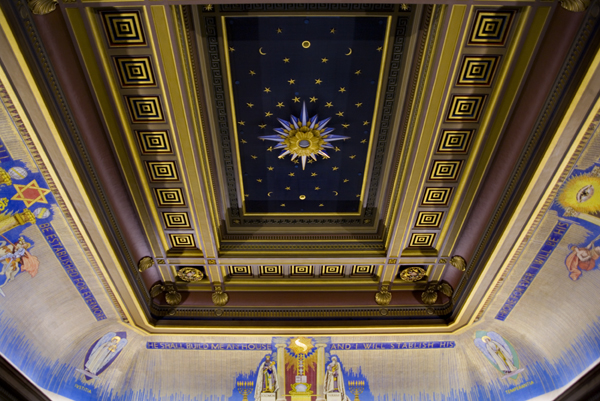


The numerous Lodge rooms are highly ornate and no two are identical in design. Some of the more notable rooms are Temples #1, #10, #17, and #23. Temple #1 contains portraits of former Grand Masters and can seat up to 600 people. Temple #10, located beneath the clock tower, is designed with a combination of classic Art Deco with Egyptian designs, and is home to an impressive domed ceiling. Temple #17 is very ornate with a large ante-room that is used by most ancient Lodges as well as 3 of the remaining 4 Lodges that founded the 1717 Grand Lodge. Temple #23 is the smallest of the Lodge rooms, allowing only 25 people to be seated, and contains portraits of former Grand Secretaries. There isn't too many labeled pictures to be found as the Lodge rooms are usually not for public tours as they are in constant use.


Also housed in this Hall is the Library and Museum of Freemasonry which is a library, archive and registered museum in central London covering Freemasonry. The Library and Museum is also a Charitable Trust that is registered with the Charity Commission. The Museum houses a collection of objects with Masonic designs and some of these items have belonged to famous Freemasons such as King Edward VII and Winston Churchill. The Museum also contains the most comprehensive collections of friendly societies (like the Oddfellows) material in the UK. The Library is located on the 1st floor of the Freemasons' Hall and is home to a very comprehensive collection of printed books and manuscripts over everything concerning Freemasonry in England, but also contains a great deal of material on Freemasonry, friendly societies, esoteric, and mystical traditions from around the world. This is also open to the general public during the hours of 10am-5pm (M-F).


Like the original Masonic Hall, the Freemasons' Hall is also used for public events such as concerts and musical events as well as filming for TV shows and movies.


This is definitely on one of one of the places I can't wait to visit. I think going here, I would outdo the amount of pictures taken versus my trips to Philly and Italy in 2011.

References

1. Freemasons' Hall. n.d. http://www.british-history.ac.uk/report.aspx?compid=74279. 

2. Freemasons' Hall, London. n.d. http://en.wikipedia.org/wiki/Freemasons'_Hall,_London. 

3. Freemasons’ Hall, London: A History. n.d. http://www.freemasonry.london.museum/resources/history-of-freemasons-hall/. 

4. History of Freemasons' Hall. n.d. http://www.ugle.org.uk/freemasons-hall/the-history-of-freemasons-hall. 

5. Ian. Freemasons Hall ~ an Art Deco masterpiece in central London. February 14, 2013. http://londonunveiled.com/2013/02/14/freemasons-hall/. 

6. Masonic Temple. n.d. http://en.wikipedia.org/wiki/Masonic_Temple. 

7. Tours of Freemasons’ Hall. n.d. http://www.freemasonry.london.museum/tours/. 

8. Wolff, Stephanie. The Freemasons Hall, home of The United Grand Lodge of England: Uncovering a few hidden treasures. November 18, 2010. http://londoninsight.wordpress.com/2010/11/18/freemasons-united-grand-lodge-england-london/.

Saturday, August 17, 2013

Goodbye Cabin

These last couple of weeks I've been busy with military training, but I must stop to make a sad announcement...to me at least. My father called me today to inform me that my family's cabin has burned down in the Elk Creek Complex Fire.


My grandfather built this cabin and it has become an icon of my family that has been a home away from home for 4 generations of my family. I have so many fond memories from this place and it saddens me to see that it could not be saved.


This cabin was a sanctuary for me. As a child I always looked forward to going to the cabin for the summer and, when I was old enough, to go hunting in the Fall for deer. This cabin rested on the hillside just a short distance from Anderson Ranch Dam (Fall Creek side) and in the summertime, we'd always take my grandfather's pontoon boat out on the reservoir for Kokane fishing. A short drive we could go find some amazing sites. After my first deployment to Iraq, the Cabin was one of the first places I visited after making it back to Idaho. My dad and I drove all night through a nice little snowstorm to make it there. We unpacked and I laid down and slept for 16-hours straight. This place was one of serenity. It echoed peace and tranquility, and I have so many wonderful memories of this place that I could write forever. The shortest thing to say is that it was a symbol of my childhood and now it's gone. All that remains is my memories.

From here I don't know what will happen to the property, but I hope my grandfather decides to keep it in the family so we can rebuild.


Thursday, August 15, 2013

The Mystic Art

By Sir Edward Bulwer-Lytton

The world may rail at Masonry, 
And scoff at Square and Line, 
We'll follow with complacency 
The Master's great Design. 

A King can make a gartered Knight, 
And breathe away another, 
But he, with all his skill and might, 
Can never make a Brother. 

This power alone, thou Mystic Art, 
Freemasonry, is thine; 
The power to tame the savage heart 
With brother-love divine!

Monday, August 5, 2013

Templar Symbols

I haven't posted an article on Templary, Masonic or Crusader, in a while so I thought I'd get one out. Like many organizations, the Templars were known to employ a variety of symbols for various purposes such as official seals, shield ornamentation, and gravestones, but there never existed a single symbol that was used during the entire existence of the medieval order.

The most common symbols used at various stages were the Red Cross, the Beauceant, Agnus Dei, and the image of two knights upon a single horse. Some lesser-known symbols that were used by the Provincial Masters included the star, dove, lion, crosses, and the fleurs-de-lis. Templar graves could be seen engraved with swords and the cavalry cross. At Chinon and Domme, where the Templars were imprisoned, there was seen graffiti carved into the walls, one such carving in Chinon was a hand with a heart superimposed on its palm.

The most popular symbol image associated with the medieval Knights Templar is the image of two knights upon one horse. This symbol was used by many Grand Masters as one of their seals with minor variations through the successive line of Grand Masters; starting around 1167 and lasting until around 1298. The official seal of the Grand Master was closely guarded in the Treasury under the protection of the Commander of the Kingdom of Jerusalem, and could only be accessed by a select few.

Like many things associated with the Templars, this symbol mystifies them and since their downfall, there have been many theories as to the meaning of it. Some military experts believe it is to emblematically represent what is seen today as the "buddy system" where soldiers, or knights in their case, would operate in pairs. Some believe this symbol goes back much farther to ancient Sumeria which was thought to represent a tactical device during battle, but also symbolic of duality and balance. This may be the reason the Templars adopted it, to represent their dual function as both warriors and monks. Others theorize that it originated with the birth and initial poverty of the Templar Order, but this would fly in the face of the Rule of the Order which established the number of horses allocated to knights (according to their rank and position) and which also prohibited the sharing of the same horse.

The next most prominent symbol for the Knights Templar is the Red Cross, which would have been emblazoned upon the mantle (color varied depending on class). The Red Cross was not an ornament of the Templars until 1147 when Pope Eugenius III granted them that privilege via papal bull. There was an exact design, but the most common cross used was the cross pattee (a variation of the Greek cross).

As I discussed in my articles "The Crown and the Cross" and "Crosses", the cross is an ancient symbol that long preceded its use by the Christian religion:
It has been found in ancient Africa, the Far East, Assyria, Phoenicia, India, Persia, Mesopotamia, Scandinavia, and Mesoamerica/Pre-Columbian America. To these ancient cultures, the cross represented the Sun or has been a symbol of Earth and nature with the number Four representing the Cardinal directions, the changing seasons, the four winds, the quarters of the moon, and the alchemical elements. Like the crown does, the cross may also emblematically represent the union of Heaven and Earth. The number four also reminds us of the Four Evangelists and their Gospels. By it are we reminded of time and the delineation of seasons, as it was on the Fourth Day that God put lights in the firmament to separate light from darkness, to mark days, and to outline the passing of seasons and time.
For the Templar, the red cross was a symbol of martyrdom to remind them of Christ.

Primarily found in England and parts of France, the Lamb of God (or Agnus Dei) was used on seals, but was not uniquely used by the Knights Templar. The Agnus Dei is often depicted as a haloed lamb cocking its leg so as to hold either a cross or flag, but there have been several variations since it first was used which was around 1241. Its origins are debated, like most symbols, but many believe that it started around the 9th Century AD since no evidence exists prior to that time of its use although this is contested as it was primarily used first in Rome and thus would most likely stem from some pagan use.

The Agnus Dei is symbolic of the martyred Christ and is referenced in the 29th Verse of the First Chapter of the Book of John wherein it is written "Behold the Lamb of God, which taketh away the sin of the world." In Masonry, we are reminded that the lamb has long been an emblem of innocence.

Another famous symbol would be the Beauceant which I discussed back in 2012. The Beauceant was the standard of the Knights Templar and still used by the Masonic Knights Templar. The Beauceant consisted of a black sec¬tion above a white one. The etymology of "Beauceant" is not known, an unknown pilgrim around the 12th or 13th century, while visiting Jerusalem, stated:
When they go to war, a standard of two colors called 'balzaus' is borne before them.
The colors of the Beauceant also remind us to be good and true to our friends and terrify the
enemies of Christ. The black section can also depict the sins of the secular world that the Templar knights had chosen to leave while the second section was white depicting the purity that the order offered them, a sort of transformation of darkness to light. To symbolize duality through the colors of black and white is quite ancient as most cultures see white and black as symbolic of good and evil. It has also been used as a comparison between the physical and spiritual world, male and female, and the sky and the earth.

The Beauceant was a rallying point during battles so they could easily regroup when separated. Knights were also not allowed to retreat or stop fighting while the Beauceant was flying. As the Beauceant was such an important symbol that the Marshall would select a group of Templars to protect it, to be led by the Confanonier, or Standard Bearer. The Standard Bearer is still an officer in the modern Masonic Templars and whose duty it is to protect the Standards of our Order. Historically the duties of the Standard Bearer included being the paymaster and ensuring the equipment (to include the horses) was kept in working order. It should be noted that although he was referred to as the Standard Bearer he never carried the banner, but led the procession which carried and protected it.

The Lion is a fairly obvious symbol for any Christian order as the lion is the king of the beasts so too is Christ the King of Kings. It was used as the sigil of the Tribe of Judah. It was used by warriors and noblemen alike as a symbol of their strength and authority. Symbolically the lion represents courage, valor, power, royalty, dignity, justice, wisdom, and ferocity. The lion while the ancients saw the lion as a "solar animal", but the lion is primarily a nocturnal hunter; with this, we see the lion as a symbol of balance between night and day, darkness and light. The Templars may have also chosen this symbol as a remembrance of those words spoken by their early champion, Bernard of Clairvaux, who described them as ferocious lions.

Found on some seals of the Templar Order, the Dove is a well-known Christian icon. The dove symbolizes peace as well as the Holy Spirit.

The Cavalry Cross, or Stepped Cross, is a Latin cross surmounted on a base of 3-steps. Cavalry is the Latin name of the Aramaic word, Golgotha, which we learn from Biblical history, is the place of a skull as there is a skull-like appearance on the hillside and it was the place where Christ was crucified. The 3-steps while were said to represent the hill, were also symbolic of the virtues: Faith, Hope, and Love (or Charity). Along with being used as gravestones, the places where Templars were imprisoned had Cavalry Crosses etched into the prison cells.

The Fleur-de-lis, or “lily flower”, is a stylized lily used as a decorative design or symbol. It was first used around the 11th century and then continued to spread in use throughout the Middle Ages. The lily from the retired state of its pedals symbolizes that it is a symbol of peace and purity, but is also said to symbolize light, faith, wisdom, and chivalry. In Christianity, the lily was said to represent the Virgin Mary and there appear many pieces of art with Mary carrying the lily. Some believe that the fleur-de-lis represents the Holy Trinity.

The carving of hands with a heart superimposed on a palm is a peculiar symbol found in the cells of Templars. This symbol is symbolic of charity as well as mercy. This symbol was also used by John Calvin and with it this motto: “My heart I offer to you LORD, promptly and sincerely." It has been used in recent times by such groups as the Shakers and the Odd Fellows.

When reading through the Knights Templar Encyclopedia by Karen Ralls, I came upon the entry of "Abraxas" which just had a quick note for the reader to go to the section on Symbols. As I perused that section it talked about that the symbol of Abraxas is displayed on "Templar Grand Master's seal in the Archives Nationales in Paris, which was used in a French charter in 1214." The seal displays a figure that is Chimera-like and portrays a male warrior with a roosters head, human arms, and snakes as legs, who carries a shield and a whip; and bears the words "Secretum Templi". This particular description of Abraxas was known as Anguipede which means "snake-foot". It is interesting to note that this seal was not used for particularly significant Templar documents, but can be found on ordinary, seemingly unimpressive, historical records like those dating from 1214.

Abraxas (Greek: ΑΒΡΑΞΑΣ) is a god written about in Gnostic texts and may also be known as Abrasax (as there is thought to have been a mistranslation from Greek to Latin). Carl Jung in his writings on the Seven Sermons to the Dead stated that Abraxas was a god higher than Jehovah. He is said to be the father of all things, "the power above all and the First Principle," and the ruler of 365 heavens. It is said that Abraxas created Nuos and Logos which led to Providence, Virtue, and Wisdom which gave rise to Principalities and Powers, and from "from these infinite productions and emissions of angels." It is these angels who govern the 365 heavens which were said to include the Judeo-Christian God, Jehovah, which followers of Basilides denied of being a god, but rather an angel. This obviously was not a very popular belief in the 2nd century and Basilides is considered a heretic and damned by many historical Roman Catholic figures.

Some have speculated that the imagery of the Anguipede represents emanations of this being which are as follows:
The human body is displayed as it is written that God created man in his own image. The snakes represent the two great supports of man given by God, Nous (mind, intellect) and Logos (reason and judgment). The cock (rooster), being the creature who traditionally greets the golden dawn, is an emblem of foresight and vigilance. He carries the shield of wisdom and the whip or flail is said to be the "whip of Helios" (Abraxas is associated with the Sun) which represents dynamism or strength/power.
No one knows the origins of Abraxas and the relics associated with him. Some believe that it originated with a man named Basilides (an Alexandrian mystic) in the 2nd Century AD, but even then it cannot be proven and is also hypothesized that it was transmitted to him from another source, yet unknown to us in modern times. Abraxas was also referred to as the Great Archon, the Lord Creator, Almighty God, and Greatest God.

Many have attempted to guess as to the reason the Templars would use such an image, but without proper records and evidence, it all falls into the realm of speculation. Historical writings and modern scholars have drawn parallels between Abraxas and Mithras of Persia as well as beliefs found in Hinduism. It is possible that the Templars were introduced to Abraxas through their time in the Middle East, but again, without hard evidence, we can only imagine. Although it is an interesting symbol, the use of this seal does not mean that the Templar Order was a Gnostic one.

There are many interesting symbols used by the ancient Templars. Some of these symbols are still seen or used today in Masonic orders that have similar names to commemorate the deeds of these great men. It is a tragedy that too little of the Templars remains for analysis and study. The symbols we know seem to resonate with their dual personality of being men of the cloth, of God, and being warriors feared on the battlefield. While not conclusive, it leads to a belief of influence by Gnostic and Eastern beliefs that the Templars may have encountered in their travels.

References

1. A Brief History of the Medieval Knights Templar. n.d. http://www.osmth.org/templar-legacy. 

2. Abraxas. n.d. http://en.wikipedia.org/wiki/Abraxas. 

3. Agnus Dei. n.d. http://www.newadvent.org/cathen/01220a.htm. 

4. Doves as Symbols. n.d. http://en.wikipedia.org/wiki/Doves_as_symbols. 

5. Fleur-de-lis. n.d. http://en.wikipedia.org/wiki/Fleur-de-lis. 

6. Fleur-de-lis. n.d. http://www.fleurdelis.com/symbolism_DEF.htm#Fleur. 

7. Fleur-de-lis Meaning. August 14, 2012. http://gnosticwarrior.com/fleur-de-lis-meaning.html. 

8. Heart in Hand. n.d. http://en.wikipedia.org/wiki/Heart_in_Hand. 

9. Heart in Hand. June 21, 2011. http://gravelyspeaking.com/2011/06/21/heart-in-hand/. 

10. "John 1:29." In Holy Bible, KJV. n.d. 

11. King, Charles W. The Abraxas Religion. 1887. http://www.sacred-texts.com/gno/gar/gar40.htm. 

12. Knights Templar. n.d. http://en.wikipedia.org/wiki/Knights_Templar. 

13. Knights Templar Seal. n.d. http://en.wikipedia.org/wiki/Knights_Templar_Seal. 

14. Lion as a Templar Symbol. n.d. http://knightstemplarvault.com/category/templar-symbols/. 

15. McMahon, Tony. Abraxas and the Templars. November 10, 2010. http://thetemplarknight.com/2010/11/10/abraxas-and-the-templars/. 

16. Napier, Gordon. Templar Symbolism. n.d. http://www.dashinvaine.co.uk/Templar%20Symbolism.htm. 

17. Newell, Barry. Banners of Royal Arch Masonry. October 10, 2012. http://www.travelingtemplar.com/2012/10/the-banners-of-royal-arch-masonry.html. 

18. Newell, Barry. Symbols of Royal Arch Masonry, Part 2. June 8, 2012. http://www.travelingtemplar.com/2012/06/symbols-of-royal-arch-masonry-part-2.html. 

19. Newell, Barry. The Crown and the Cross. September 9, 2012. http://www.travelingtemplar.com/2012/09/the-crown-and-cross.html. 

20. Ralls, Karen. Knights Templar Encyclopedia. Franklin Lakes, NJ: New Page books, 2007. 

21. Symbolic Meaning of Lions. n.d. http://www.whats-your-sign.com/symbolic-meaning-of-lions.html. 

22. The Calvary Cross. n.d. http://www.seiyaku.com/customs/crosses/calvary.html. 

23. The Chimera Androgyne: The Esoteric Mystique of Baphomet and Abraxas (Part 2). July 12, 2011. http://theaeoneye.wordpress.com/tag/abraxas/. 

24. The Templars & Gnosticism. n.d. http://www.templeofmysteries.com/the-knights-templar/the-templars-and-gnosticism/. 

25. Lamb of God. n.d. http://en.wikipedia.org/wiki/Lamb_of_God.

Wednesday, July 31, 2013

Going Dark

Well, folks, my Summer break was short as I took some Summer college courses. I enjoyed my break, but now it's time for my unit's Annual Training and I will be out in the field till the last half of August. I may get in a few articles this month, but they will be few and far between until after the middle of the month.

Sunday, July 28, 2013

Zabud

Like Adoniram, Zabud is an obscure character in Freemasonry and is one not seen in the Symbolic or Blue Lodge. Zabud is referenced in 1st Kings and, in Freemasonry, we are introduced to him in the Select Master degree of the American York Rite.

From the Bible, specifically 1 Kings 4:5, we learn that Zabud was the son of Nathan, the Prophet, and was said to be an officer of the court and a friend of King Solomon. Many speculate that through the love that Solomon had for Nathan that he honored Zabud with his friendship and place in his court. It is also most likely they were about the same age and would have grown up together at the court of King David.

The degree of Select Master takes reference from the Secret Vault discovered in the Royal Arch degree and concerns itself with how it was created. The Secret Vault was created by the three Grand Masters, with a select group of Masons, and connects the events and myths surrounding the loss and hope of the future discovery of the Master's Word through the deposition of the Grand Master's secrets. It is during this degree that the candidate representing Zabud stumbles upon the Secret Vault and is taken prisoner until he can prove he meant no offense by his actions and becomes one of the Select Masters in place of one who proved to be unworthy. The lessons of this degree are devotion, zeal, and overlooking the failings of those who through ignorance or curiosity may often overstep the bounds of propriety.

References

1. Holy Bible (KJV), 1 Kings 4:5

2. Mackey, Albert G. "Zabud." Encyclopedia of Freemasonry and it's Kindred Sciences. n.d. http://www.masonicdictionary.com/zabud.html.

3. Mackey, Albert G. "The Cryptic Rite." Encyclopedia of Freemasonry and it's Kindred Sciences. n.d. http://www.masonicdictionary.com/cryptic.html.

4. "What is Cryptic Masonry?" The Grand Council of Cryptic Masons of the State of New York. May 2010. http://www.nycryptic.org/education/what_is_cryptic_masonry.pdf.

Monday, July 15, 2013

The 1782 Congress of Wilhelmsbad

Throughout the history of Freemasonry, there have been gatherings and events that have had a large impact on the fraternity in general, specific Orders within the Fraternity, or due to the lack of documentation has lead to theories abound. The history of Freemasonry is a complex topic, not always because of one's ability or inability to comprehend the subject, but often due to the lack of recorded evidence to support or reject a hypothesis. When faced with incomplete information one may let their imagination wonder which can sometimes lead to far-fetched and exaggerated speculations. One such event that many Masons and anti-Masons have theorized about is the 1782 Congress of Wilhelmsbad; Albert Mackey refers to this Congress as "the most important Masonic Congress of the eighteenth century". To the Masons, this meeting marks the impending doom of Rite of Strict Observance and the rise of the Rectified Scottish Rite. To the anti-Mason and conspiracy theorists, this is the meeting where the Bavarian Illuminati is said to have infiltrated and taken over Freemasonry to enhance their nefarious agenda for global domination.

To discuss this matter we must stop for a moment and first discuss the early history of the Rite of Strict Observance.

The Legend of Pierre d'Audmont

According to Stephen Dafoe, Past Grand Historian of the Sovereign Great Priory of Canada, the legend of Pierre d’Audmont, a Templar continuation myth, is said to be the brainchild of the Rite of Strict Observance, which was largely promoted by Baron Karl Gotthelf von Hund, or more commonly referred to as Baron von Hund, in Germany between 1751 and 1754. The legend says that Pierre d’Aumont, the Preceptor of Auvergne, with a number of Knights Templar fled to Scotland disguised as Operative Masons. On arrival they created a new order to preserve the traditions of the soon to be disbanded Knights Templar. This new order they named Franc Maçons. This order would later be known as Free Masons when they traveled to England.

Truth is that the Preceptor of Auvergne was not Pierre d’Audmont, but rather Imbert Blanke who did indeed flee to England after dodging the arrests of 13 October 1307. He was there arrested and later played a role in defending his Brethren in the courts. Many Masonic scholars such as Stephen Dafoe point out the absurdity of this legend, particularly the etymology of the name of Freemason. Albert Mackey believes that it was through Ramsey’s Oration that this legend of Templar continuation was able to take hold, but dismisses it as rubbish having no “particle of historical evidence”. Although he does admit that this legend has had a large influence on the modern Masonic organization particularly with the incorporation of Templar Orders.

The Rite of Strict Observance

In the 1740s a few German Lodges started giving their Entered Apprentices and Fellow Crafts the names of French Knights. Most of these Lodges were in Dresden, but Baron von Hund founded one of these Lodges on his estates East of Dresden around 1751. It was from the close ties of these Lodges that the Rite of Strict Observance was created.

It was said that the Rite originated with C.G. Marschall von Bieberstein, who had founded two of the Lodges in Germany; one in Dresden and one in Naumber called “Lodge of the Three Hammers”. Von Hund is said to have taken over after von Bieberstein died in 1750. Under von Hund’s watch, the Rites degrees consisted of: Entered Apprentice, Fellowcraft, Master Mason, Scottish Master, Novice, and Knights Templar. The Scottish Master degree concerned itself with the preservation of the lost word of Freemasonry which had been cut on a plate of pure metal, placed in a secure location, and centuries later discovered. This was not an exclusive belief as the Ecossais degrees used this, which had sprung up after Ramsey’s Oration.

One of the strangest aspects of the Rite of Strict Observance was that the adherence had to swear an oath to blindly follow the directives of "Unknown Superiors" who ruled the order. This invisible leader was said to have possibly been Charles Edward Stuart, the Young Pretender. This was the same man whom Ramsey had tried to tutor some year prior. There is a lack of evidence that supports this idea, but nonetheless the invisible rulers are said to have communicated through Baron von Hund.

The 1782 Congress of Wilhelmsbad

Although it was one of the more notable of meetings, the meeting held in Wilhelmsbad comes as a result of several meetings held over the years in Jena, Altenburg, Kohlo, Brunswick, and Wolfenbuttel.

The first 2 conventions were held in Jena, Scotland, where a man referred to as Johnson was said to have been invested with authority and was acting on behalf of the "Unknown Superiors" in Scotland attempted to convince those present to invest him with unprecedented authority. The first meeting convened on the October 25th, 1764, for the purpose of convincing the Lodges under the Strict Observance system to recognize Johnson in the officer of Superior. At the second meeting held in 1765, Baron von Hund was invited to attend who had supported Johnson, but, upon discovery that he was a fraud, had him arrested and jailed where he died on May 13th, 1775. The third convention was held in Altenburg, near Jena, in 1768 where Baron von Hund was proclaimed as the Grand Master of all the Strict Observance Lodges.

A meeting was convened in Kohlo in 1772 which called for by some Lodges of the system of Strict Observance, with the object of opposing a new and competing rite established by Johann Wilhelm von Zinnendorff. At this meeting the Duke Ferdinand of Brunswick was elected Grand Master of Strict Observance Lodges. This meeting also concerned with formalizing an alliance with the Clerici Ordinis Templarii, or Clerical Templars, which had been founded by Jean Auguste Starck

The failure of this alliance and the lack of Cleric's unwillingness to share some of their supposed mystic knowledge lead to the Convention at Brunswick which started on May 23rd, 1775, and even though it last over a month, no official decision was ever made. The breakdown between the Strict Observance and the Clerical Templars laid the grounds for another impostor to appear by the name of Gugumos. He first appeared at the Brunswick convention and dropped hints that he possessed special knowledge. Eventually this fraud would be exposed and would flee the country.

The Grand Master, Duke Ferdinand, would call for another meeting that convened on July 15th, 1778, in Wolfenbuttel. Like some of the past meetings, did not clarify much by the end. Since they could not come to any definitive conclusion as to the mysterious origins of Freemasonry, the assemblage appealed to all Masonic bodies and called for a future meeting in Wilhelmsbad.

The Congress of Wilhelmsbad took place near the city of Hanau in Hesse-Cassel. It was presided over by Ferdinand, Duke of Brunswick, who was head of the Rite of Strict Observance and opened the meeting on July 16th, 1782. It was attended by Masons from several European countries and there were held 30 Sessions. The goals of this convention were to discuss the general reformation of Freemasonry, the origin of the different systems, rites, and doctrines that had formed, and to solve the question as to whether or not Freemasonry is a modern society or derived from something far more ancient. All these questions, submitted to the assembly during its thirty meetings, were unanswered. What it did succeed in was exposing a number of fraudulent systems that had formed and reforming, some say "de-Templarized", the Rite of Strict Observance which would later fade and a new system known as the Rectified Scottish Rite would emerge, a system still in existence today.

Illuminati Takeover?

According to anti-Masons and conspiracy theorists alike, this Convention is where the Illuminati integrated and took-over the Masonic fraternity even though they provide no citation or documentation, but rely on speculation. The main fact they focus upon is the fact that Adolph Freiherr Knigge and Franz Dietrich von Dittfurth, members of the Bavarian Illuminati, were in attendance at the Wilhelmsbad meeting and some speculate that the convention was held in Meyer Amschel Rothschild's castle; the Rothschild's are the target of many conspiracy theories.  Other sources suggest that the meeting took place on property owned by William IX, ruler of the Hanau principality, although William was friends with the Rothschild family and had a close relationship. Many anti-Masons state that what occurred at these meetings will never be known due to oaths taken, but in the same breath make many bold statements as to what they think did happen such as that it was the decisions of the Illuminati-controlled Masons to kill Emperor Leopold of Austria and Gustavus II of Sweden. They also theorize that the "Unknown Superiors" were Jesuits, but no evidence exists that demonstrates the "Unknown Superiors" ever existed let alone contacted any of the known leaders of the Rite of Strict Observance.

According to some theories, Adam Weishaupt, leader of the Bavarian Illuminati, via his representative Knigge, enticed the assembly with promises of secrets that the Illuminati possessed and that people adopted their degree system. They believe that one such convert was Duke Ferdinand and that through the help of such men like Jean-Baptist Willermoz, founder of the Rectified Scottish Rite, and his followers brought about a large conversion to "Illuminism", which of course we know that from this convention would lead to the rise of the Rectified Scottish Rite, or Chevalier Bienfaisant de la Cité Sainte/Beneficent Knights of the Holy City. And holding true to the common disposition of the anti-Mason, they say this was the time when Jews were allowed to the Lodges and further lead Freemasonry as a part of so-called "New World Order" since they are not well-known for their tolerance of Jews or other non-Christian religions.

This convention didn't embrace the Illuminati as that was not the purpose or intent of this assembly, but a few are said to have joined the Illuminati. Knigge would leave the Illuminati just 2-years after the meeting in Wilhelmsbad; some speculate that his failures at Wilhelmsbad, as well as disagreements over the direction of the Order, led to degradation in the relationship between Knigge and Weishaupt. It is also curious to note that during Knigge's final years he wrote against Weishaupt and the Illuminati, but never speaks of any infiltration into Freemasonry. For many anti-Masons though this is ignored and rather they would continue to make wild exaggerations and accusations limited only by their own imagination and not based on recorded fact (something they admit themselves).

In the end and with actual facts, this convention was important as it was a point when many of the now defunct and dead rites were seen as fraudulent and many of the Templar continuation or perpetuation myths were rejected. This is also when the fate of the declining Rite of Strict Observance was decided and the Rectified Scottish Rite would emerge, which Willermoz combined aspects of the Strict Observance and the Elus-Cohen Order to preserve aspects important to Willermoz and his followers. It also shows that less than 50-years after the famous Oration of Andrew Michael Ramsay, where stated that Freemasonry was descended from Knights of St. John, many chivalric orders had risen and died away or were rejected as most were seen as a Ponzi scheme. Had the Rite of Strict Observance survived, the anti-Mason, in my view, would have more credence in their accusation of Illuminati infiltration, but alas the Strict Observance and its "unknown superiors" were rejected. With the limited information that is indicative of 18th century Masonry record keeping, it is not surprising to see theories that are formed based solely on speculation and not fact, whether by Masons or otherwise.

References

1. Conress of Wilhelmsbad. (n.d.). Retrieved from Metapedia: http://en.metapedia.org/wiki/Congress_of_Wilhelmsbad 

2. Mackey, A. G. (n.d.). Wilhelmsbad, Congress of. Retrieved from An Encyclopedia of Freemasonry and its Kindred Sciences: http://www.phoenixmasonry.org/mackeys_encyclopedia/w.htm 

3. Melanson, T. (2008, November 08). Illuminati Sightseeing: Masonic Congress of Wilhelmsbad. Retrieved from Bavarian Illuminati: http://www.bavarian-illuminati.info/tag/wilhelmsbad/ 

4. Nesta H. Webster’s "Secret Societies". (n.d.). Retrieved from Grand Lodge of British Columbia and Yukon: http://freemasonry.bcy.ca/anti-masonry/webster_n.html 

5. Our History. (n.d.). Retrieved from Orden Illuminati: http://www.ordeniluminati.net/english/historia.html 

6. Rebold, E. (1872). A General History of Freemasonry. Cincinnati: American Masonic Publishing Association. 

7. Samuelson, E. A. (n.d.). The 1782 Congress of Wilhelmsbad. Retrieved from Hermanubis Martinista: http://www.hermanubis.com.br/Artigos/EN/AAREN001The1782CongressofWilhelmsbad.htm 

8. The Rite of Strict Observance. (n.d.). Retrieved from Grand Lodge of British Columbia and Yukon: http://freemasonry.bcy.ca/texts/strict_observance.html 

9. William I. (n.d.). Retrieved from Wikipedia: http://en.wikipedia.org/wiki/William_I,_Elector_of_Hesse

10. Brennan, J. F., & Mackey, A. G. (1859). American Freemason's Magazine (Vol. 4). New York.

Thursday, July 4, 2013

Happy Independence Day

I hope everyone stays cool and enjoys their 4th of July. I am going to my parent's to hang out with my family.

Happy Independence Day everyone!!


Tuesday, July 2, 2013

Ingress

Well, for the past 2-months I've been playing a game called Ingress. It's pretty addicting and a lot of fun, but it also requires that you walk around and not just a game where you sit on your backside. Ingress is a near-real-time augmented reality massively multiplayer online video game created by Niantic Labs for Android devices and is played globally.

The game has a complex back-story which Google is revealing in segments. The primary goal of the game is to defend the takeover of the human race by an unknown “Shaper” force or, depending on your perspective, to assist in an “Enlightenment” of mankind through an alliance with the Shapers. Progress in the game is measured by the number of Mind Units controlled by each Faction.

This is accomplished by aligning with either the Resistance or the Enlightened faction and by creating “Control Fields” over geographic areas. Control Fields are established by claiming Portals and then linking those Portals together to form Fields. More powerful Portals can link over longer distances (up to hundreds of kilometers).  The link range of a Portal is determined by the power of the attached Resonators. Portal Keys are needed to form links. When three Portals are linked to form a triangle, a Control Field is established over the region. It will be rendered on the Scanner as a hazy blue or green field over the area. The number of Mind Units claimed is related to the population density of the area covered. Cities yield more Mind Units than rural areas.

The backstory of the game is as follows:
Earth has been seeded with “Exotic Matter” (XM) by the Shapers, mysterious extraterrestrials who are neither described nor seen. The in-universe motivation for the Enlightened faction is their belief that the Shapers are working toward a powerful enlightenment which will uplift all mankind. The Resistance believes that it is protecting humanity from Shaper ingression. The factions have been, however, occasionally observed to ignore the back-story and to co-operate for the sake of real-life gameplay and game balance, for example by establishing neutral zones and rules of engagement. 
A player using the mobile app (Droid phones only) is presented with a map representing the area nearby. The map has a black background; streets and buildings are represented in grey, but not named. Visible on the map are portals, Exotic Matter (XM), links, control fields, portal keys, and items that have been dropped from a player's inventory. Players must be physically near objects on the map to interact with them. The mobile client represents the player as a small arrow in the center of a 40-meter circle which represents the perimeter within which direct interaction is possible.

The makers of the game have seeded the earth with a large number of “Portals”, visible to those using the game software. They are colored green, blue, or grey, depending on whether they are controlled by the Enlightened, the Resistance, or Neutral (controlled by neither faction at that point in time). A portal with no resonators is unclaimed; to claim a portal for a faction, a player deploys a resonator on it. Each portal may be equipped with up to eight resonators and four modifications ("mods").

Portals are typically associated with landmarks such as sculptures and other public art, libraries, post offices, memorials, places of worship, and notable buildings. Players may submit requests for the creation of new portals, and the number of portals has increased steadily over the lifetime of the game.

A portal may be equipped with up to eight resonators, all from the same faction; that faction owns the portal. Resonators have levels, ranging from L1 to at least L8. A player can deploy resonators only up to the player's own level, and there are rules about how many of each level they can deploy. A portal also has a level, which is the sum of its resonators' levels divided by the number of slots (8), rounded down to the nearest integer unless the average is less than 1 in which case it would be rounded up to L1. Resonators, when deployed, are fully charged. The charge level decays spontaneously overtime at the rate of approximately 15% per day; when it reaches zero, the resonator is destroyed. Players may recharge resonators. This may also be done remotely if the player is in possession of the respective portal's key. 

A portal may be equipped with up to four mods. As of June 2013, there are six types of modification available: Shields, Force Amplifiers, Link Amplifiers, Multi-hack, Heat sinks, and Turret mods.

Many interactions with portals consume XM; the game software provides a continuous display of the player’s XM reserves (a bar along the top of the phone screen). XM is scattered across the map of the world, represented on the player's map by small, bright, glowing, drifting blobs. If a player’s XM reserves are not full, any XM that comes within the player’s perimeter of interaction is automatically sucked in and added to the reserves. XM is distributed sparsely on the map, except near portals, where clusters of new XM regularly appear. XM may also be replenished (as of April 2013) by using Power Cubes or “recycling” unwanted inventory items. Items 

A player’s inventory may include Resonators, XMP Bursters, Mods, Portal Keys, Portal Shields, Media, Power Cubes, and refactoring "viruses." These can be obtained primarily by “hacking” portals, an operation provided by the mobile client when the portal is within the interaction perimeter. This consumes XM, takes a few seconds to complete, and yields either a variable number of items or none at all. A player may hack portals belonging to either faction. There are limits on how frequently a player may hack a portal (5-minutes between hacking the same portal).

To attack a portal owned by the opposing faction, a player fires an XMP Burster using the mobile client. XMP Bursters have levels; a player may fire XMP Bursters up to his or her own level. The success of the attack depends on the relative levels of the XMP Burster and the resonators, whether or not the portal is equipped with shields, and the physical location of the attacker relative to the resonators. Successful attacks reduce the charge levels of the resonators; when a resonator is reduced to zero, it is destroyed. When all eight resonators are destroyed, the portal turns grey, whereupon the attacker may claim it for their faction by deploying, at a minimum, a single resonator. A portal which is under attack may in turn attack the attacking player; this depletes the player’s XM reserves. A player may defend a portal that is under attack by recharging resonators and deploying replacements for destroyed resonators. Recharging a portal may be done using the mobile client for any portal for which the player has a key, even if the player is not near the portal at the time.

A player within the interaction range of a portal may link it to another portal, if the player has a portal key for the destination, if the link would not intersect an existing link, and if the other portal is within the first portal’s linking range, which in turn depends on its level. The portal that the player is the nearest is called the origin portal, while the portal being linked to is called the destination portal. Only a portal key for the destination portal is needed, which is consumed when a link is created. When three portals are linked in a triangle, a Control Field is created. The space occupied by the field is claimed for the player’s faction, which is rewarded with a number of Mind Units dependent on the population density and size.


Players begin at Level 1 and progress through levels by accumulating Action Points (AP); the highest known level is L8. Players receive AP for hacking opposing portals, destroying resonators, deploying and upgrading resonators (with extra points for claiming a portal with the first resonator and completing its complement with the eighth), breaking links, making links, and breaking and creating control fields.

I love playing this game as it gets you out and about. I play on the Enlightened side and there is a group of us from Lodge who play this. Of course one of the portals in my town is the Masonic Temple. Right now this game is still in Beta Testing, but you can go to www.ingress.com and request an invite, or if you know someone have them send you an invite. In addition to needing a Droid system, you must use a GMail account to play the game.

Monday, July 1, 2013

I Am Freemasonry

By Ray V. Denslow


I was born in antiquity, in the ancient days when men first dreamed of God. 
I have been tried through the ages, and found true. 
The crossroads of the world bear the imprint of my feet, and the cathedrals of all nations mark the skill of my hands. 
I strive for beauty and for symmetry. 

In my heart is wisdom and strength and courage for those who ask. 
Upon my alters is the Book of Holy Writ, and my prayers are to the One Omnipotent God, my sons work and pray together, without rank or discord, in the public mart and in the inner chamber. 
By signs and symbols I teach the lessons of life and of death and the relationship of man with God and of man with man. 
My arms are widespread to receive those of lawful age and good report who seek me of their own free will. 
I accept them and teach them to use my tools in the building of men, and thereafter, find direction in their own quest for perfection so much desired and so difficult to attain. 
I lift up the fallen and shelter the sick. I hark to the orphans' cry, the widows tears, the pain of the old and destitute. 
I am not church, nor party, nor school, yet my sons bear a full share of responsibility to God, to country, to neighbor and themselves. 
They are freemen, tenacious of their liberties and alert to lurking danger. 
At the end I commit them as each one undertakes the journey beyond the vale into the glory of everlasting life. 
I ponder the sand within the glass and think how small is a single life in the eternal universe. 
Always have I taught immortaility, and even as I raise men from darkness into light, I am a way of life. 
I Am Freemasonry. 
"The End" but actually, just the beginning.