Friday, February 20, 2015

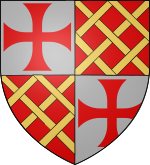
Templar Biography: Odo de St Amand

Known for his part in the Battle of Montgisard, Odo de St Amand served as the Order's eighth Grand Master.

Odo de St. Amand, also referred to as Eudes de St. Amand, was born of a noble family from Limousin, France around 1110 AD. He joined the Knights Templar in 1128. He became Grand Master after Phillipe de Milly resigned as Grand Master to become an Ambassador. He is remembered as a strong and zealous leader which earned him both respect and displeasure. 

He followed the Rule to a fault. In one incident in 1172, a Templar knight was accused of murdering an Ismaeli dignitary. King Amalric I, demanded that the Templar be turned over to him, but St. Amand refused, citing the Papal Bull which places the Templar order solely under the authority of the Pope. Some say that the Templar knight killed the dignitary on orders from the Grand Master.

He is also remembered for leading several victories, but the most notable is the Battle of Montgisard where the Templars defeated a superior size force of Saladin's Army. This battle occurred on November 25, 1177, located in Ramla (Israel southeast of Tel Aviv). This battle was between a Christian army of 375 knights, 80 Knights Templar, and several thousand infantry against Saladin's army of around 27,000 men. Saladin was taking advantage of the lack of Crusader forces in the area (as most of them were up north fighting) to march towards Jerusalem. King Baldwin IV, the leper king, dispatched what he could and to head them off. Saladin underestimated the king and allowed his army to become spread out over a large area. The two forces met at Montgisard near Ramla which caught Saladin by surprise and his troops were tired from their march from Egypt and looting. The Crusader forces charged and broke through the center routing Saladin's forces. Both sides lost many, but the Muslim forces lost over three-quarters of their troops; Saladin himself only survived by escaping on a camel.

Toward the end of his rule, St. Amand oversaw the construction of an impregnable fortress known as Chastellet near Jacob's Ford in Jordan. This fortress was located in an important place and effective in preventing Saladin's army from conquering Jerusalem in 1179.

After Saladin was defeated at the fortress, the Christians thought they could inflict further damage on Saladin so they launched an assault at the Battle of Marj Ayun (southern Lebanon). Unfortunately, Saladin had reorganized his forces and defeated the Christian Army, killing and capturing many. Among those captured was the Templar Grand Master, Odo de St. Amand. There were proposals of ransoming him, but he refused as it was against the Rule of the Order. In the next year, St. Amand died while still in jail, but no exact date is known. 


While Odo de St. Amand was seen by some as stubborn and bull-headed, he was a strong leader whose victories gained their new recruits and gifts from European nobility; after the Battle of Montgisard, Renaud Mazoir II, Lord of Margat (now in Syria), donated half of the income of several of his cities to the Templar order. St. Amand's rule also played an important part in the historical record of the Order. King Amalric held a poor view of the order and was close to the Archbishop, Wiliam of Tyre, who is known as a leading historian of the Crusades and the Templar order. The Templars were seen as overstepping the privileges given to them by the Pope; as a contender for Patriarch of Jerusalem, William had a natural hatred for the hindrance of ecclesiastical authority and thus held no positive opinion of the Templars on this account as well.


References

1. Addison, Charles G. History of the Knights Templar. 1842. http://www.sacred-texts.com/sro/hkt/hkt06.htm. 

2. Battle at Montgisard. n.d. http://www.templiers.org/montgisard-eng.php. 

3. Crusades: Battle of Montgisard. n.d. http://militaryhistory.about.com/od/battleswars10011200/p/montgisard.htm. 

4. Dafoe, Stephen. The Battle of Montgisard. June 5, 2010. http://blog.templarhistory.com/2010/06/the-battle-of-montgisard/. 

5. de Tyre, Robert. Odo de St. Amand. n.d. http://detyre.tripod.com/Articles/ODO.html. 

6. Eudes de Saint-Amand. n.d. http://www.templiers.org/eudesstamand-eng.php. 

7. Odo de St Amand. n.d. http://en.wikipedia.org/wiki/Odo_de_St_Amand. 

8. Saint-Amand Lineage. n.d. http://www.fluckers.com/family/daspit/stamand1.html.

Monday, February 16, 2015

George Washington's First Inaugural Address

In honor of Brother and General George Washington's birthday, here is the First Inaugural Address which was given on April 14, 1789, in New York:
Fellow-Citizens of the Senate and of the House of Representatives:
Among the vicissitudes incident to life no event could have filled me with greater anxieties than that of which the notification was transmitted by your order, and received on the 14th day of the present month.
On the one hand, I was summoned by my country, whose voice I can never hear but with veneration and love, from a retreat which I had chosen with the fondest predilection, and, in my flattering hopes, with an immutable decision, as the asylum of my declining years—a retreat which was rendered every day more necessary as well as more dear to me by the addition of habit to inclination, and of frequent interruptions in my health to the gradual waste committed on it by time.
On the other hand, the magnitude and difficulty of the trust to which the voice of my country called me, being sufficient to awaken in the wisest and most experienced of her citizens a distrustful scrutiny into his qualifications, could not but overwhelm with despondence one who (inheriting inferior endowments from nature and unpracticed in the duties of civil administration) ought to be peculiarly conscious of his own deficiencies. In this conflict of emotions all I dare aver is that it has been my faithful study to collect my duty from a just appreciation of every circumstance by which it might be affected. All I dare hope is that if, in executing this task, I have been too much swayed by a grateful remembrance of former instances, or by an affectionate sensibility to this transcendent proof of the confidence of my fellow-citizens, and have thence too little consulted my incapacity as well as disinclination for the weighty and untried cares before me, my error will be palliated by the motives which mislead me, and its consequences be judged by my country with some share of the partiality in which they originated.
Such being the impressions under which I have, in obedience to the public summons, repaired to the present station, it would be peculiarly improper to omit in this first official act my fervent supplications to that Almighty Being who rules over the universe, who presides in the councils of nations, and whose providential aids can supply every human defect, that His benediction may consecrate to the liberties and happiness of the people of the United States a Government instituted by themselves for these essential purposes, and may enable every instrument employed in its administration to execute with success the functions allotted to his charge. In tendering this homage to the Great Author of every public and private good, I assure myself that it expresses your sentiments not less than my own, nor those of my fellow-citizens at large less than either. No people can be bound to acknowledge and adore the Invisible Hand which conducts the affairs of men more than those of the United States. Every step by which they have advanced to the character of an independent nation seems to have been distinguished by some token of providential agency; and in the important revolution just accomplished in the system of their united government the tranquil deliberations and voluntary consent of so many distinct communities from which the event has resulted can not be compared with the means by which most governments have been established without some return of pious gratitude, along with an humble anticipation of the future blessings which the past seem to presage. These reflections, arising out of the present crisis, have forced themselves too strongly on my mind to be suppressed. You will join with me, I trust, in thinking that there are none under the influence of which the proceedings of a new and free government can more auspiciously commence.
By the article establishing the executive department it is made the duty of the President “to recommend to your consideration such measures as he shall judge necessary and expedient.” The circumstances under which I now meet you will acquit me from entering into that subject further than to refer to the great constitutional charter under which you are assembled, and which, in defining your powers, designates the objects to which your attention is to be given. It will be more consistent with those circumstances, and far more congenial with the feelings which actuate me, to substitute, in place of a recommendation of particular measures, the tribute that is due to the talents, the rectitude, and the patriotism which adorn the characters selected to devise and adopt them. In these honorable qualifications I behold the surest pledges that as on one side no local prejudices or attachments, no separate views nor party animosities, will misdirect the comprehensive and equal eye which ought to watch over this great assemblage of communities and interests, so, on another, that the foundation of our national policy will be laid in the pure and immutable principles of private morality, and the preeminence of free government be exemplified by all the attributes which can win the affections of its citizens and command the respect of the world. I dwell on this prospect with every satisfaction which an ardent love for my country can inspire, since there is no truth more thoroughly established than that there exists in the economy and course of nature an indissoluble union between virtue and happiness; between duty and advantage; between the genuine maxims of an honest and magnanimous policy and the solid rewards of public prosperity and felicity; since we ought to be no less persuaded that the propitious smiles of Heaven can never be expected on a nation that disregards the eternal rules of order and right which Heaven itself has ordained; and since the preservation of the sacred fire of liberty and the destiny of the republican model of government are justly considered, perhaps, as 'deeply', as 'finally', staked on the experiment entrusted to the hands of the American people.
Besides the ordinary objects submitted to your care, it will remain with your judgment to decide how far an exercise of the occasional power delegated by the fifth article of the Constitution is rendered expedient at the present juncture by the nature of objections which have been urged against the system, or by the degree of inquietude which has given birth to them. Instead of undertaking particular recommendations on this subject, in which I could be guided by no lights derived from official opportunities, I shall again give way to my entire confidence in your discernment and pursuit of the public good; for I assure myself that whilst you carefully avoid every alteration which might endanger the benefits of an united and effective government, or which ought to await the future lessons of experience, a reverence for the characteristic rights of freemen and a regard for the public harmony will sufficiently influence your deliberations on the question how far the former can be impregnably fortified or the latter be safely and advantageously promoted.
To the foregoing observations I have one to add, which will be most properly addressed to the House of Representatives. It concerns myself, and will therefore be as brief as possible. When I was first honored with a call into the service of my country, then on the eve of an arduous struggle for its liberties, the light in which I contemplated my duty required that I should renounce every pecuniary compensation. From this resolution I have in no instance departed; and being still under the impressions which produced it, I must decline as inapplicable to myself any share in the personal emoluments which may be indispensably included in a permanent provision for the executive department, and must accordingly pray that the pecuniary estimates for the station in which I am placed may during my continuance in it be limited to such actual expenditures as the public good may be thought to require.
Having thus imparted to you my sentiments as they have been awakened by the occasion which brings us together, I shall take my present leave; but not without resorting once more to the benign Parent of the Human Race in humble supplication that, since He has been pleased to favor the American people with opportunities for deliberating in perfect tranquillity, and dispositions for deciding with unparalleled unanimity on a form of government for the security of their union and the advancement of their happiness, so His divine blessing may be equally 'conspicuous' in the enlarged views, the temperate consultations, and the wise measures on which the success of this Government must depend.

Sunday, February 15, 2015

Templar Biography: Phillipe de Plessis

This article is the first in a series of articles on notable figures associated with the medieval Knights Templar. The first seven will be on certain Grand Masters of the order and notable events surrounding their government of the Templars.

Serving as head of the entire international Order the Grand Master exercised supreme authority and only answered to the Pope. The Grand Master was an elected position and the Knight elected would serve for life, although that was not always a long amount of time as many Grand Masters lost their lives in battle which shows that he oversaw military operations as well as the administrative operations. The Grand Master led the Templar Order into battle which, such as in this case, made this position very hazardous and sometimes a Grand Master's tenure was very short.

Phillipe de Plessis served as the 13th Grand Master of the Poor Knights of Christ and the Temple of Solomon which occurred during the 4th Crusade. He is remembered for assisting in upholding the treaty between Sultan Saladin and King Richard I of England, and it was during this time the Templar order reached its height of power in Europe.

He was born of an old noble family in 1165 in the fortress of Plessis-MacĂ©, Anjou, France (8-miles NE of Angers). Being the younger son, at the age of 24, he left his family, sold his property, and took part in the 3rd Crusade, but didn't join the Order until he arrived in Palestine where he was impressed by the discipline and fortitude demonstrated by the knights in battle. 

The relationship between the Knights Hospitaller became tense and the Templars would have been expelled from Germany if it had not been for the intervention of the Pope, although this friendship of Pope Innocent III would be shaken. He acted more as a diplomat, than a military leader, not only between Saladin and Richard, but also worked with other chivalric orders in setting peace treaties with Muslim leaders. In 1208, Phillipe suggested that the Teutonic and Hospitallier knights make peace with the new Ayyubid Sultan, Malek-Adel. This suggestion was condemned by the Pope to the point he threatened to charge the Templars with apostasy. The tense relationship with the Hospitallers also caused Papal intervention, but often favor went to the Hospitallers which caused further animosity.

Due to little fighting being done during the 4th Crusade, the reign of Phillipe de Plessis is remembered for the Templar order reaching the climax of its reputation and power as recruits from all over were pouring in and many gifts such as tracts of land were given by the nobility of Europe.

According to surviving records, he is said to have died on November 12th, 1209, but there sources that list him as dying in 1208.

References

1. Cobbold, David. Philippe du Plessis. n.d. http://www.templiers.org/philippeplessis-eng.php. 

2. History of the Order. n.d. http://www.templars.org.uk/public/history/p_history_6_glossary.htm. 

3. Phillipe de Plessis. n.d. http://en.wikipedia.org/wiki/Phillipe_de_Plessis.

Sunday, February 1, 2015

Templar Song

From the Masonic Manual compiled and arranged by Robert Macoy:

As, when the weary trav'ler gains
The height of some commanding hill,
His heart revives, if o'er the plains
He seees his home, though distant still.

So, when the Christian pilgrim views
By faith his mansion in the skies,
The sight his fainting strength renews,
And wings his speed to reach the prize.

The hope of heaven his spirit cheers;
No more he grieves for sorrows past;
Nor any future conflict fear,
So he may safe arrive at last.

O Lord, on thee our hopes we stay,
To lead us on to thine abode;
Assur'd thy love will far o'erpay
The hardest labors of the road.

Thursday, January 29, 2015

An Auspicious Day

Today marks an important day in history. This afternoon the Province of the United States of America was dissolved and the Grand Master's Council in England constituted Ye Commemorative Order of St. Thomas of Acon USA in Reston, VA.

The following officers were installed to lead the newly established Grand Council:

Most Worthy Grand Master: Sir AndrĂ© of Byron
Grand Prior: Sir Reese of Bexar, KH
Protector of Canterbury: Sir Michael of Seasalter, KH
Grand Marshal: Sir Matthew of Philadelphia, KC
Grand Treasurer: Sir Fred of Mount Pleasant
Assistant Grand Treasurer: Sir William of Seattle
Grand Registrar: Sir Joe of Gloucestershire
Grand Secretary: Sir Ernest "Randy" of Lavalette
Grand Historian: Sir John of Groveport
Deputy Grand Marshal: Sir Joseph of Toftingall
Grand Almoner: Sir David of Monroe 
Grand Warden of Regalia: Sir Christopher of Brenham
Grand Sword Bearer: Sir Jackie of Virginia Beach
Deputy Grand Secretary: Sir Jack of Booneville
Grand Banner Bearer: Sir Allen of Randolph
Assistant Grand Marshal: Sir James of Midlothian
Assistant Grand Marshal: Sir Aaron of Muhlenberg
Assistant Grand Marshal: Sir Quentin of Lake Placid
Assistant Grand Secretary: Sir James of Arlington
Grand Herald: Sir Edward of Belle Vernon
Grand Organist: Sir Jerry of Glenside
Grand Doorkeeper: TBA 
Grand Cellarer: Sir Palmer of Barre
Grand Cellarer: Sir Bernard of Houston
Grand Cellarer: Sir Emmett of Lizella
Grand Cellarer: Sir Louis of Edinburgh
Grand Cellarer: Sir Robert of Sparta
Grand Cellarer: Sir Ronald of Ruston
Grand Sentry: Sir Haigh of Belfast
Grand RepreĹżentative: Sir Leslie of Wealas-ieg, KC
The history of the Commemorative Order of St. Thomas of Acon in the US dates back to October 1999 when a large group of Mason, under the leadership of Reese Harrison, went to England and were initiated. At the 2000 Masonic Week, Pilgrim Chapel No.11 and Trinity Chapel No.12 were constituted, and for 4-years were the only two Chapels in the US. 

In 2004, Tahoma Chapel No.30 was constituted which allowed for the creation of the Province of the United States of America which occurred on September 11th, 2005. Sir André of Byron was installed as the Right Worthy Grand Preceptor and Sir Reese of Bexar was installed as the Provincial Grand Prior. Over the last 10-years, the Province of the United States of America has grown from three to twenty-three Chapels.


By 2014 the Province of the United States of America had grown large enough to separate and create its own Grand Master's Council. The Grand Master, Sir AndrĂ© of Byron, has stated that due to English roots, "we will continue to maintain all of the flavors of our English foundation. We will have the same rules for officeholders and honors as we now have under the English Constitution."


Today started with the meeting of Trinity Chapel No.12 then the Sir Melvyn of Wud Plumpton, Grand Master from England, then established two new Chapels. After a Festive Board, the Grand Master's Council reconvened where he invested Sir AndrĂ© of Byron and Sir Reese of Bexar with Knights Humilitas, the highest honor in the order. Sir AndrĂ© of Byron was then installed as Most Worthy Grand Master of the United States of America and Sir Reese of Bexar was installed as the Most Eminent Grand Prior. It was then Sir AndrĂ©'s duty to install some of his officers and then invest Sir Matthew of Philadelphia with the honor of Knight Caritas. The Grand Masters, Grand Priors, and Grand Secretaries of both Grand Councils signed an accord that laid the foundation for the growth and recognition of each other. The Knights present then approved the constitution and ritual of the order.


Consecration of the two Chapels

Consecration of the two Chapels

Consecration of the two Chapels

Investiture of the Knight Humilitas

Investiture of the Knight Humilitas

Investiture of the Knight Humilitas

Knight Humilitas


Sir André taking the oath of office

The Baton and Ring of the Most Worthy Grand Master
  
Sir Reese taking his oath of office

The signing of the concord

Knight Caritas


Sir AndrĂ© giving his remarks before closing

Sunday, January 11, 2015

First Days in DC

Well, the last few days have been very busy for me. Wednesday I flew into DC; I have moved to the East Coast for a few months to work as an intern. That night I got in, settled down, and got my bearings.

Then Thursday and Friday, I decided to visit the sites from the book "The Lost Symbol." I visited the Capitol Building, Library of Congress, National Gallery of Art, US Botanic Gardens, Freedom Plaza, and Franklin Square. I also visited the White House Visitor Center, Washington Monument, Lincoln Memorial, and WWII Memorial. Saturday was a day of relaxation...for my feet.

Sunday, I had the pleasure of meeting with Bro. Shawn Eyer at the George Washington Masonic Memorial and then going to Oldtown. I have had fun so far on the East Coast and look forward to the rest of my time here. Now the time has come to get ready for my Internship.

Thursday, January 1, 2015

Janus

"The day dawns prosperous: be propitious all, with tongue and heart. Now good words on a good day must be spoken. Let ears be free from lawsuits, let mad disputes forthwith be absent. Malicious tongue, put off your business!"
This quote is taken from the first book of Ovid's Fasti, a six-book poem on the origins of holidays in the Roman empire. A great portion of the first book deals with the god Janus, who is the god of beginnings, travel, transitions, war and peace, doors, gates, passages, and endings, which is significant to the New Year and for whom the month January is named after. It is important to note that the Greek's had no equivalent god to Janus.

The god Janus was often depicted as having two faces so he can look forward to the future and to the past. In Ovid's Fasti, Janus appears before the bard holding "a staff in his right hand and a key in his left." He goes on to tell Ovid that he is known by many names including Chaos and describes that he has been around since the elements separated and the material world formed. He states that he was formless and as the world came out of chaos, so did he:
"At that time I, who had been a round mass and a bulk without form, resorted to a shape and limbs appropriate to a god. Even now, small indication of my once chaotic shape, what's in front and behind in me appears the same."
He is most known for time and transition, but being the god of the "beginning and the end" also included conflict. During times of war, the doors of the Temples of Janus were left open and closed during times of peace. The exact nature of Janus is debated, but he is seen to be a god venerated not and used to symbolize more than just sacred practices, but even the mundane; he is venerated for his part at the beginning of time, but is invoked by farmers during the harvest. There were numerous rites to Janus because he could be worshiped at the beginning of the year as well as each month, and was also venerated on the beginnings and ends of important events such as the harvest or military seasons. He is sometimes also seen as a uranic deity which is the personification of the sky and is a deity dealing with the creation myth of a particular faith, religion, or mythology.

The first, or kalends, of January, was especially important in the celebration of Janus. It was to be a day of good luck and kindness so as to be a good omen for the rest of the year. This custom carries on today with the singing of Auld Lang Syne or serving "good luck foods" on New Years Day.

January 1st is set as the beginning of the New Year and is held in the cold of winter rather than the spring when life springs anew because Janus states:
"The winter solstice is the first day of the new sun, the last of the old. Phoebus and the year take the same starting point."
Now, let us not dwell on the past, but look forward to a new dawn, a bright new year full of opportunity. I wish you all a very Happy New Year!!

References

1. Book I: January 1 - Kalends. n.d. http://www.poetryintranslation.com/PITBR/Latin/OvidFastiBkOne.htm#anchor_Toc69367257.

2. Janus. n.d. http://en.wikipedia.org/wiki/Janus. 

3. Ovid. Fasti. Translated by Anne Wiseman and Peter Wiseman. Oxford University Press, 2011. 

4. Thiel, B. January 1st: Is this a Date to Celebrate? n.d. http://www.cogwriter.com/new.htm. 

5. Uranic deity. April 22, 2012. http://arzael.blogspot.com/2012/04/profile-of-god-uranic-deity.html.

Wednesday, December 31, 2014

The Tyler's Toast

By Author Unknown


Then to our final Toast tonight, our glasses freely drain, 
Happy to meet, sorry to part, happy to meet again. 

The Mason's social Brotherhood around the festive board, 
Reveals a Truth more precious far, than the miser's hoard. 
We freely share the bounteous gifts, that generous hearts contain, 
Happy to meet, sorry to part, happy to meet again. 

We meet as Masons free and true, and when our work is done, 
The merry song and social glass is not unduly won. 
nd only at our farewell pledge is pleasure mixed with pain, 
Happy to meet, sorry to part, happy to meet again. 

Amidst our mirth we drink to all poor Masons o'er the Earth, 
On every shore our flag of love is gloriously unfurled. 
We prize each Brother, fair or dark, who bears no moral stain, 
Happy to meet, sorry to part, happy to meet again. 

We Masons prize that noble truth, the Scottish peasant told, 
That rank is but a guinea stamp: The man himself the gold. 
We meet the rich and poor alike, the equal rights maintain, 
Happy to meet, sorry to part, happy to meet again.

Dear Brethren of the Mystic tie, the night is waning fast, 
Our work is done, our feast is o'er, this toast must be the last. 
Good night to all, once more good night, again that farewell strain, 
Happy to meet, sorry to part, happy to meet again.

Into the Looking Glass

Well, another year is done and a new one begins tomorrow. This last year brought change and transition to my life.

In 2014 I transitioned fully into civilian life by ending my service with the Idaho Army National Guard after 12-years and two deployments to Iraq.

In Masonry, I had the pleasure of attending the AMD Masonic Week for the first time where I met many as well as being initiated into the AMD, Ye Antient Order of the Corks, and Masonic Order of the Bath. In April, I was honored with being initiated as a Knight of the York Cross of Honor. I September, I was installed as Grand Orator for my Grand Lodge and look forward to next September when I give my Oration. Lastly, I served a second term as Worshipful Master of my Lodge and I had a great time, but I'm glad to hand the gavel over to my friend and Brother.

I also earned my Bachelors degree at Boise State and will be pursuing my Master's next Fall at the same institution.

The New Year brings a large change as I will soon be embarking to Washington DC to work as an Intern. While there I will also have many chances to visit the Masons on the East Coast and attend another Masonic Week held at the end of January. 

2014 was a good year and I look forward to comes my way in 2015.

Now, it's time to head out to a New Year's Eve Party and celebrate with some great friends.

Monday, December 29, 2014

Saint Thomas a Becket

Today celebrates and commemorates the life and the death of Saint Thomas a Becket: defender of his faith, despised by his monarch and slaughtered by four knights.

Thomas Becket, sometimes referred to as Thomas of London or Thomas of Canterbury, was born around December 21st, 1118 (others say 1120), in Cheapside, London. He was the son of Gilbert and Matilda Becket. There are theories as to the lineage of the parents both being from Normandy and one famous one that Thomas's mother was a Saracen that fell in love with his father while in the Holy Land. What is known is that Gilbert was a merchant living in London when Saint Thomas was born.


As a child, Saint Thomas studied at Merton Priory and then later the grammar school at St. Paul's Cathedral in London. Throughout his schooling, he studied just what was required and whose skills were described as rudimentary.

Saint Thomas began working as a clerk after his father suffered from financial difficulties. He would eventually start to work for Theobald of Bec, Archbishop of Canterbury. Under Theobald's direction, Saint Thomas began to study canon law in Italy and France. In 1154, Saint Thomas was named Archdeacon of Canterbury, Provost of Beverly, Prebends at Lincoln Cathedral and St. Paul's Cathedral, and other ecclesiastical offices.

When Henry II became King in 1154, Theobold recommended to the new sovereign that Saint Thomas be appointed as Lord Chancellor, which occurred in January 1155. The Chancellor served as royal chaplain, the king's secretary in secular matters, and keeper of the royal seal. Saint Thomas excelled so well at the job and gained the favor of the king that he sent his son to live with Saint Thomas. Some describe Henry and Saint Thomas as behaving like schoolboys and being great friends.

Theobold of Bec, the Archbishop of Canterbury, died in the spring of 1161. Saint Thomas a Becket would eventually be nominated to take that position and the election confirming that position occurred on May 23, 1162. Saint Thomas was ordained a priest on June 2, 1162, at Canterbury Cathedral and then the next day was consecrated as Archbishop of Canterbury by Henry of Blois, Archbishop of Winchester. 

When Saint Thomas took this position, a transformation occurred. King Henry II had wished that Saint Thomas would continue as Chancellor and put the interests of the kingdom before the church, but such hopes were in vain. Soon after becoming Archbishop, Thomas resigned from being Chancellor, removed all signs of his former lavish lifestyle, and soon troubles began between Saint Thomas and Henry. Saint Thomas would support the king, but if the king's wishes pushed into the church's realm Saint Thomas would adamantly and often publicly oppose such policies.

One such issue came over the jurisdiction of secular courts over the clergy. The king pushed for clergymen to be tried for petty crimes in secular courts, but Saint Thomas opposed it as it was his duty to be the judiciary over the clergy in England. The king attempted to turn some of the bishops against and usurp church authority. This would all lead to the Council of Clarendon.

This council passed a set of legislative procedures to restrict ecclesiastical privileges as well as the authority of religious courts and general authority of the Catholic Church. Saint Thomas was asked to sign off, but he rejected this constitution. On October 8, 1164, Saint Thomas was summoned by the king to the council and was accused of contempt of royal authority and malfeasance during his time as Chancellor. After celebrating mass, he presented himself before the council where the king demanded a sentence should be passed on him for his crimes, but refused to accept such sentence as he was not subject to only the laws of God and the Church. Before he could be arrested, Saint Thomas secreted himself out of the kingdom and fled to France where he was welcomed by the French monarch, King Louis VII. He offered his resignation to Pope Alexander III, but refused to accept it from Saint Thomas.

Saint Thomas spent much of his time in a Cistercian Abbey, but Henry threatened the Cistercians in England so as to avoid further persecution in England, expelled Saint Thomas from their abbey in Pontigny (several kilometers of SE of Paris). Pope Alexander III attempted to resolve this conflict by diplomatic means and sent representatives to serve as arbitrators between Henry and Thomas. Eventually, Saint Thomas would be allowed to return to England.

In June 1170, Roger de Pont L'ÉvĂŞque, Archbishop of York; Gilbert Foliot, Bishop of London; and Josceline de Bohon, Bishop of Salisbury, crowned the heir apparent, Henry the Young King, at York; something that was likely done as an insult to Saint Thomas. Authority to do such a thing was left to the Archbishop of Canterbury, so in November of 1170, Saint Thomas a Becket excommunicated all three of the priests. This incident was what led to the death of Saint Thomas.

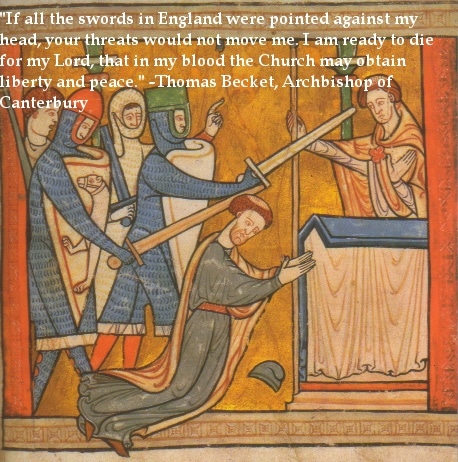
There are a variety of theories as to exactly what happened, but the most accepted theory is that upon hearing of Saint Thomas recent actions, he stated "Will no one rid me of this turbulent priest?" Reginald Fitzurse, Hugh de Morville, William de Tracy, and Richard le Breton, four knights, hearing these words, and taking them literally, took off for Canterbury and arrived on December 29th, 1170. They originally left their weapon outside the cathedral and disguised themselves under cloaks that concealed their armor. They attempted to coerce him to leave with them to answer for his actions, but he refused them.

The knights left and retrieved their weapons. They found Saint Thomas on his way to the main hall where it is said they yelled out "Where is the traitor?" and to which he responded with "Here I am, no traitor, but archbishop and priest of God." They attempted to drag him out, but after meeting with resistance, they executed him in the cathedral.

The news of his death spread throughout Europe and soon many began venerating him as a martyr. Even King Henry visited Becket's tomb, had himself scourged, and denounced the actions of the knights; likely done to appease the Pope and avoid ex-communication. Nearly three years after his assassination, he was canonized as a Saint by Pope Alexander III. The knights who had executed Saint Thomas were themselves excommunicated and were ordered to serve in the Holy Land for 14-years.

Saint Thomas's tomb became a popular pilgrimage destination and existed until the time of the Reformation when Henry VIII dissolved the religious institutions. There are theories that Saint Thomas's body was moved or hidden away in another location, but no evidence exists to corroborate such ideas.

Saint Thomas has been an influence in the world in the form of the Commemorative Order of St. Thomas of Acon, has had an effect on literature such as Chaucer's "The Canterbury Tales", and is a Saint celebrated by both Anglicans and Catholics. This saint died defending his integrity and conscience rather than being bullied by a tyrannical monarch.

References

1. Lord Chancellor. n.d. http://www.britannica.com/EBchecked/topic/348007/lord-chancellor. 

2. St. Thomas Becket. American Catholic. http://www.americancatholic.org/features/saints/saint.aspx?id=1244. 

3. Thomas Becket. n.d. http://www.waymarking.com/waymarks/WMMG11_Thomas_Becket_London_UK. 

4. Thomas Becket. n.d. http://en.wikipedia.org/wiki/Thomas_Becket. 

5. Thomas of Canterbury, Archbishop and Martyr. n.d. http://justus.anglican.org/resources/bio/23.html. 

6. Thurston, Herbert. St. Thomas Becket. 1912. http://www.newadvent.org/cathen/14676a.htm.

7. St. Thomas Becket. n.d. http://www.catholic.org/saints/saint.php?saint_id=12.