Friday, October 19, 2012

Invite to Knight Masons

Well, today at the Northwest Regional York Rite Conference that is being held in Boise, I was approached by my friend Paul, who is an Idaho and Oregon York Rite Mason, and told me that I have been invited to join Clontarf Council No.69, Order of Knight Masons out of Bremerton, WA. I'm scheduled to go through the degrees in March 2013.

The reason I am going to Washington is that there are no Councils in Idaho. I am truly honored to be one of just a handful of Idaho Masons to be a member of this invitational body.

Tuesday, October 16, 2012

To A Rose

Well here is this month's poem and I posted it today as it dedicated to my sister and my aunt on their birthday! Happy Birthday!

To a Rose
By Charles Hine Hubbard from "Rosicrucian Writings Online"

Ah! Beautiful Rose!
To me thy petals oft disclose
The flaming Beauty of the tender rays
That in the Master's Sun I praise!

Beautiful Rose--sweet Rose of tender Truth
That all is Life Forevermore! Oft in my youth
Beside thy ope'ning petals I would lie
Wrapt in the Beauty of thy softness! I
Would gaze upon you as a lover would, and you
Would sweetly, earnestly my raptures view!

Ah! Rose! Most Beautiful Rose!
In thee so tender--God's Repose
Must surely be--so pure, Sweet Rose, art thou!
Dear Rose, accept my humble praises! How
The love of thee remains, Sweet Rose--in absence, too--
For thou art pure, Kind Rose--all pure and true!

Wednesday, October 10, 2012

The Banners of Royal Arch Masonry

While I was writing the article "Symbols of Royal Arch Masonry - Part 2", I started to wonder about the sigils (the symbol or seal) which adorned each of the four banners used in Royal Arch Masonry. I wondered as to why we used the Tribes we did on our Banners, but the answer to that was easy enough to find. I wasn't done though, I wondered as to what the significance of these four symbols was and what, if any, connection they had with ancient cultures and mythologies.

First off, I must note a considerable difference between American Royal Arch Masonry and English Royal Arch Masonry. In the American system, we use just four banners while the English use twelve banners to represent the 12 Tribes of Israel. Why only use four banners instead of all twelve?  A likely answer comes to us from the Encyclopedia of Freemasonry, wherein it states:
But our American Royal Arch Masons, as we have seen, use only four banners, being those attributed by the Talmudists to the four principal Tribes Judah, Ephraim, Reuben, and Dan. The devices on these banners are respectively a lion, an ox, a man, and an eagle.
It is in the Book of Numbers that we read about these principal Tribes of Israel. In Chapter 2, we find a description of the encampment which surrounded the Tabernacle that Moses erected by Divine command. The following verses describes the four principle Tribes:
And on the east side toward the rising of the sun shall they of the standard of the camp of Judah pitch throughout their armies
 - Numbers 2:3

On the south side shall be the standard of the camp of Reuben according to their armies
 - Numbers 2:10

On the west side shall be the standard of the camp of Ephraim according to their armies
 - Numbers 2:18

The standard of the camp of Dan shall be on the north side by their armies
 - Numbers 2:25
I find this a reasonable answer as to why the American Royal Arch uses just these four banners and tribes. One must also see that the use of four comes to us as a reminder of the veils to the Tabernacle. Now we're faced with the question, "Why do we use the sigils or devices on these specific banners?" In the second verse of the Second Chapter of the Book of Numbers, we read that "Every man of the children of Israel shall pitch by his own standard, with the ensign of their father's house." As to what the color and device of each banner were cannot be found in the Holy Writings, so we must, as we see above rely on the inventive genius of the Talmudists.  Again from the Encyclopedia of Freemasonry, we read:
We must, then, depend on the Talmudic writers solely for the disposition and arrangement of the colors and devices of these banners. From their works we learn that the color of the banner of Judah was white; that of Ephraim, scarlet; that of Reuben, purple; and that of Dan, blue; and that the devices of the same Tribes were respectively the lion, the ox, the man, and the eagle.
As to what influenced the application of these devices one needs only look to the Book of Ezekiel, wherein we read:
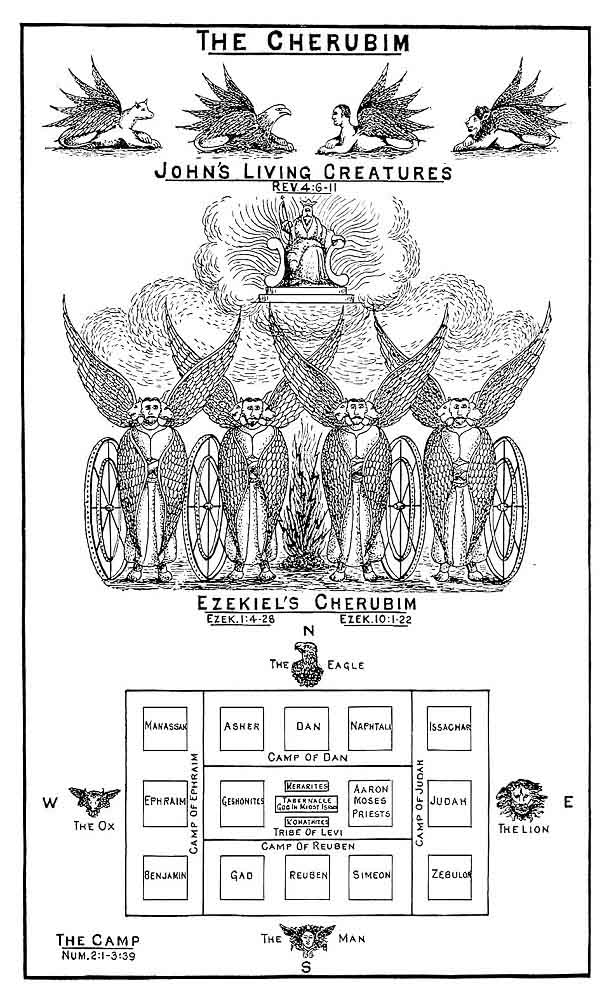
As for the likeness of their faces, they four had the face of a man, and the face of a lion, on the right side: and they four had the face of an ox on the left side; they four also had the face of an eagle.
 - Ezekiel 1:10
Leaving the Old Testament and going to the last book of the Bible, in the Book of Revelations we read:
And the first beast was like a lion, and the second beast like a calf, and the third beast had a face as a man, and the fourth beast was like a flying eagle.
 - Revelations 4:7
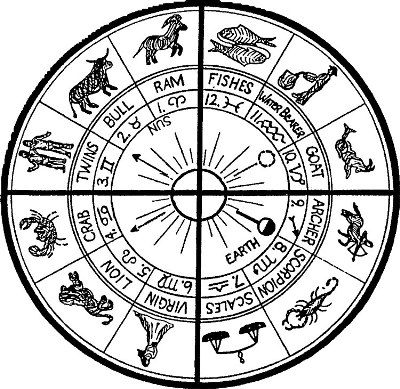
It's likely that this last verse was influenced by Ezekiel's vision. Ezekiel and the use of the four faces in his vision may have been influenced by his environment as he wrote his work during the Jewish captivity in Babylon. These Four Living Creatures seen in Ezekiel's vision are referred to as "tetramorphs" and are said to be the Four Cherub who surround God on His Throne and represent the Tetragrammaton (the four Hebrew letter theonym), and in the New Testament are said to represent the Four Evangelists who scribed the four aspects of Christ. The Four Living Creatures associated with Ezekiel's vision, then applied to the Four Evangelists and the four principal Tribes of Israel are also associated with the four fixed signs of the Zodiac where the Man represents Aquarius, the Lion represents Leo, the Ox or Bull represents Taurus, and the Eagle is associated with Scorpio.

Tetramorphs are defined as "a symbolic arrangement of four differing elements, or the combination of four disparate elements in one unit. The term is derived from the Greek tetra, meaning four, and morph, shape." Tetramorphs appear in many ancient and modern cultures, and the most common theme that binds them all together is that they usually stand as guardians or protectors. Some cultures may use the same or similar animals and some use completely different animals, but the theme of guardianship remains the same.

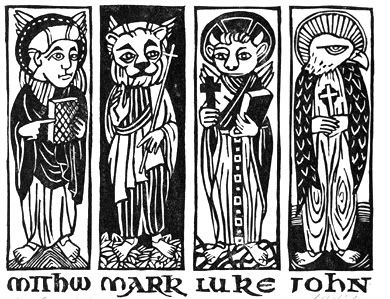
As I stated above, the Four Evangelists have been symbolically represented by the Four Living Creatures seen in Ezekiel and Revelations. In Christian art these tetramorphs often surround Christ and each Evangelist is represented by one of the Four Living Creatures. Matthew is represented as a Man as his Gospel revolves around the human life of Christ. Mark is said to be represented as a Lion because his Gospel surrounds the royalty of Christ as the lion is the king of the beasts so too is Christ the King of Kings. The Bull or Ox, an ancient symbol of sacrifice, is said to represent Luke due to the fact that this Gospel shows us the atonement and great sacrifice of Jesus Christ. Finally, John is said to be represented by the Eagle as his Gospel deals with Christ and the Word of God as the Eagle was to the ancients a divine messenger and is the Master of the Skies.

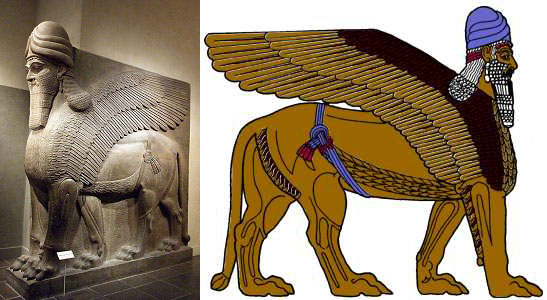
There are many examples of the use of tetramorphs in ancient cultures such as Egypt, Assyria, Sumer, Mesopotamia, Greek, and Babylon. The first example that came to mind is the "lamassu".


The lamassu is a protective or guardian deity that was often depicted with a bull or lion's body, wings, and a human head. The lamassu could often be found near the entrances to households, palaces, temples, or cities. To protect houses and smaller dwellings, the lamassu was engraved upon tablets and then buried at the threshold of the door.  For palaces, temples, and city entrances there could be found large statues of the lamassu, often in pairs, each standing as a sentinel on either side of the gate or doorway. For city entrances, location permitting, there would be four pairs of lamassu where each pair would face in a cardinal direction.

The lamassu is also linked to the sphinx which likewise unites various creatures together into a single entity. The most famous is the Great Sphinx of Giza which is composed of a lion's body with a human head. This sphinx is said to be the guardian over the tomb of Khafre. Staying with the ancient Egyptians, I want to also point out that when one died, they went through the process of mummification (the process of preserving the body after death) and certain organs were harvested and stored in four jars referred to as Canopic jars. Each jar contained a specific organ, which was the stomach, lungs, liver, and intestines. Jars in the early Egyptian dynasties were plain, but in later dynasties, the stoppers or lids to these jars were ornamented with the heads of the Four Sons of Horus who were charged to be guardians of the organs as well as the gods of the cardinal directions. There are some differences between the Christian tetramorphs and these guardians as the Four Sons of Horus were composed of the following gods:
Duamutef, a jackal-headed god who protected the stomach and represented the East

Hapi protected the lungs and represented the North, and was represented by a baboon

Imseti was depicted as a human-headed god that protected the liver and represented the Southern direction

Qebehsenuef, a falcon-headed god, protected the intestines and represented the West
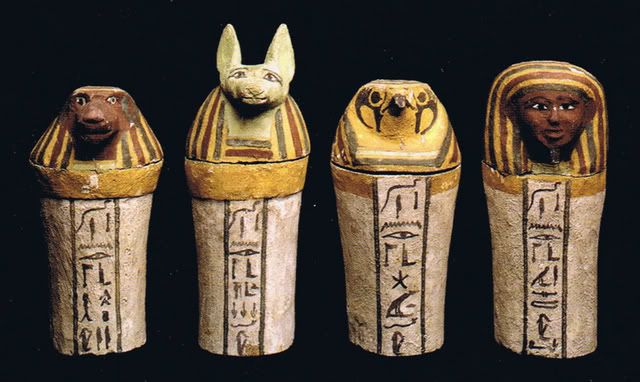
We see the difference and that only two of the heads correspond to the Christian tetramorphs, that of the human and the eagle/falcon. It should be noted that Ezekiel saw in his vision that these creatures came forth from a cloud and the Four Sons of Horus would never have been associated with a cloud or storm due to the fact that Set, the nemesis of Horus, was the god of storms and chaos. There are also many examples of tetramorphs in various mythologies like the manticore or harpies.

In closing, it's reasonable to assume that the sigils of these four Royal Arch banners were, depicted as they are, influenced by Ezekiel's vision of the four cherubim. Such use of tetramorphs is not unique to the Judeo-Christian traditions, but has been long seen in the ancient world. Tetramorphs are commonly used as divine guardians and we see this commonality with the Masters of the Veils and Royal Arch Captain who bear and protect the banners, and who represent the attendants who protected the four veils of the Tabernacle.


References

1. Bennett, J. (2009-2010). Royal Arch Banners - Part 1. Retrieved from The York Rite Bodies of Texas: http://texasyorkrite.org/chapter/forms/general/ShortTalk8-Banners-pt1.pdf

2. Canopic Jars. (n.d.). Retrieved from Wikipedia: http://en.wikipedia.org/wiki/Canopic_jars

3. Cherubim (Kerubim, Kerubs). (n.d.). Retrieved from SymbolDictionary.net: http://symboldictionary.net/?p=3021

4. Four Sons of Horus. (n.d.). Retrieved from Wikipedia: http://en.wikipedia.org/wiki/Four_sons_of_Horus

5. Horvat, M. T. (n.d.). The Man, The Ox, The Lion & The Eagle. Retrieved from Tradition in Action: http://www.traditioninaction.org/religious/f005rp.htm

6. Lamassu. (n.d.). Retrieved from Wikipedia: http://en.wikipedia.org/wiki/Lamassu

7. Mackey, A. G. (n.d.). Banners, Royal Arch. Retrieved from Encyclopedia Of Freemasonry And Its Kindred Sciences: http://encyclopediaoffreemasonry.com/b/banners-royal-arch/

8. Smid, D. (2012, January 8). ZODIAC, CROSS AND TETRAMORPH-SPHINX. Retrieved from Esoteric Online: http://www.esotericonline.net/group/astrosymbolism/forum/topics/zodiac-cross-and-tetramorph-sphinx

9. Spoke 4 - Dalet. (n.d.). Retrieved from Bible Wheel: http://www.biblewheel.com/wheel/spokes/Dalet_Four_Creatures.asp

10. Tetramorph. (n.d.). Retrieved from Wikipedia: http://en.wikipedia.org/wiki/Tetramorph

Saturday, September 22, 2012

History of York Rite Masonry in Idaho - Part I: Royal Arch Masonry

In early July the Grand Commander of Idaho asked me to create an article discussing the history of York Rite Masonry in Idaho.  Here is the first part discussing the history of Royal Arch Masonry.

To discuss anything with Masonry in Idaho one must discuss the founding of this territory and State. Idaho primarily had been passed by whether it was by the Lewis & Clark expedition or by the gold rushers going to Pacific Coast. It wasn't helped that the Oregon Trail was closed off after the Ward Massacre in the Boise Valley in 1854.

Masonry in Idaho can be traced back to the gold rushes that brought men to the territory in 1860. Until March 3rd, 1863, when the Idaho Territory was created, part of what is now Idaho, belonged to Washington Territory. So, it is not unusual to find the history of Idaho Masonry to be found in the Proceedings of the Grand Lodge of Washington. The first remnants of Masonry were seen in the northern portions of the State until gold was discovered in the Boise Basin. As it was in the north, among the gold rushers were Masons and soon Idaho City (formerly Bannock City) became an epicenter of Masonry in the Idaho Territory.

Lodges were created in Idaho City, Boise (then referred to as Boise City), Placerville, Silver City, and Pioneerville. These Lodges came together on December 16th, 1867, and formed the Grand Lodge of Idaho.

Royal Arch Masonry

The first Chapter of Royal Arch Masons in the Idaho Territory was given dispensation by the Grand Chapter of Oregon on June 18, 1867. This chapter was constituted on August 21, 1867, in Idaho City. Companion Cartee, a Past High Priest from Oregon, advised the Grand Chapter of Oregon that they technically no legal right to issue dispensations to Idaho and so the Grand High Priest turned to the General Grand Chapter for direction. On September 18, 1868, a charter was granted to Idaho Chapter No.1 of Idaho City. This chapter was in existence for 41-years prior to the formation of the Grand Chapter of Idaho and therefore held its allegiance solely to the General Grand Chapter. For this period, it is sad to say, there is no existing record documenting their activities.

What is known of this first Chapter is that a few of the members became Grand Master of the Grand Lodge and the first Grand High Priest, James A Pinney, when the Grand Chapter formed in 1908. As with the ebb of flows of the gold rush, the population of Idaho City waned and so in 1915 the Chapter ended its run, and by order of the Grand Chapter of Idaho, they consolidated with Boise Chapter No.3.

With some of the movements of the gold rushers, so came a second Chapter in the form of Cyrus Chapter No.2.  It was given dispensation on March 8, 1870, and chartered on September 19, 1871. This chapter held its place in Silver City for some time until the population dropped to just a handful of residents, but now currently meets in Nampa.

The third chapter, my home Chapter, was formed in Boise. It took over 2-years for the General Grand Chapter to issue a dispensation for the petition which occurred on March 30, 1870,  This chapter was chartered on September 12, 1871, and designated as Boise City Chapter No.3, but is now known as Boise Chapter No.3. This Chapter existed for 38-years prior to the formation of a Grand Chapter.

The fourth chapter was formed in Lewiston.  Though I didn't list it with the original Lodges of Idaho, Lewiston was truly where the first Masonic Lodge was created, but it was short-lived, having surrendered its charter 2-years after being chartered. There exists no record of dispensation, but it is known to be chartered on August 27, 1880,

On May 22, 1884, the fifth chapter was given a dispensation in Hailey, ID by the General Grand Chapter.  A charter was granted on October 1, 1886, and was designated as Alturas Chapter No.5, and constituted on April 9, 1887. This chapter had poor membership growth and struggled for years until they surrendered their charter on August 23, 1894.  There exists little record of this chapter as documents were destroyed in a fire that happened in July of 1889.

Pocatello Chapter No.6 was given dispensation on May 28, 1889, and chartered on November, 22, of the same year. Until the time of the formation of the Grand Chapter little is known of this Chapter's activities.

The seventh chapter was formed in Moscow, dispensation being given on July 3, 1890, and chartered on January 25, 1891.

The eighth chapter was organized in Payette, ID.  The General Grand Chapter issued a dispensation on November 12, 1892, and chartered on August 24, 1894.

Wallace Chapter No.9 was given dispensation on May 9, 1901, and chartered on October 8, 1903.

The tenth chapter was founded in Idaho Falls and received dispensation on June 30, 1903.  It was chartered on October 8, 1903.

The eleventh chapter was formed in Weiser, ID.  It was given dispensation on February 18, 1905, and chartered on June 22, 1906.

The talk of the formation of a Grand Chapter of Idaho came from a discussion at the Annual Grand Conclave of the Grand Commandery of Idaho in 1907.  On June 16, 1908, a number of representatives of various chapters assembled in a convention in Pocatello, ID. With the approval of the General Grand Chapter, the Companions assembled made the necessary arrangements to constitute the Royal Arch Chapters of the State of Idaho into a Grand Chapter, and provide a constitution for its government. This convention was presided over by Thomas Barnes, of the Silver City chapter.  Elections were held and the following officers were installed:
James A Pinney, Grand High Priest
Frank D Winn, Deputy Grand High Priest
Andrew B Anderson, Grand King
Jotham A Lippincott, Grand Scribe
Jay R Mason, Grand Treasurer
Albert A Jessup, Grand Secretary
James E WIlliamson, Grand Chaplain
Thomas Barnes, Grand Captain of the Host
T.G.  Woodward, Grand Principal Sojourner
John H Hiler, Grand Royal Arch Captain
George Doehne, Jr, Grand Master of the 3rd Veil
Francis Jenkins, Grand Master of the 2nd Veil
John M Elder, Grand Master of the 1st Veil
Robert Crisswell, Grand Sentinel
Hiram T French assigned Grand Marshal, proclaimed the officers installed and that the Grand Chapter, Royal Arch Masons, of the State of Idaho, was regularly formed and constituted. Additional Chapters were chartered and with the flow of populations, they have grown or shrunk to a point that now some of the first chapters are no more.

I will continue with Part II soon enough that will cover Cryptic and Chivalric Masonry in Idaho.  To be continued...

References

1. Brown, J. W. (n.d.). Freemasonry in the State of Idaho. Retrieved from Masonic History of the Northwest: http://www.freemason.com/library/norwst28.htm

2. Denslow, R. V., & Turnbull, E. R. (1956). History of Royal Arch Masonry. Virginia.

3. Freemasonry in Idaho. (n.d.). Retrieved from Eagle Rock Lodge No.19, AF&AM of Idaho: http://www.eaglerock19.org/history.php

4. Idaho. (n.d.). Retrieved from Encyclopedia of Freemasonry: http://encyclopediaoffreemasonry.com/i/idaho/

Saturday, September 15, 2012

Grand Encampment Legislation Update

Here is a belated update to my post on the 65th Triennial Conclave Information Packet and the proposed legislation.

Talking with the Right Eminent Grand Commander of Idaho, he said that the first eight Resolutions were housekeeping issues for a variety of issues.  They all passed.

The Ninth Resolution was, in my opinion, a fairly controversial one. I feel it has good motives, but should have been written a little differently. It provides an appeal process for Sir Knights that were possibly improperly suspended. It passed.  Here is the wording as proposed by Sir Knight Duane Vaught, Deputy Grand Master:
Notwithstanding the previous paragraph of this section, if a Knight Templar believes he has been involuntarily suspended or expelled from Chapter, or Council where required, either illegally or because of personal, arbitrary, capricious or other improper motive by the Chapter or Council he may appeal to the Grand Master and suspension from Templary shall be held in abeyance for a period of not more than 30 days to allow investigation. If within that period the Grand Master and any two other elected officers of the Grand Encampment agree, the requirement of continuous Chapter, or Council if otherwise required, membership may be waived for that member.

The requirement of Chapter, or Council if required, for a petition for affiliation or to receive the orders is not affected by this exception.
The Tenth Resolution also passed and clarified that Commanderies may appear in public for funerals or religious services without dispensation, but other functions required Sir Knights to go through the dispensation process of the Grand Encampment.

The rest of the Resolutions (11 thru 14) failed as they were seen as unsuitable:
Resolution 11 purported to change our mission statement, but it was felt that the change may identify us as a religious establishment and jeopardize our standing with the IRS.

Resolution 12 attempted to create voluntary Outposts of a Commandery with a Charter to a four year period to bring that Commandery up to minimum standards of performance. If unsuccessful this would result in loss of their Charter without prodigious to its members. Jurisprudence pointed out that all Commanderies are to be of equal status and are not to be thus penalized and that there are sufficient provisions accommodating probation.

Resolution 13 attempted to limit multiple office holding in other Commanderies and require at least two years of service prior to being elected as Eminent Commander through Junior Warden, inclusive.

Resolution 14 tried to permit the wearing of a Knights of the York Cross of Honor (KYCH) bar upon our uniforms, but was declared out of order.
There were two unpublished Resolutions presented on the floor.  They were:

Jurisprudence Resolution 1: Deals with the Rectified Scottish Rite (CBCS/KBCH), particularly with sanctions that may fall upon a Sir Knight should he join an unrecognized Masonic Templar Order.  This resolution passed.

Jurisprudence Resolution 2: Deals with the authority of the Grand Encampment to confer the Fourth through the Sixth degrees of the Rectified Scottish Rite. The resolution passed. From what I've heard they're a number of Grand Lodges that have declared the Grand Priory as a clandestine organization.
Thursday, September 13, 2012

Happy Birthday Boise York Rite bodies!

This month marks the anniversaries of the three Boise York Rite bodies. Boise Chapter No.3, Royal Arch Masons, turned 141-years old, on September 12, and Idaho Commandery No.1, Knights Templar, turned 130-years old, on September 11. Although Cyrus Chapter No.2 is still in existence, Boise Chapter No.3 is actually older by one week (it's a long story). Idaho Council No.1 though hits its Centennial anniversary on September 27 and I am honored to be serving as Illustrious Master this year.

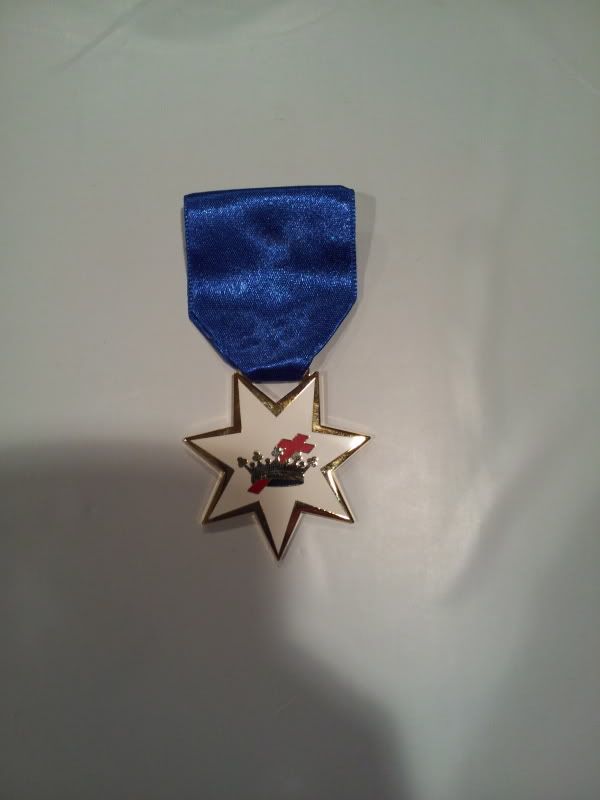
I'd like to thank all of the Companions and Sir Knights who attended this historic meeting. We had a good meeting with several things to discuss as well as the Official Visit of the Right Eminent Grand Commander of Idaho. I was surprised when the Grand Commander awarded me the Order of the White Star, the highest award in Idaho Templary, and I was appointed as the Commandery's Education Officer, designated by the white and black rope on my left shoulder.

A close-up

Monday, September 10, 2012

Associate Bethel Guardian

This evening was the first meeting for the newly installed Honored Queen of Bethel No.29, Job's Daughters International. Prior to the meeting, the Guardian Council was installed. I was installed as Associate Bethel Guardian, which is the Masonic connection to the Bethel and male Guardian.  I assist in the duties of the Guardian and one of my more important duties is to verify the petitioner's Masonic affiliation. The Vice Associate Grand Guardian of the Grand Bethel of Idaho is a good friend and he said to me the other day, "Remember, T-L-C.  Tote. Lug. Carry. Those are your biggest duties."  I just laughed.

I have been with this Bethel since 2009 and have enjoyed their company and I was ecstatic when the previous Bethel Guardian told me I had been chosen to be the Associate Bethel Guardian. I think this will be a fun year as this Bethel has a great group of young ladies who I get to mentor and watch grow.


Sunday, September 9, 2012

The Crown and the Cross

The Crown and the Cross is a familiar symbol in Christianity and is a peculiar logo of the Knights Templar Order within the York Rite of Freemasonry. As the Knights Templar is founded upon Christian principles so to are our symbols.

To point out the obvious, this symbol is the combination or uniting of two separate symbols - the crown and the cross. United this symbol has its own unique history and meaning, but separately each symbol has a much larger history and symbolic interpretation.

Be thou faithful unto death, and I will give thee a crown of life.
Revelations 2:10

Blessed is the man that endureth temptation: for when he is tried, he shall receive the crown of life, which the Lord hath promised to them that love him.
James 1:12

Together they represent the reward awaiting in Heaven that the Faithful will receive after the suffering and trials of this life on Earth; the cross secures and the crown assures. Some have interpreted it to stand for the meaning of the life, ministry, message, and glory of our Blessed Redeemer, our Savior, Jesus Christ.

The Crown, by itself, has traditionally been a symbol of authority and sovereignty, whether it is governance over a society/community or over oneself. Head coverings, like crowns, are also seen as a symbol of victory like you would see with the wreath or garland. As I talked about in Symbols of Royal Arch Masonry - Part 1:
Symbolically we can see through its circular shape it denotes perfection, which Heaven is seen as, and eternal life, and while wearing it we unite the spiritual world with this material world where the sovereign can receive divine inspiration to justly rule.
In the Masonic Templar Orders, there are many crosses used, but we will only talk of a few and discuss the general symbolism. For the Sir Knights of the Templar Orders and Christians, the cross reminds us of the crucifixion of Jesus Christ, but is much older than the Christian religion. First, let's look at what a cross is.

The Cross is simplistic in shape, usually two intersecting beams, a vertical one intersecting a horizontal one.  These may vary upon the religious denomination. There are basically four forms from which most other crosses stem. They are:
The Latin Cross (crux immissa) is a type of the cross in which the vertical beam sticks above the crossbeam.

The Greek Cross (crux immissa quadrata) is similar to the Latin Cross except that all four arms are of equal length. It is said this is the most ancient of the cross symbols used.

St. Andrew's Cross (crux decussata) is in the form of a diagonal cross (like the letter X). This cross also resembles the Greek letter Chi which is represented as 'X' which is one of the symbols Constantine saw in a dream which led him to victory against Maxentius, and which led Constantine to his legendary conversion to Christianity.

The Tau Cross (crux commissa) is a cross named after the Greek letter it resembles.
There are several variations of these crosses, particularly the first two, that are commonly seen in the Templar Order. The first common one, the Latin Cross infused with rays of light emanating from the intersection is a badge of a Commander and Past Commander, and the Latin Cross in this manner is also referred to as the Passion Cross. The second is the Templar Cross which is a variant of the Greek Cross. The Templar Cross (Cross Formée/Patée) is created from four equilateral triangles whose apexes meet at a common center. In our Order, the Templar Cross is used to designate a Grand Commandery officer and a Past Grand Commander. There are many other crosses seen in the Chivalric Orders of Masonry, but we will come to those in a later article.

It is important to note that neither the Latin nor Passion Cross was used as a Christian symbol until around the 7th century.  Prior to this, the lamb and fish were the most common Christian symbols. This style of the cross has been seen throughout history in such places as Africa, the Far East, Assyria, Phoenicia, India, Persia, Mesopotamia, Scandinavia, and Mesoamerica/Pre-Columbian America. To these ancient cultures, the cross represented the Sun or has been a symbol of Earth and nature with the number Four representing the Cardinal directions, the changing seasons, the four winds, the quarters of the moon, and the alchemical elements. Like the crown does, the cross may also emblematically represent the union of Heaven and Earth. The number four also reminds us of the Four Evangelists and their Gospels. By it are we reminded of time and the delineation of seasons, as it was on the Fourth Day that God put lights in the firmament to separate light from darkness, to mark days, and to outline the passing of seasons and time.

There have been many older cultures that have taken the cross as an emblem. One that comes to mind the quickest is the Egyptian Ankh (sometimes referred to as the Handled Cross, the Egyptian Cross, the Key of the Nile, or Crux Ansata) which is basically a Tau Cross with an inverted tear shape on its top.  It is said to represent Isis and Osiris in their sexual union. In other cultures, the cross represents the four directions in which the Sun shines. In Scandinavia, the Tau Cross symbolizes the fabled hammer of the god Thor.

As I stated above, the cross can be seen to represent the four elements which at its intersection symbolize the 5th element, Ether or quintessence, in Alchemy. With such crosses like the Templar Cross, you can also see a liberal representation that the four equilateral triangles symbolize the 12 Signs of the Zodiac.  The Greek Cross has been applied with a circular diagram of the Zodiac to indicate the solstices and equinoxes. The Greek Cross within a circle has appeared all over the Paleolithic world as a symbol of the Sun

It is amazing to see how the most simple symbols can have such an astonishing history and mean so much to so many different beliefs and opinions.  Combined they seem to stack and compound each other. Separately their history and interpretations span the Ages. Combined they can represent so much dear to the followers of that humble Carpenter who sacrificed so much 2,000-years ago.

References

1. The Crown. (2010). Retrieved from Tarot Symbolism: http://tarotreadingpsychic.com/tarot-symbolism-the-crown/

2. BOSTONWILL. (n.d.). Gravestone Art. Retrieved from Symbol & Meaning: http://bostonwill.tripod.com/id5.html

3. Christian Symbols Illustrated Glossary: Cross & Crown. (n.d.). Retrieved from About.com: http://christianity.about.com/od/symbolspictures/ig/Christian-Symbols-Glossary/The-Cross-and-Crown.htm

4. Cross. (n.d.). Retrieved from Wikipedia: http://en.wikipedia.org/wiki/Cross

5. Crosses. (n.d.). Retrieved from MasonicDictionary.com: http://www.masonicdictionary.com/crosses.html

6. The Cross: An Overview. (2011). Retrieved from Campbell M Gold: http://campbellmgold.com/archive_esoteric/cross.pdf

7. Pastor Leyrer (2011, April 17). The Cross and the Crown. Retrieved from St. John's Evangelical Lutheran Church: http://www.sjtosa.org/groups/sermons/2011/04.17.11.htm

8. Maltese Cross. (n.d.). Retrieved from Wikipedia: http://en.wikipedia.org/wiki/Maltese_cross

9. Marshall, Jr., G. L. (2010, January). The Crosses of Templary. Retrieved from Knights Templar magazine: http://issuu.com/gektusa/docs/0110

10. Moon, S. (2007, April 26). The Origin of the Cross Symbol Used in Christianity. Retrieved from Yahoo Voices: http://voices.yahoo.com/the-origin-cross-symbol-used-christianity-307109.html?cat=34

11. Newell, B. E. (2012, April 2). Symbols of Royal Arch Masonry - Part 1. Retrieved from Traveling Templar: http://www.travelingtemplar.com/2012/04/symbols-of-royal-arch-masonry-part-1.html

12. Newell, B. E. (2012, June 8). Symbols of Royal Arch Masonry - Part 2. Retrieved from Traveling Templar: http://www.travelingtemplar.com/2012/06/symbols-of-royal-arch-masonry-part-2.html

Thursday, September 6, 2012

Birthday and Anniversary

Well, today marks my 28th year on this Earth. I'm not sure how it worked out, but my one class today was canceled due to my Professor being out of town, and then my family came over for a Lasagna dinner and cake.  My mom is an amazing cook. My parents got me an awesome present, the Dragon NaturallySpeaking, speech-to-text, software.  This will help me with my book writing, and with the blog, immensely!

Today also marks the day, almost down to the minute (with the time change) when I left Iraq last year. It has been an interesting year for all aspects of my life, and I am glad to be home among my loved ones. I look forward to the rest of 2012 and what the next year of my life will bring my way.

Emerald Tablet

By Kate Chambers

Hermes set down seven steps to transform 
From the 'lead' of Self, the 'gold' of Spirit is born. 
Step one, CALCINATION, the Spirit awakes 
What is life about? Questions you make. 
Step two, DISSOLUTION, the Psyche stirs 
Remorse abounds, realization occurs. 
Step three, SEPARATION. Release! Let go! 
Use your willpower now and still your Ego. 
Step four, CONJUNCTION. Empowering! Behold! 
Intuition now grows and realities unfold. 
Step five, FERMENTATION, time to contemplate 
Prepare to receive, focus and concentrate. 
Step six, DISTILLATION, intuition perfected 
Contact is made, knowledge is now projected. 
Step seven, COAGULATION, you are one with all 
Thoughts become actions, you have made the call. 
Four steps below, three above, we see 
Hermes gives us his tablet of Spirit Alchemy.