Sunday, February 1, 2015

Templar Song

From the Masonic Manual compiled and arranged by Robert Macoy:

As, when the weary trav'ler gains
The height of some commanding hill,
His heart revives, if o'er the plains
He seees his home, though distant still.

So, when the Christian pilgrim views
By faith his mansion in the skies,
The sight his fainting strength renews,
And wings his speed to reach the prize.

The hope of heaven his spirit cheers;
No more he grieves for sorrows past;
Nor any future conflict fear,
So he may safe arrive at last.

O Lord, on thee our hopes we stay,
To lead us on to thine abode;
Assur'd thy love will far o'erpay
The hardest labors of the road.

Thursday, January 29, 2015

An Auspicious Day

Today marks an important day in history. This afternoon the Province of the United States of America was dissolved and the Grand Master's Council in England constituted Ye Commemorative Order of St. Thomas of Acon USA in Reston, VA.

The following officers were installed to lead the newly established Grand Council:

Most Worthy Grand Master: Sir André of Byron
Grand Prior: Sir Reese of Bexar, KH
Protector of Canterbury: Sir Michael of Seasalter, KH
Grand Marshal: Sir Matthew of Philadelphia, KC
Grand Treasurer: Sir Fred of Mount Pleasant
Assistant Grand Treasurer: Sir William of Seattle
Grand Registrar: Sir Joe of Gloucestershire
Grand Secretary: Sir Ernest "Randy" of Lavalette
Grand Historian: Sir John of Groveport
Deputy Grand Marshal: Sir Joseph of Toftingall
Grand Almoner: Sir David of Monroe 
Grand Warden of Regalia: Sir Christopher of Brenham
Grand Sword Bearer: Sir Jackie of Virginia Beach
Deputy Grand Secretary: Sir Jack of Booneville
Grand Banner Bearer: Sir Allen of Randolph
Assistant Grand Marshal: Sir James of Midlothian
Assistant Grand Marshal: Sir Aaron of Muhlenberg
Assistant Grand Marshal: Sir Quentin of Lake Placid
Assistant Grand Secretary: Sir James of Arlington
Grand Herald: Sir Edward of Belle Vernon
Grand Organist: Sir Jerry of Glenside
Grand Doorkeeper: TBA 
Grand Cellarer: Sir Palmer of Barre
Grand Cellarer: Sir Bernard of Houston
Grand Cellarer: Sir Emmett of Lizella
Grand Cellarer: Sir Louis of Edinburgh
Grand Cellarer: Sir Robert of Sparta
Grand Cellarer: Sir Ronald of Ruston
Grand Sentry: Sir Haigh of Belfast
Grand Repreſentative: Sir Leslie of Wealas-ieg, KC
The history of the Commemorative Order of St. Thomas of Acon in the US dates back to October 1999 when a large group of Mason, under the leadership of Reese Harrison, went to England and were initiated. At the 2000 Masonic Week, Pilgrim Chapel No.11 and Trinity Chapel No.12 were constituted, and for 4-years were the only two Chapels in the US. 

In 2004, Tahoma Chapel No.30 was constituted which allowed for the creation of the Province of the United States of America which occurred on September 11th, 2005. Sir André of Byron was installed as the Right Worthy Grand Preceptor and Sir Reese of Bexar was installed as the Provincial Grand Prior. Over the last 10-years, the Province of the United States of America has grown from three to twenty-three Chapels.


By 2014 the Province of the United States of America had grown large enough to separate and create its own Grand Master's Council. The Grand Master, Sir André of Byron, has stated that due to English roots, "we will continue to maintain all of the flavors of our English foundation. We will have the same rules for officeholders and honors as we now have under the English Constitution."


Today started with the meeting of Trinity Chapel No.12 then the Sir Melvyn of Wud Plumpton, Grand Master from England, then established two new Chapels. After a Festive Board, the Grand Master's Council reconvened where he invested Sir André of Byron and Sir Reese of Bexar with Knights Humilitas, the highest honor in the order. Sir André of Byron was then installed as Most Worthy Grand Master of the United States of America and Sir Reese of Bexar was installed as the Most Eminent Grand Prior. It was then Sir André's duty to install some of his officers and then invest Sir Matthew of Philadelphia with the honor of Knight Caritas. The Grand Masters, Grand Priors, and Grand Secretaries of both Grand Councils signed an accord that laid the foundation for the growth and recognition of each other. The Knights present then approved the constitution and ritual of the order.


Consecration of the two Chapels

Consecration of the two Chapels

Consecration of the two Chapels

Investiture of the Knight Humilitas

Investiture of the Knight Humilitas

Investiture of the Knight Humilitas

Knight Humilitas


Sir André taking the oath of office

The Baton and Ring of the Most Worthy Grand Master
  
Sir Reese taking his oath of office

The signing of the concord

Knight Caritas


Sir André giving his remarks before closing

Sunday, January 11, 2015

First Days in DC

Well, the last few days have been very busy for me. Wednesday I flew into DC; I have moved to the East Coast for a few months to work as an intern. That night I got in, settled down, and got my bearings.

Then Thursday and Friday, I decided to visit the sites from the book "The Lost Symbol." I visited the Capitol Building, Library of Congress, National Gallery of Art, US Botanic Gardens, Freedom Plaza, and Franklin Square. I also visited the White House Visitor Center, Washington Monument, Lincoln Memorial, and WWII Memorial. Saturday was a day of relaxation...for my feet.

Sunday, I had the pleasure of meeting with Bro. Shawn Eyer at the George Washington Masonic Memorial and then going to Oldtown. I have had fun so far on the East Coast and look forward to the rest of my time here. Now the time has come to get ready for my Internship.

Thursday, January 1, 2015

Janus

"The day dawns prosperous: be propitious all, with tongue and heart. Now good words on a good day must be spoken. Let ears be free from lawsuits, let mad disputes forthwith be absent. Malicious tongue, put off your business!"
This quote is taken from the first book of Ovid's Fasti, a six-book poem on the origins of holidays in the Roman empire. A great portion of the first book deals with the god Janus, who is the god of beginnings, travel, transitions, war and peace, doors, gates, passages, and endings, which is significant to the New Year and for whom the month January is named after. It is important to note that the Greek's had no equivalent god to Janus.

The god Janus was often depicted as having two faces so he can look forward to the future and to the past. In Ovid's Fasti, Janus appears before the bard holding "a staff in his right hand and a key in his left." He goes on to tell Ovid that he is known by many names including Chaos and describes that he has been around since the elements separated and the material world formed. He states that he was formless and as the world came out of chaos, so did he:
"At that time I, who had been a round mass and a bulk without form, resorted to a shape and limbs appropriate to a god. Even now, small indication of my once chaotic shape, what's in front and behind in me appears the same."
He is most known for time and transition, but being the god of the "beginning and the end" also included conflict. During times of war, the doors of the Temples of Janus were left open and closed during times of peace. The exact nature of Janus is debated, but he is seen to be a god venerated not and used to symbolize more than just sacred practices, but even the mundane; he is venerated for his part at the beginning of time, but is invoked by farmers during the harvest. There were numerous rites to Janus because he could be worshiped at the beginning of the year as well as each month, and was also venerated on the beginnings and ends of important events such as the harvest or military seasons. He is sometimes also seen as a uranic deity which is the personification of the sky and is a deity dealing with the creation myth of a particular faith, religion, or mythology.

The first, or kalends, of January, was especially important in the celebration of Janus. It was to be a day of good luck and kindness so as to be a good omen for the rest of the year. This custom carries on today with the singing of Auld Lang Syne or serving "good luck foods" on New Years Day.

January 1st is set as the beginning of the New Year and is held in the cold of winter rather than the spring when life springs anew because Janus states:
"The winter solstice is the first day of the new sun, the last of the old. Phoebus and the year take the same starting point."
Now, let us not dwell on the past, but look forward to a new dawn, a bright new year full of opportunity. I wish you all a very Happy New Year!!

References

1. Book I: January 1 - Kalends. n.d. http://www.poetryintranslation.com/PITBR/Latin/OvidFastiBkOne.htm#anchor_Toc69367257.

2. Janus. n.d. http://en.wikipedia.org/wiki/Janus. 

3. Ovid. Fasti. Translated by Anne Wiseman and Peter Wiseman. Oxford University Press, 2011. 

4. Thiel, B. January 1st: Is this a Date to Celebrate? n.d. http://www.cogwriter.com/new.htm. 

5. Uranic deity. April 22, 2012. http://arzael.blogspot.com/2012/04/profile-of-god-uranic-deity.html.

Wednesday, December 31, 2014

The Tyler's Toast

By Author Unknown


Then to our final Toast tonight, our glasses freely drain, 
Happy to meet, sorry to part, happy to meet again. 

The Mason's social Brotherhood around the festive board, 
Reveals a Truth more precious far, than the miser's hoard. 
We freely share the bounteous gifts, that generous hearts contain, 
Happy to meet, sorry to part, happy to meet again. 

We meet as Masons free and true, and when our work is done, 
The merry song and social glass is not unduly won. 
nd only at our farewell pledge is pleasure mixed with pain, 
Happy to meet, sorry to part, happy to meet again. 

Amidst our mirth we drink to all poor Masons o'er the Earth, 
On every shore our flag of love is gloriously unfurled. 
We prize each Brother, fair or dark, who bears no moral stain, 
Happy to meet, sorry to part, happy to meet again. 

We Masons prize that noble truth, the Scottish peasant told, 
That rank is but a guinea stamp: The man himself the gold. 
We meet the rich and poor alike, the equal rights maintain, 
Happy to meet, sorry to part, happy to meet again.

Dear Brethren of the Mystic tie, the night is waning fast, 
Our work is done, our feast is o'er, this toast must be the last. 
Good night to all, once more good night, again that farewell strain, 
Happy to meet, sorry to part, happy to meet again.

Into the Looking Glass

Well, another year is done and a new one begins tomorrow. This last year brought change and transition to my life.

In 2014 I transitioned fully into civilian life by ending my service with the Idaho Army National Guard after 12-years and two deployments to Iraq.

In Masonry, I had the pleasure of attending the AMD Masonic Week for the first time where I met many as well as being initiated into the AMD, Ye Antient Order of the Corks, and Masonic Order of the Bath. In April, I was honored with being initiated as a Knight of the York Cross of Honor. I September, I was installed as Grand Orator for my Grand Lodge and look forward to next September when I give my Oration. Lastly, I served a second term as Worshipful Master of my Lodge and I had a great time, but I'm glad to hand the gavel over to my friend and Brother.

I also earned my Bachelors degree at Boise State and will be pursuing my Master's next Fall at the same institution.

The New Year brings a large change as I will soon be embarking to Washington DC to work as an Intern. While there I will also have many chances to visit the Masons on the East Coast and attend another Masonic Week held at the end of January. 

2014 was a good year and I look forward to comes my way in 2015.

Now, it's time to head out to a New Year's Eve Party and celebrate with some great friends.

Monday, December 29, 2014

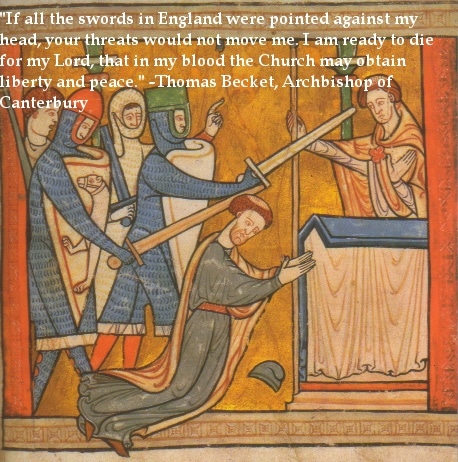
Saint Thomas a Becket

Today celebrates and commemorates the life and the death of Saint Thomas a Becket: defender of his faith, despised by his monarch and slaughtered by four knights.

Thomas Becket, sometimes referred to as Thomas of London or Thomas of Canterbury, was born around December 21st, 1118 (others say 1120), in Cheapside, London. He was the son of Gilbert and Matilda Becket. There are theories as to the lineage of the parents both being from Normandy and one famous one that Thomas's mother was a Saracen that fell in love with his father while in the Holy Land. What is known is that Gilbert was a merchant living in London when Saint Thomas was born.


As a child, Saint Thomas studied at Merton Priory and then later the grammar school at St. Paul's Cathedral in London. Throughout his schooling, he studied just what was required and whose skills were described as rudimentary.

Saint Thomas began working as a clerk after his father suffered from financial difficulties. He would eventually start to work for Theobald of Bec, Archbishop of Canterbury. Under Theobald's direction, Saint Thomas began to study canon law in Italy and France. In 1154, Saint Thomas was named Archdeacon of Canterbury, Provost of Beverly, Prebends at Lincoln Cathedral and St. Paul's Cathedral, and other ecclesiastical offices.

When Henry II became King in 1154, Theobold recommended to the new sovereign that Saint Thomas be appointed as Lord Chancellor, which occurred in January 1155. The Chancellor served as royal chaplain, the king's secretary in secular matters, and keeper of the royal seal. Saint Thomas excelled so well at the job and gained the favor of the king that he sent his son to live with Saint Thomas. Some describe Henry and Saint Thomas as behaving like schoolboys and being great friends.

Theobold of Bec, the Archbishop of Canterbury, died in the spring of 1161. Saint Thomas a Becket would eventually be nominated to take that position and the election confirming that position occurred on May 23, 1162. Saint Thomas was ordained a priest on June 2, 1162, at Canterbury Cathedral and then the next day was consecrated as Archbishop of Canterbury by Henry of Blois, Archbishop of Winchester. 

When Saint Thomas took this position, a transformation occurred. King Henry II had wished that Saint Thomas would continue as Chancellor and put the interests of the kingdom before the church, but such hopes were in vain. Soon after becoming Archbishop, Thomas resigned from being Chancellor, removed all signs of his former lavish lifestyle, and soon troubles began between Saint Thomas and Henry. Saint Thomas would support the king, but if the king's wishes pushed into the church's realm Saint Thomas would adamantly and often publicly oppose such policies.

One such issue came over the jurisdiction of secular courts over the clergy. The king pushed for clergymen to be tried for petty crimes in secular courts, but Saint Thomas opposed it as it was his duty to be the judiciary over the clergy in England. The king attempted to turn some of the bishops against and usurp church authority. This would all lead to the Council of Clarendon.

This council passed a set of legislative procedures to restrict ecclesiastical privileges as well as the authority of religious courts and general authority of the Catholic Church. Saint Thomas was asked to sign off, but he rejected this constitution. On October 8, 1164, Saint Thomas was summoned by the king to the council and was accused of contempt of royal authority and malfeasance during his time as Chancellor. After celebrating mass, he presented himself before the council where the king demanded a sentence should be passed on him for his crimes, but refused to accept such sentence as he was not subject to only the laws of God and the Church. Before he could be arrested, Saint Thomas secreted himself out of the kingdom and fled to France where he was welcomed by the French monarch, King Louis VII. He offered his resignation to Pope Alexander III, but refused to accept it from Saint Thomas.

Saint Thomas spent much of his time in a Cistercian Abbey, but Henry threatened the Cistercians in England so as to avoid further persecution in England, expelled Saint Thomas from their abbey in Pontigny (several kilometers of SE of Paris). Pope Alexander III attempted to resolve this conflict by diplomatic means and sent representatives to serve as arbitrators between Henry and Thomas. Eventually, Saint Thomas would be allowed to return to England.

In June 1170, Roger de Pont L'Évêque, Archbishop of York; Gilbert Foliot, Bishop of London; and Josceline de Bohon, Bishop of Salisbury, crowned the heir apparent, Henry the Young King, at York; something that was likely done as an insult to Saint Thomas. Authority to do such a thing was left to the Archbishop of Canterbury, so in November of 1170, Saint Thomas a Becket excommunicated all three of the priests. This incident was what led to the death of Saint Thomas.

There are a variety of theories as to exactly what happened, but the most accepted theory is that upon hearing of Saint Thomas recent actions, he stated "Will no one rid me of this turbulent priest?" Reginald Fitzurse, Hugh de Morville, William de Tracy, and Richard le Breton, four knights, hearing these words, and taking them literally, took off for Canterbury and arrived on December 29th, 1170. They originally left their weapon outside the cathedral and disguised themselves under cloaks that concealed their armor. They attempted to coerce him to leave with them to answer for his actions, but he refused them.

The knights left and retrieved their weapons. They found Saint Thomas on his way to the main hall where it is said they yelled out "Where is the traitor?" and to which he responded with "Here I am, no traitor, but archbishop and priest of God." They attempted to drag him out, but after meeting with resistance, they executed him in the cathedral.

The news of his death spread throughout Europe and soon many began venerating him as a martyr. Even King Henry visited Becket's tomb, had himself scourged, and denounced the actions of the knights; likely done to appease the Pope and avoid ex-communication. Nearly three years after his assassination, he was canonized as a Saint by Pope Alexander III. The knights who had executed Saint Thomas were themselves excommunicated and were ordered to serve in the Holy Land for 14-years.

Saint Thomas's tomb became a popular pilgrimage destination and existed until the time of the Reformation when Henry VIII dissolved the religious institutions. There are theories that Saint Thomas's body was moved or hidden away in another location, but no evidence exists to corroborate such ideas.

Saint Thomas has been an influence in the world in the form of the Commemorative Order of St. Thomas of Acon, has had an effect on literature such as Chaucer's "The Canterbury Tales", and is a Saint celebrated by both Anglicans and Catholics. This saint died defending his integrity and conscience rather than being bullied by a tyrannical monarch.

References

1. Lord Chancellor. n.d. http://www.britannica.com/EBchecked/topic/348007/lord-chancellor. 

2. St. Thomas Becket. American Catholic. http://www.americancatholic.org/features/saints/saint.aspx?id=1244. 

3. Thomas Becket. n.d. http://www.waymarking.com/waymarks/WMMG11_Thomas_Becket_London_UK. 

4. Thomas Becket. n.d. http://en.wikipedia.org/wiki/Thomas_Becket. 

5. Thomas of Canterbury, Archbishop and Martyr. n.d. http://justus.anglican.org/resources/bio/23.html. 

6. Thurston, Herbert. St. Thomas Becket. 1912. http://www.newadvent.org/cathen/14676a.htm.

7. St. Thomas Becket. n.d. http://www.catholic.org/saints/saint.php?saint_id=12.

Thursday, December 25, 2014

Wednesday, December 24, 2014

The Baal’s Bridge Square

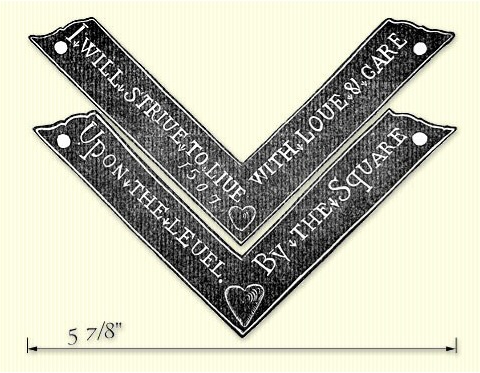
The Square is one of the Great Lights of Freemasonry and the jewel of the Worshipful Master of the Lodge. To the Speculative Mason, it is an emblem of virtue, morality, and perfection, while to the Operative Mason it was an instrument to test the angles of a stone to ensure it was a true right angle. The Square is also important archaeologically as the oldest known artifact in Freemasonry is the Baal's Bridge Square which was found during the reconstruction of the Baal's Bridge in Limerick, Ireland.

The Baal's Bridge, or Ball's Bridge, is one of the oldest bridges in the city. This bridge was important as it was the only link between the two sections of the town known as Englishtown and Irishtown. The current bridge was built from 1830 to 1831 and is composed of a single-arched, hump-backed bridge that links Mary St (on the northern bank) to Broad Street (on the southern bank) over the Abbey River. It replaced an older four-arched bridge. In November of 1830, during excavation, the ancient square was discovered in the foundation of the bridge by Brother James Pain, the architect, and engineer in charge of the renovations.


The Baal's Bridge Square was made of brass and inscribed with "I will strive to live with love and care" and "upon the level, by the square" as well as the date "1507". You can also see a heart etched into the center of each side of the square. The date 1507 is supported by history as the bridge was built sometime before 1558 where the earliest mention of Baal's Bridge was recorded. This artifact is a possible demonstration of leaving artifacts as history and record of the Masons who constructed the bridge, but also by its inscription alludes to an influence by Speculative Masonry.


The square was presented to Brother Michael Furnell who was the Provincial Grand Master. This relic is currently in possession of Antient Union Lodge No.13 in Limerick who received it in 1871 from the Furnell's widow after her husband's death. The square was presented in a frame along with a drawing of the original bridge and the location of the square's discovery. A replica of the square is on display in the museum.

References

1. Architecture of Limerick. n.d. http://en.wikipedia.org/wiki/Architecture_of_Limerick#Baal.27s_Bridge. 

2. Baal's Bridge Square. n.d. http://www.freemasonsnorthmunster.com/Baal's_Bridge_Square.htm. 

3. Crossle, Philip, and J. Hugo Tatsch. The Baal's Bridge Square 1507. 1929. http://www.irishmasonichistory.com/the-baals-bridge-square-1507.html. 

4. Gazow, Kurt. The Baal's Bridge Square. April 30, 2011. http://www.northbank182.org/image-of-the-month/thebaalsbridgesquare. 

5. Grand Lodge of Ireland. n.d. http://en.wikipedia.org/wiki/Grand_Lodge_of_Ireland. 

6. Tatsch, J. Hugo. Some New Facts About the Baal's Bridge Square. 1929. http://www.irishmasonichistory.com/some-new-facts-about-the-baals-bridge-square-by-bro-j-hugo-tatsch.html. 

7. The Baal’s Bridge Square. n.d. http://freemasonry.bcy.ca/texts/baals_bridge.html. 

8. The history of ‘The Baal’s Bridge Square’. n.d. http://www.lodgestpatrick.co.nz/baalsbrsquare.php. 

9. Ward, B. C. Square and Compass. October 1916. http://www.masonicdictionary.com/sac.html.

Saturday, December 20, 2014

A Day of Celebration

Well yesterday was a day of celebration and closed a major chapter in my life. I graduated from Boise State University with a Bachelors of Science in Political Science with an emphasis on International Relations and a minor in History. I had an amazing time at Boise State and I'd like to thank all the staff and faculty that I worked with along with my fellow officers of the Political Science Association. I look forward to coming back next Fall to start my Master of Arts in Political Science.

Graduating Student Leaders Celebration

Walking out of Graduation

My parents and I in the pouring rain

My niece and I


Then in the evening my Lodge installed the new officers for the ensuing year. I am happy to hand the gavel over to the new Worshipful Master. I was installed as Tyler of the Lodge and Secretary for the Idaho Lodge of Research for the ensuing year. I had a great year as Worshipful Master and I was glad to see several of the Master Masons raised during my year at the installation as now junior officers.


Now it is time to relax for a few days and then get ready for the holidays.