Sunday, September 29, 2013

The Operatives

Officially known as the "Worshipful Society of Free Masons, Rough Masons, Wallers, Slaters, Paviors, Plaisterers and Bricklayers", the Operatives is an invitational body dedicated to the preservation of the history and workings of operative masonry. The legend of Operative Masonry goes back to the Assemblage held by King Athelstan back in 926 AD and by the 20th century only a few Operative Lodges still existed in England, and many feared the lessons and rituals would fall from human memory. On May 21st, 1913, the Channel Row Assemblage (now known as Bedford House) was reconstituted and this date is considered the founding date of the Operatives.
“Speculative masons are happy to trace their origins to the practices of the ancient stone masons, but many then tend to forget all about them.”
This organization exists to perpetuate a memorial of the practices of operative Free Masons existing prior to modern speculative Freemasonry. To be considered eligible for invitation into this body, one must be a Master Mason, Mark Master Mason, and a Companion of Royal Arch Masonry. 

It is governed by 3 Grand Masters in England, but there are also Deputy Grand Master Masons (also referred to as the Senior Passed Master of a Region) who govern Regions such as the USA. The base organization is called an Assemblage and is governed by a Deputy Master Mason. There are nearly 3,000 members and over 100 Assemblages around the world in countries such as England, Wales, France, Belgium, Canada, Spain, Australia, New Zealand, and the USA.

The regalia for this order are minimal and consist of a blue cord/collarette from which hangs the badge that designates the grade of the member; the badge changes as the member progresses through the grades. In addition to this, members wear distinctive ties.

Rather than degrees as seen in the Ancient Craft Masonry, members progress through grades. Like Lodge, there is a separate ceremony and furniture array for each degree in the Assemblage. In addition to one's grade, an ashlar is used to indicate the progress of a member, or rather "workman while in the quarries". There are 7-grades in the Operatives and progression through them is based on one's performance in the various offices held as well as the percentage of one's attendance in each office. The seven grades are: 
I° - Indentured Apprentice
II° - Fellow of the Craft
III° - Fitter and Marker
IV° - Setter Erector
V° - Intendent, Overseer, Super Intendent and Warden.
VI° - Passed Master (not Past Master)
VII° - The three Grand Master Masons (in addition to those appointed to that grade “Honoris Causa”) 
The first 4-grades are conferred in an Assemblage of Lodges, but there are separate Assemblages for the higher grades. To advance to the "Chair", to be the presiding officer, one must have progressed to the VI° or above, and one must have an attendance rate of 70% and preside over a Craft and Mark Mason Lodge.

Up until last year, I had never heard of such a group, but, regardless, I find this group rather interesting not only for their mission but also their rank structure; they don't have any Grand ranks or Past ranks, but rather the grades designate one's standing within the organization. One can also see a correlation between the work done in the Operatives and the rituals seen in Cryptic Masonry.

References

1. Introduction. (n.d.). Retrieved from The Operatives: http://www.operatives.org.uk/upload/operatives.pdf 

2. Pushee, D. (n.d.). Region of the USA. Retrieved from The Operatives: http://www.operatives-usa.org

3. Falconer, D. (n.d.). The Operatives. Retrieved from Pietre-Stones: http://www.freemasons-freemasonry.com/donoperatives.html

Saturday, September 21, 2013

Choosing Your Mark

The first of the Capitular or Royal Arch degrees is that of Mark Master. In this degree the candidate represents a Fellow Craft Mason during the construction of King Solomon’s Temple. The work he presents to the Overseers is rejected at first, but later becomes the piece necessary to complete the Temple as seen in the Most Excellent Master degree. It is a common desire of man to wish to leave a lasting record in this world and in this degree candidates are taught the importance of the Mark whereby one can distinguish his work from others and leave a lasting impression as testament of his efforts. Today, candidates choose a Mark of their own, and this Mark is recorded and kept in every Chapter of Royal Arch Masons.


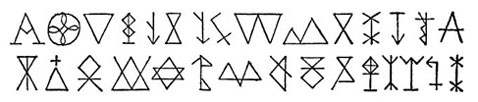
The Mason's Mark should be seen as an equivalent of a signature, particularly when illiteracy was common place. It represents not only the name of the Mason, his character, but, for the operative Mason, it represented his skill and workmanship. By use of the Mark we are demonstrating that we believe our work is of quality to be used in the construction of a building and through such identification would a craftsman receive his wages for his labor. Knowing such things, the use of the Mark gave the craftsman incentive to do their best work before they identified a particular piece by placing their Mark on it. Alongside identifying a particular craftsman marks were used to indicate where a stone would be placed within the structure.

The use of the Mark is very ancient. Marks have been found that date back farther than 5,000 years. Marks have been found on stones in ancient Egypt; castles, churches, and cathedrals in Europe from about the 12th century on; on ancient Greek temples; Roman ruins; and in preserved cities such as Pompeii.

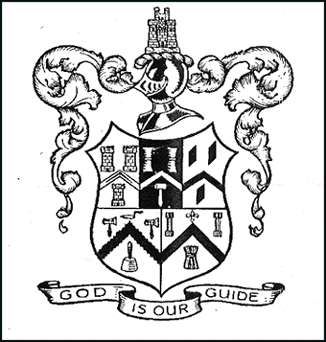
Mark Masonry is one of the oldest degrees in Freemasonry and helps bridge operative and speculative Freemasonry. Some of the earliest Marks found in England date back to the 12th century. Operative Masonry started emerged in England after Norman conquests. In the following centuries it would grow to such a level that required it to be regulated in custom and practices, thus Mason guilds arose. The first regulatory body was the Masons’ Company, formed in London sometime around 1375. This group would later known as the London Masons’ Company and was granted a coat of arms in 1472 during the reign of Edward VI. 

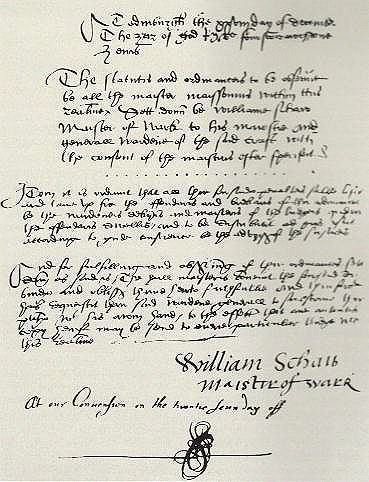
In 1598, William Schaw as Master of Works, named by King James VI of Scotland, published a set of statutes known today as the Schaw Statutes of 1598. These statutes established the duties and structure for Lodges among other things, but, more importantly, it required the recording of the Mason's Mark in a book:
No master or fellow of craft shall be received or admitted without there being present six masters and two entered 'prentices, the warden of the lodge being one of the six, when the day of receiving the new fellow of craft or master shall be duly booked and his mark inserted in the same book, with the names of the six admitters and entered 'prentices, as also the names of the intenders [intendaris-instructors] which shall be chosen for every person so entered in the book of the lodge. Providing always that no man be admitted without an essay and sufficient trial of his skill and worthiness in his vocation and craft.
Within the first half of the 17th century came the appearance of speculative Masons into the operative Mason's Lodge in Scotland. Many of these early Lodges have some existing records that show a combination of names of the Brothers with or without their Marks alongside the signature, but there are also some entries that are just the Marks themselves. Many of these ancient records also speak of men choosing their mark.

From recorded history it is seen that there wasn't much to the ritual of early Mark Masonry, but with the entry of speculative Masons, more elaborate ceremonies were established and enhanced throughout the years becoming more important. In the record books kept from early Lodges, we see entries talking about Mark Masons and Mark Master Masons, and this is still something seen outside of America were a Fellow Craft Mason would receive the Mark Man or Mason and a Master Mason would receive the Mark Master degree. 


The history of Mark Masonry in America is foggy due to lacking records. At various times, it has been conferred by Blue Lodges, the Scottish Rite, Chapters of Royal Arch Masonry, Knights Templar Encampments (now known as Commanderies), and independent Mark Mason Lodges. Eventually this degree would be absorbed and under the authority of Royal Arch Masonry in the 19th century. This was done through the efforts of Thomas Smith-Webb who published in 1798 a Monitor that became very popular and widespread in the US. Today for one to advance to the degree of Royal Arch Mason, one must go through the Mark Master Mason degree; this is true for Masonry in the US, Ireland, and Scotland. In England, Mark Masonry is an independent body known as Grand Lodge of Mark Master Masons of England, Wales and the Dominions and Dependencies of the British Crown which was established in 1856 and oversees around 1,200 Mark Lodges.

The Mark Master Mason degree teaches and explains many valuable lessons such as how to receive the wages talked about in the Blue Lodge, the value of labor, integrity, individual responsibility, and humility. It also teaches one not to judge one by simply on outward appearances, but seek the inner, hidden truth. In this degree we are introduced to the Mallet and Chisel, which, alongside the keystone, are prominent symbols of this degree as both of these instruments are essential preparing stone for the builder's use.

We are taught that through the Mallet we are to correct our irregularities and superfluous habits, and is similar to the Gavel talked about in the 1st degree and can be aligned with the Cardinal Virtue, Temperance. The Chisel is to stone, what education and discipline are to our mind, which reveals the hidden beauty and virtues hidden beneath the surface. It was through these two instruments that our ancient Operative Brethren were able to place their Mark upon their piece of work. Although today, we use other devices to draw our Mark, which allows us to come up with all sorts of designs, Marks of old were primarily a combination of straight lines as they only used the Chisel and the Mallet. Like the old days, once a Mason chooses his Mark it can never be changed.


It has always been man's desire to make his Mark upon the world. With the Mason's Mark, operative Masons proved their work, and, today, while we speculative Masons still choose a Mark, we must show our work by building ourselves and showing the world we are better men for being Masons. What will be your Mark?

References

1. Are you Worthy to Receive your Mark? n.d. http://www.eastangliamark.org.uk/about-the-degrees. 

2. Capitular Degrees of Freemasonry. n.d. http://www.goldenstatechapter.org/pdf/Capitular%20Degrees%20of%20Freemasonry.pdf. 

3. Mark Masonry. n.d. http://utahmarkmasonry.org/mark-masonry/. 

4. Mason's Marks. n.d. http://freemasonry.bcy.ca/aqc/masonmarks/operative.html. 

5. Speidel, Frederick. The York Rite of Freemasonry. Mitchell-Fleming Printing, Inc., 1978. 

6. Turnball, Everett R., and Ray V. Denslow. A History of Royal Arch Masonry. Vol. 1. 2 vols. Highland Springs, VA: Anchor Communications, 1956. 

7. Wallace, George M. The Mason's Mark. n.d. http://www.masonicworld.com/education/articles/the-masons-mark.htm. 

8. Woolmer, George. A History of Mark Masonry. n.d. http://www.themasonictrowel.com/books/mark_history_by_George_Woolmer/files/origins_operatives_and_mark_masonry.htm.

Friday, September 6, 2013

This is Your Day

Author Unknown

Blessed is the man, indeed, 
Who in this life can find; 
A purpose that can fill his days, 
And goals to fill his mind! 

The world is filled with little men 
Content with where they are; 
Not knowing joys success can bring, 
Not willing to go that far! 

Yet, in this world there is a need, 
For men to lead the rest 
To rise above the "average" life, 
By giving of their best! 

Would you be one, who dares to try, 
When challenged by the task; 
To rise to heights you've never seen, 
Or is that too much to ask? 

This is your day--a world to win 
Great purpose to achieve; 
Accept the challenge of your goals 
And in yourself, believe! 

You will be proud of what you've done, 
When at the close of day; 
You look back on your battles won, 
Content, you came this way!

Thursday, September 5, 2013

Invited into the Royal Order of Scotland

Last night I checked my mail and I can now officially say that I have been invited into the Royal Order of Scotland. I'd like to thank both David Grindle for the invite and Paul Gehrman for his continued support in Freemasonry. I received a letter from the Provincial Grand Lodge, USA, of the Royal Order of Scotland informing me that my petition had been accepted by the Screening and Selection Committee of my jurisdiction as well as by the Provincial Grand Master. There is one caveat that I must still be accepted by the members present at the meeting.

I am required to be initiated within one year's time and I am excited that I will be able to attend the meeting that will be held in Seattle, WA, on November 9th. This Fall is going to be incredibly busy for me in Freemasonry. I can't wait!!

Wednesday, September 4, 2013

My Top 10 Posts

I got to looking back at my old posts and I've decided to talk about my Top 10 favorite posts. These 10 posts have either become or were from the start one of my favorites for one reason or another.

In taking our degrees there is one thing you must remember, namely, the order in which events happen is seldom the order in which we learn about them. The successive degrees in Masonry picture events in the order we learn about them, not the chronological order in which they occurred. For instance, the Mark Master's Degree took place before those of the Master Mason's, but they were not presented to you in that order. The degree you are about to receive pictures events that happened prior to and after the Tragedy of the Third Degree, and we would have you notice how well they fill in the gaps in our knowledge of that Tragedy and its meaning.
This is one of my very favorites. This post was a long time coming as I had noticed from the very beginning of my York Rite journey that the degrees and orders were not invested in their chronological order. Before I posted I presented this to my Lodge and because of that was able to do some much-needed revisions.

In closing, it's reasonable to assume that the sigils of these four Royal Arch banners were, depicted as they are, influenced by Ezekiel's vision of the four cherubim. Such use of tetramorphs is not unique to the Judeo-Christian traditions, but has been long seen in the ancient world. Tetramorphs are commonly used as divine guardians and we see this commonality with the Masters of the Veils and Royal Arch Captain who bear and protect the banners, and who represent the attendants who protected the four veils of the Tabernacle.
This post actually resulted from a discussion I had with what I thought was an anti-Mason, but actually was just a bit rough around the edges yet was very knowledgeable in esoteric studies and we got to talking about the Tribes of Israel, the zodiac, and astrology in general.

When discussing the Founding of the United States of America and influence of those who were members of the Masonic fraternity one may hear that all the Founding Fathers were Masons and that America is just one Masonic experiment. Well, when I was approached to speak at a local school on the subject of Masonry in American history, and I decided I would research and present on the subject on those men who were Masons and their influence during the Revolutionary War.
This post was originally a PowerPoint that I had presented to an AP History course at a local high school. One of the Brothers requested from the Idaho Lodge of Research to give a presentation for a class after a teacher had approached him. I later presented this to my Lodge and then decided to share this on m blog with revisions.

From the beginnings of our lessons in Masonry we see examples of chivalry. Many symbols can be shown to represent actions and beliefs that all good men should embrace, but I particularly want to focus on the 3 Tenets: Brotherly Love, Relief, and Truth. By truth is every noble virtue we know founded upon and should dictate every thought, word, and action. As the Square teaches us to square our actions, the level to treat every person as equal, and the plumb to walk uprightly before God and man, so does Brotherly Love teach us to regard the whole human species as one family, thereby rendering us responsible to aid, support, and protect to the best of our ability. The last, but not least (I know, cliché) is Relief, and as the lecture tells us, all men are required to assist the distressed, destitute, and sorrowed. This last tenet can also be seen in the lessons given in the Order of the Temple where one must vow to defend the weak and defenseless.
This post took me a long time to write. I wrote a major portion of this during several nights when I had trouble sleeping. As a Knights Templar, I find chivalry very important...obviously, but I also see the need that chivalry needs more emphasis in our world today. To practice chivalry, I find it necessary to see where it originated and evolved to become what we see it and wish it to be.

From my early interest in the Templars of the Crusades, I always found their garments, and the distinction between the two, interesting as it was both simple, but highly symbolic. Fast forward to Fall 2008 and I have entered the Asylum for the first time to see the Sir Knights seated in their uniforms; one of a black jacket (similarly used by the Naval Petty Officer), a feathered Chapeau, and armed with a sword. I, as many people have, found the difference in uniform styles to be weird (for lack of a better word). For such a prestigious order to commemorate themselves by taking the name of those valiant knights of the Crusades, but veering away from them in such a manner.
I had always been curious about how the American Templars came to use the Chapeau and Jacket as well as the original outfit. This thread is my top post in my blog and at first, I was shocked to see how popular it was among my other articles, but I started to notice that the uniform is a point of contention among many Templars and prospective members.

Throughout its history the rose has caught the imagination of the masses. This flower has been used as a symbol in a variety of forms, from one of romance to duality (celestial perfection and Earthly passion), to wisdom, and many more, by various groups, cultures, and individuals. As it is such a complex symbol let's take a look at some the uses and by whom.
I loved doing the research for this symbol. I've always liked the Rose as a symbol and enjoyed researching its connection to and application in Freemasonry.

Simplistic in its design, but unique with its many meanings, the Beauceant was and is the standard of the Knights Templar. The Beauceant consisted of a black sec­tion above a white one. Note that some say it was hung from a perpendicular pole near the top of the vertical one so that both of the colors could be seen without any wind.
Like I talked about it the article, I was a Guidon Bearer in my early days of military service. What I didn't explain was that the Guidon I received was in need of repair. My mother repaired the cloth and I refitted the staff with a stronger piece of leather to hold the top of the guidon to the staff. I took a great deal of interest in my duties and during my pre-deployment, I had to march around. During my deployment, I was also present at Ramp Side ceremonies where we would see our fallen brother depart the base on a C-130. Having served as a Guidon Bearer I understand the symbolism of the Guidon and its use. I had thought about going further back into the earlier uses of guidon/flags by ancient societies like the Romans.

History of the York Rite in Idaho: Part I & Part II
Masonry in Idaho can be traced back to the gold rushes that brought men to the territory in 1860. Until March 3rd, 1863, when the Idaho Territory was created, part of what is now Idaho belonged to Washington Territory. So, it is not unusual to find history of Idaho Masonry to be found in the Proceedings of the Grand Lodge of Washington. The first remnants of Masonry were seen in the northern portions of the State until gold was discovered in the Boise Basin. As it was in the north, among the gold rushers were Masons and soon Idaho City (formerly Bannock City) became an epicenter of Masonry in the Idaho Territory.
The Grand Commander asked me to research this subject. This took me some time to write both parts as I had to sift through records. Researching the Royal Arch Masons was easy because of the published 4-volume set on its history which included Grand Chapters. The speed bump came when researching for the Council and Commandery, but I pushed through it, and with the help of the Grand Secretary/Recorder I got the needed information.

King Athelstan, the grandson of King Alfred the Great (known for his defense against the Viking invaders), Athelstan (also spelled: Athelstane, Athelstone, Athelston, Aldiston, Adelstan, Adelston, and Ethelstan) is historically known for his success in securing the submission of Constantine II, King of Scots, at the Treaty of Eamont Bridge in 927 AD through to the Battle of Brunanburh in 937 AD led to his claiming the title "King of all Britain". While overlooked by his grandfather, it is important to point out that Athelstan was the first King of a unified England from 927 AD. He reigned between 925 and 939 and was a distinguished and courageous soldier who pushed the boundaries of the kingdom further than anyone had done before. According to Masons, particularly those of the York Rite persuasion, he holds an endearing place in our history as great supporter of Masonry in England, establishing charges and articles given to the Craft to live by.
Since the time I first heard of the Regius Poem, I became very interested in King Athelstan and his legendary role in the origins of Freemasonry. I enjoyed reading through the manuscripts and from this, I've started researching the Comacine Masters, the Roman Collegia, and how or if it ties back to King Athelstan.

Throughout the history of Freemasonry there have been gatherings and events that have had a large impact on the fraternity in general, specific Orders within the Fraternity, or due to the lack of documentation has lead the theories abound. The history of Freemasonry is a complex topic, not always because of one's ability or inability to comprehend the subject, but often due to the lack of recorded evidence to support or reject a hypothesis. When faced with incomplete information one may let their imagination wonder which can sometimes lead to far-fetched and exaggerated speculations. One such event that many Masons and anti-Masons have theorized about is the 1782 Congress of Wilhelmsbad; Albert Mackey refers to this Congress as "the most important Masonic Congress of the eighteenth century". To the Masons, this meeting marks the impending doom of Rite of Strict Observance and the rise of the Rectified Scottish Rite. To the anti-Mason and conspiracy theorists, this is the meeting where the Bavarian Illuminati is said to have infiltrated and taken over Freemasonry to enhance their nefarious agenda for global domination.
Although it's one of the more recent articles, this one is on my Top 10 list as it took me a long time to write. It took some time as there is very little information readily available and I refused to publish this for a very long time until I had exhausted much of my time and effort. This post was inspired by the dealings I have had with anti-Masons and their thought that the Masonic fraternity is a puppet organization of the fabled Illuminati.

There are several other posts that are some of my favorites, but are not relevant to Freemasonry. Some of these would include "Do it Anyway", which is a poem I heard recited at the first Job's Daughter meeting I attended, or "End Times", which I wrote for my World Religions class while in Iraq. I also made separate posts about my departure from Iraq and arrival back to Idaho, but this was prior to my establishing a Facebook page. I hope you enjoy these posts as much as I have.

Saturday, August 31, 2013

Sights and Places: NOLA Scottish Rite Cathedral

Nestled less than a mile from the Mississippi River and the French Quarter lays a little jewel of the Crescent City. Located at 619 Carondelet Street in New Orleans is the Scottish Rite Cathedral for the New Orleans Valley under the Orient of Louisiana. I had a chance to visit this place when I visited New Orleans back in November of 2010 prior to my last deployment to Iraq.


The construction of this building began in 1850 after it was purchased by the First United Methodist Church of New Orleans from Mrs. Sarah Elizabeth French of Philadelphia. Freemasonry was growing in New Orleans as it was the second largest seaport in the nation and the population was exceeding 125,000. The material used was transported down the Mississippi River on barges then moved into position by horse and wagon. Even the barges were dismantled and some were used in the material and foundation of the building. It was not completed until 1853 due to several problems. Much of this building's materials are very unique and cannot be replaced if destroyed such as the cypress wood that is used throughout the building.


This building was used by the First United Methodist Church of New Orleans until it was purchased by the Grand Consistory of Louisiana on May 1st, 1905. After the purchase, the notable stained-glass window that adorns the front of the building was installed by the Lips Family, a family of glassworkers and Masons. The Brothers also conducted other renovations on the building to make it more suitable to their needs. The auditorium and the stage area, which contains over 160 scenery drops, were built by members of the Consistory. Another addition to this building was the library which contains a great collection of literary works outside academic institutions; one of the works the Brothers are proud of is the history of the New Orleans Consistory


Adjacent property was purchased in the 1970s and through the efforts of the members of the Valley have kept the property in order; one such noticeable addition is that they have placed protective glass around the stained-glass window. On July 1st, 1997, the Scottish Rite Foundation of New Orleans took over the care and maintenance of the Cathedral. It is an endeavor for them to do this as their geographic location leaves them under constant assault from Mother Nature, particularly hurricanes. The building has been placed on the National Register of Historic Places and thus is protected from the vicissitudes of modern development. Like all of man's constructions, this will eventually fall to the ravages of time and vicissitudes and the inclemency of the seasons, so it is my hope to keep a record of this structure.


Wednesday, August 28, 2013

The Pelican

Those who are members of the Scottish Rite should recognize the Pelican from the 18°, or Knight Rose Croix, that teaches us to practice virtue that it may produce fruit, labor to eliminate vice and purify humanity, and be tolerant of the faith and creed of others. The jewel of this degree has on the reverse, a pelican, piercing its breast to feed its seven young in a nest under it. To the Scottish Rite Mason, the pelican symbolizes every philanthropist and reformer who has offered up his life for the benefit of humanity, and so teaches us never-ending munificence toward all men, especially the needy and defenseless. It also represents the large and bountiful beneficence of nature, from whose bosom all created things draw their sustenance. The pelican has been adopted as an icon by several cultures, groups, organizations, and religions around the world to include the Christian religion.

The name comes from the Ancient Greek word 'pelekan' (πελεκάν), which itself is derived from the word 'pelekys' (πελεκυς) meaning "ax". In classical times, the word was applied to both the pelican and the woodpecker. Pelicans are a large water bird from the family Pelecanidae. They are characterized by a long beak and large throat pouch used in catching prey and draining water from the scooped up contents before swallowing. They have predominantly pale plumage except for the Brown and Peruvian Pelicans. The bills, pouches, and bare facial skin of all species become brightly colored before the breeding season. The eight living pelican species have a patchy global distribution, ranging from the tropics to the temperate zone, though they are absent from interior South America as well as from polar regions and the open ocean. They are ancient animals, fossil evidence dating them back as far as 30-million years. They also have a long history of significance in mythologies.


Heraldry used in Hungary
To the Christian, the Pelican represents the Savior hat the pelican feeds her young with her blood, as the Savior shed his blood for mankind; and hence the bird is always represented as sitting on her nest, and surrounded by her brood of young ones, who are dipping their bills into a wound in their mother's breast. Centuries ago some fabled that:
"It is said, if it be true, that the pelican kills its young, and grieves for them for three days. Then she wounds herself, and with the aspersione of her blood resuscitates her children."
The Pelican was seen as a natural symbol of Christ. There are also variations that believe it was the male pelican that killed the young and then the female brought them back. Variations of this legend are also found in India and this legend though long preceded the establishment of the Christian faith. Dante Alighieri referred to Christ as "our Pelican" in the Divine Comedy. Some believe the myth of a pelican feeding blood to her young stems from the Dalmatian Pelican which has a blood-red pouch in the early breeding season. Some also state that because the pelican collects and stores in its bill it must force it against its breast to get the contents out which makes it appears as if it is stabbings itself to feed its young.

To the ancient Egyptians, the Pelican is associated with death and the afterlife. It was also used as a protective symbol against snakes.

Pelicans are found heavily in heraldry, particularly with Christian heraldry, for reasons as explained above. It is used as a national bird for Romania as well as countries in the Caribbean and, here in the US, the Pelican is closely associated with the State of Louisiana.


Aside from the more known sacrificial symbolism, the Pelican is seen also as a symbol of nourishment, opportunism, healthy relationships. One can observe the pelican flying as a group around fisherman intent on using the efforts of the fisherman to accomplish the goal of nourishing the group. This animal has also been used as a symbol for constancy, preparation, magic, focus, wisdom, safety, humility, charity, humanity, nurturing, direction, resources, generosity, camaraderie, friendliness, and responsibility.

It was and is used by alchemists. This bird was associated with the Philosopher's Stone and the stages of transformation. The red stage is the feeding stage and the predecessor to rebirth and associated with the majestic pelican. The pelican also symbolizes making sacrifices to perfect one's inner self. In his book, The Birds in Alchemy, Adam McLean states:
"The alchemist must enter into a kind of sacrificial relationship with his inner being. He must nourish with his own soul forces, the developing spiritual embryo within."
This bird has been adopted by the Masons as a symbol used most notably in the Scottish Rite, but is said to have been seen in early Knights Templar Encampments (today known as Commanderies). Let us all remember the lessons of self-sacrifice of the Pelican that we may transform into a better man emblematically represented by the resurrection of the Phoenix as reminded by the 18° of the Scottish Rite.

References

1. Mackey, Albert G. Pelican. n.d. http://www.phoenixmasonry.org/mackeys_encyclopedia/p.htm. 


2. McLean, Adam. The Birds in Alchemy. 1979. http://www.levity.com/alchemy/alcbirds.html. 

3. Newell, Barry. Chapter of Rose Croix. October 28, 2012. http://www.travelingtemplar.com/2012/10/chapter-of-rose-croix.html. 

4. Panek, Joe. The Pelican (As a Symbol). August 21, 2011. http://www.aseekersthoughts.com/2011/08/pelican-as-symbol.html. 

5. Pelican. n.d. http://en.wikipedia.org/wiki/Pelican. 

6. Pike, Albert. "18°." In Morals & Dogma. 1871. 

7. Saunders, William. The Symbolism of the Pelican. n.d. http://www.catholiceducation.org/articles/religion/re0682.html. 

8. Symbolic Pelican Meaning. n.d. http://www.whats-your-sign.com/symbolic-pelican-meaning.html.

Friday, August 23, 2013

Sights and Places: Freemasons' Hall

It's been quite a while since I've posted anything from this series so I've come back with another example of beautiful architecture, the Freemasons' Hall in London, England. Its interior has been described as a "kaleidoscope of intensely-decorated corridors."


This building is located on Great Queen Street and serves as the headquarters of the United Grand Lodge of England as well as the principal meeting place for Masonic Lodges in London. The Grand Lodge has been located at this location since 1775, but this building is not the original and is in fact the third building.


In the early recorded years of Freemasonry, the Brethren didn't meet like we did today. Today most Lodges meet in buildings owned by the Masons and reserved strictly for their use, but in the early days this was not so. In the early years Lodges met either in private homes or in taverns where rooms could be rented out. Meeting in such public places required the transporting, and emplacing and displacing of Masonic paraphernalia. This led to the Brothers looking for establishing a permanent facility for Masonic use.

Although England leads Freemasonry with many firsts, the first Masonic building was actually built by French Freemasons in 1765 in Marseille. The first building in England was planned back in 1769 by the Premier Grand Lodge (Moderns) and after raising funds from its members purchased a plot of land on Great Queen Street. This site consisted of a tavern house fronting the street with a garden behind leading to a second house. Thomas Sandby won a competition to design the Freemasons' Hall which was built over the garden that linked the house and tavern. The newly built Freemasons' Hall is dedicated 23 May 1776, and was an important building, both for Masons and the public; as it was could be rented out for concerts, balls, and other such events for philanthropic societies such the Anti-Slavery Society and others.


In the 1820s, Sir John Soane, Grand Superintendent of Works, extensively remodeled the building. In the 1860s, Frederick Pepys Cockerell extended the building to the East and part of this façade still exists as part of the Connaught Rooms. In 1883 a fire damaged the building which would lead to its demolition and rebuilding in the 20th century.


In 1919 the Masonic Million Memorial Fund was established with the goal of rebuilding the Freemasons' Hall as a memorial those Masons who lost their lives on active service in WWI. 1925 was a busy year for the British Masons as the competition was launched and won by the partnership of Henry Victor Ashley and F. Winton Newman, but also the Most Worshipful Grand Master held a lunch where around 7,250 Brothers attended a lunch and raised over £825,000 for the building fund. The work on the building started in 1927 after the cornerstone laying on the 14th of July and continued into 1933, and stands as one of the finest examples Art Deco in England. On 19 July 1933 over 5,000 Masons congregated at the new Hall and the building was dedicated to Masonic service by the Grand Master, Prince Arthur, Duke of Connaught. It was originally known as the Masonic Peace Memorial, but was changed to Freemasons' Hall at the outbreak of WWII.


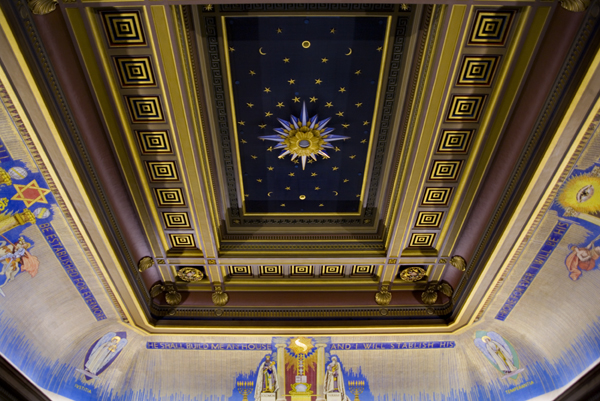
This building covers 2.25 acres and contains the Grand Temple, 21 Lodge rooms, a Library and Museum, various administrative offices, storage spaces, archives, and a Masonic shop. The Grand Temple is the meeting place for the Grand Lodge as well as the Grand Chapter (Royal Arch Masons), Provincial Grand Lodges, and other Masonic and non-Masonic organizations. Before one even enters the Grand Temple, he is met with an imposing set of Bronze doors, each weighing 1.25 tons that are decorated with scenes relating to the building of King Solomon's Temple. These doors lead into a room that is 123-ft long, 90-ft wide, and 62-ft high that can seat up to 1,700 people. Mosaic work covers the ceiling and in the corners there are depicted the Arms of Prince Arthur and the four cardinal virtues: Prudence, Temperance, Fortitude, and Justice. This room houses a large pipe organ that was built by Henry Willis & Sons, a leading British organ builder. This room is open to the public and is something to be seen on tours given throughout the Freemasons' Hall.


The numerous Lodge rooms are highly ornate and no two are identical in design. Some of the more notable rooms are Temples #1, #10, #17, and #23. Temple #1 contains portraits of former Grand Masters and can seat up to 600 people. Temple #10, located beneath the clock tower, is designed with a combination of classic Art Deco with Egyptian designs, and is home to an impressive domed ceiling. Temple #17 is very ornate with a large ante-room that is used by most ancient Lodges as well as 3 of the remaining 4 Lodges that founded the 1717 Grand Lodge. Temple #23 is the smallest of the Lodge rooms, allowing only 25 people to be seated, and contains portraits of former Grand Secretaries. There isn't too many labeled pictures to be found as the Lodge rooms are usually not for public tours as they are in constant use.


Also housed in this Hall is the Library and Museum of Freemasonry which is a library, archive and registered museum in central London covering Freemasonry. The Library and Museum is also a Charitable Trust that is registered with the Charity Commission. The Museum houses a collection of objects with Masonic designs and some of these items have belonged to famous Freemasons such as King Edward VII and Winston Churchill. The Museum also contains the most comprehensive collections of friendly societies (like the Oddfellows) material in the UK. The Library is located on the 1st floor of the Freemasons' Hall and is home to a very comprehensive collection of printed books and manuscripts over everything concerning Freemasonry in England, but also contains a great deal of material on Freemasonry, friendly societies, esoteric, and mystical traditions from around the world. This is also open to the general public during the hours of 10am-5pm (M-F).


Like the original Masonic Hall, the Freemasons' Hall is also used for public events such as concerts and musical events as well as filming for TV shows and movies.


This is definitely on one of one of the places I can't wait to visit. I think going here, I would outdo the amount of pictures taken versus my trips to Philly and Italy in 2011.

References

1. Freemasons' Hall. n.d. http://www.british-history.ac.uk/report.aspx?compid=74279. 

2. Freemasons' Hall, London. n.d. http://en.wikipedia.org/wiki/Freemasons'_Hall,_London. 

3. Freemasons’ Hall, London: A History. n.d. http://www.freemasonry.london.museum/resources/history-of-freemasons-hall/. 

4. History of Freemasons' Hall. n.d. http://www.ugle.org.uk/freemasons-hall/the-history-of-freemasons-hall. 

5. Ian. Freemasons Hall ~ an Art Deco masterpiece in central London. February 14, 2013. http://londonunveiled.com/2013/02/14/freemasons-hall/. 

6. Masonic Temple. n.d. http://en.wikipedia.org/wiki/Masonic_Temple. 

7. Tours of Freemasons’ Hall. n.d. http://www.freemasonry.london.museum/tours/. 

8. Wolff, Stephanie. The Freemasons Hall, home of The United Grand Lodge of England: Uncovering a few hidden treasures. November 18, 2010. http://londoninsight.wordpress.com/2010/11/18/freemasons-united-grand-lodge-england-london/.

Saturday, August 17, 2013

Goodbye Cabin

These last couple of weeks I've been busy with military training, but I must stop to make a sad announcement...to me at least. My father called me today to inform me that my family's cabin has burned down in the Elk Creek Complex Fire.


My grandfather built this cabin and it has become an icon of my family that has been a home away from home for 4 generations of my family. I have so many fond memories from this place and it saddens me to see that it could not be saved.


This cabin was a sanctuary for me. As a child I always looked forward to going to the cabin for the summer and, when I was old enough, to go hunting in the Fall for deer. This cabin rested on the hillside just a short distance from Anderson Ranch Dam (Fall Creek side) and in the summertime, we'd always take my grandfather's pontoon boat out on the reservoir for Kokane fishing. A short drive we could go find some amazing sites. After my first deployment to Iraq, the Cabin was one of the first places I visited after making it back to Idaho. My dad and I drove all night through a nice little snowstorm to make it there. We unpacked and I laid down and slept for 16-hours straight. This place was one of serenity. It echoed peace and tranquility, and I have so many wonderful memories of this place that I could write forever. The shortest thing to say is that it was a symbol of my childhood and now it's gone. All that remains is my memories.

From here I don't know what will happen to the property, but I hope my grandfather decides to keep it in the family so we can rebuild.


Thursday, August 15, 2013

The Mystic Art

By Sir Edward Bulwer-Lytton

The world may rail at Masonry, 
And scoff at Square and Line, 
We'll follow with complacency 
The Master's great Design. 

A King can make a gartered Knight, 
And breathe away another, 
But he, with all his skill and might, 
Can never make a Brother. 

This power alone, thou Mystic Art, 
Freemasonry, is thine; 
The power to tame the savage heart 
With brother-love divine!